

TP & SL Tool: Risk Reward Ratio Calculator RRR MT4 | Prop Firm Protector: Trade Assist Prop Firm Plus TF Expert MT4 | Money Management + DrawDown Protector: Trade Panel Prop Firm Drawdawn Limiter Pro MT4 |Get a free Expert Advisor license via Telegram and WhatsApp
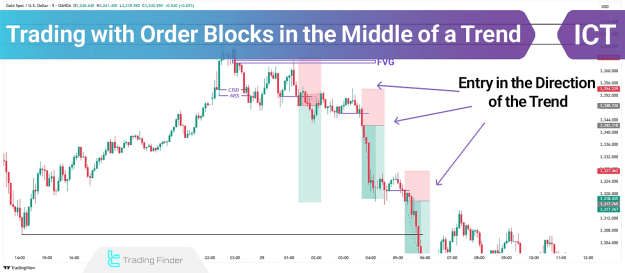
How to Trade Using Order Blocks in Trend Following with ICT
#1 Analysis of Higher Time Frame Price Action
- Begin by analysing price action on the higher time frame to identify Smart Money Tactics (SMT) and potential Order Block formations.
- When a low is collected through SMT and an Order Block forms in the same area, move to a lower time frame to identify a bullish structure.
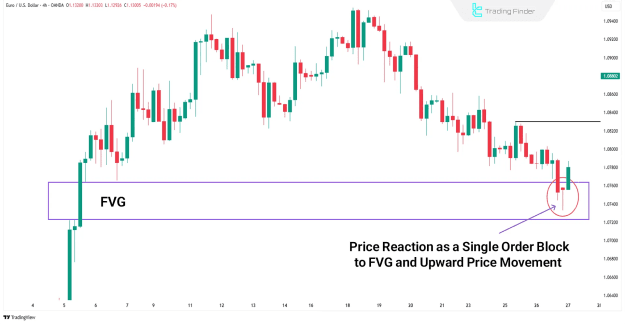
Example:
On the 4H chart, price reacts within a single Order Block located at an FVG zone, resulting in upward continuation.
#2 Switching to a Lower Time Frame to Identify a Higher Low
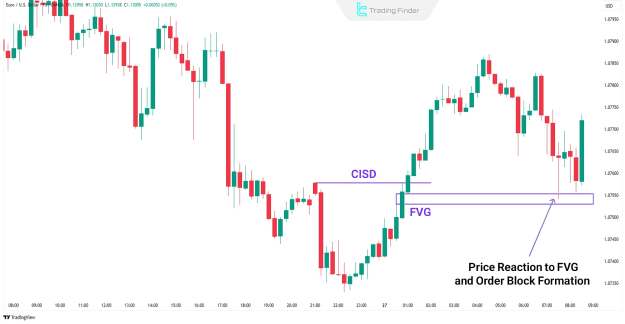
- Observe the lower time frame for the formation of a Higher Low (HL) or a reaction to an FVG.
- Multiple FVGs may be present, but it is unnecessary to determine the valid zone in advance.
Instead:
- Wait for price to react to an FVG, form a low, and confirm the entry scenario with the appearance of a Single Order Block with a shadowed candle.
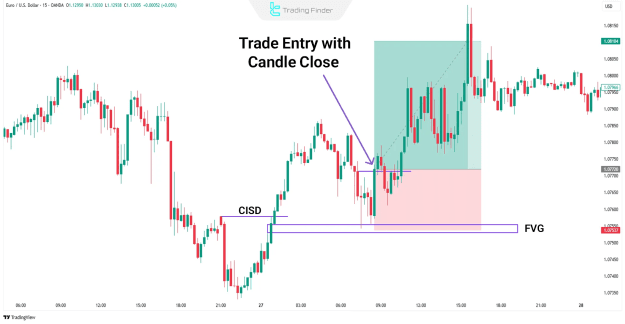
Example:
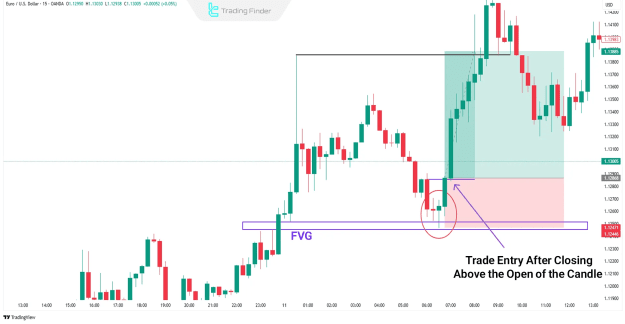
On the M15 chart, price reacts to an FVG and forms a shadowed Order Block before continuing upward.
#3 Confirmation for Trade Entry
Trading with Order Blocks during trend following in ICT requires confirmation based on entry timing:
- At trend initiation:
- Confirmation occurs with a Change in State of Delivery (CISD), a pullback to the FVG on a lower time frame, and a candle closing above the open of the initial bearish candles.
- Example: Entry is triggered after a candle closes above the opening of the corrective move’s initial bearish candle, forming a Higher Low.
- Mid-trend:
- After a top is confirmed and price continues upward, entry is validated when a candle closes above the open of the candle that initiated the downward corrective move combined with an FVG reaction.
- Example: Entry occurs after a strong reaction to the FVG and a bullish candle closes above the last bearish candle’s open.
Advantages and Limitations of Using Order Blocks in Trend Following with ICT
Advantages
- Provides precise entry opportunities during trend corrections using Order Blocks and FVGs.
- Allows placing small stop losses behind OB or FVG, offering favourable risk-reward ratios.
- Fully aligns with SMT, CISD, and Break of Structure (BOS) confirmations.
- Highly effective in lower time frames (M1 to M15) with structured validation.
- Utilises liquidity draw zones for robust institutional-style entries.
Limitations
- Requires exact synchronisation between time frames to confirm structures.
- Incorrectly identifying an OB can result in immediate stop loss activation.
- Demands high proficiency in advanced ICT concepts and price behaviour analysis.
- May provide misleading signals in ranging or low-liquidity markets.
- Increases risk of liquidity misanalysis when comparing multiple time frames.
Common Mistakes in Trading Order Blocks Mid-Trend with ICT
Frequent errors resulting in failed entries or early stop-outs include:
- Misidentifying Single Order Blocks as confirmations.
- Relying solely on OB while ignoring FVG structures.
- Entering trades without structural confirmations.
- Disregarding the higher time frame context.
- Overlooking SMT divergence.
- Setting stop losses without valid technical justification.
Risk Management for Trading Order Blocks in Trend Following
Define Stop Loss (SL) and Take Profit (TP) levels based on:
- Stop Loss: Positioned behind the Order Block or the low formed after FVG reaction.
- Take Profit: Set at the previous structural high or in accordance with a 1:2 risk-to-reward ratio.
Key Principles for Effective Mid-Trend Entries with Order Blocks
- Mid-trend entries are valid only upon receiving confirmed structural signals.
- Combining OB and FVG analysis minimises trade risks.
- Synchronising higher and lower time frames filters false signals and validates price structure.
- Tools such as SMT and CISD are critical for identifying new market waves.
Note:
The same scenarios and principles apply in reverse for bearish market setups.
Conclusion
Employing structural tools such as Order Blocks and Fair Value Gaps within a trend allows traders to enter positions after the initial market move, provided that confirmations are clearly received. Under the ICT methodology, successful mid-trend entries rely on lower time frame price action analysis, CISD confirmations, shadowed candle formations, and validated structural highs or lows to execute trades with institutional precision.