

This approach focuses on optimizing the risk-to-reward ratio. It leverages the mathematical principle of compound interest to accelerate equity growth without requiring additional deposits. When applied within high win-rate systems, the strategy can generate remarkable exponential account growth. However, its effectiveness depends entirely on disciplined risk management, as consecutive losses can quickly accumulate, resulting in severe drawdowns.
Prop Firm DrawDown Protector : Prop Firm Capital Protection Expert MT5 |Forex Money Management: Forex Trade Management Expert MT5 | ICT Concepts Indicator MT5 |Smart Money Concepts Expert MT5 | Smart Money Trap Scanner | Get a free Expert Advisor license via Telegram and WhatsApp
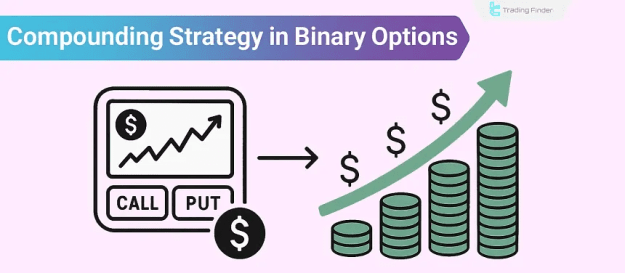
What is the Compounding Strategy in Binary Options?
In essence, it is a reinvestment method. After each profitable trade, the earned profit is not cashed out but is rather combined with the existing capital to form a larger base for the next investment. This cycle, powered by compounding, enables exponential account expansion.
Successful application hinges on two critical factors: maintaining a winning streak and exercising strict discipline in executing the underlying trading strategy. For a detailed tutorial on implementing this method, you can refer to the dedicated guide on compounding in binary options available on cyberfutures.com.
Advantages and Disadvantages of the Compounding Strategy
When applied under stable market conditions with disciplined execution, the Compounding Strategy can yield significant returns. Conversely, a lack of discipline or deployment in highly volatile environments can quickly reveal its destructive potential.
Key Advantages:
- Exponential Capital Growth: Reinvesting profits can lead to accelerated, non-linear growth of your trading account.
- Structured Capital Management: It provides a clear, percentage-based framework for managing trade sizes.
- Enhanced Profit Efficiency: It maximizes returns by ensuring that profits themselves generate further profits.
- Strategic Flexibility: The strategy can be tailored to conservative or aggressive risk appetites.
- Long-Term Potential: It is designed to deliver higher returns over an extended trading horizon.
Key Disadvantages:
- Exponential Losses: Losses can also compound rapidly if a losing streak occurs, especially with aggressive settings.
- Plan Sensitivity: The framework is highly sensitive to deviations from the predefined trading plan.
- Profit Risk: All accumulated profits remain exposed to the risk of subsequent trades.
- Psychological Pressure: As trade sizes grow, the emotional stress on the trader can increase significantly.
- Execution Complexity: Some advanced variants of the strategy can be error-prone and require experience.
Psychology and the Role of Mindset
Implementing a compounding strategy places a premium on psychological discipline. As position sizes grow incrementally, so does the emotional weight of each trade. Fear of losing accumulated profits or greed for faster growth often leads traders to abandon their plan.
To manage these emotions effectively, a trader should:
- Define a clear trading cycle in advance (e.g., a set of 5 to 7 consecutive trades).
- Have a rule to stop and reset to the initial capital size after a loss.
- Utilize techniques like maintaining a trading journal to track decisions and emotional states.
Execution Methods for the Compounding Strategy
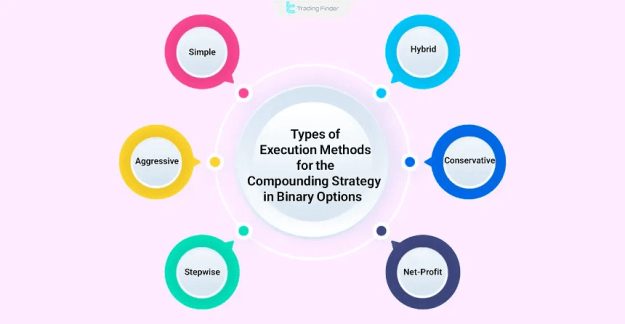
The core compounding effect can be applied through several distinct execution models, each with its own risk profile.
Simple Compounding Strategy (Fixed Percentage)
This is the most straightforward approach. The trader allocates a fixed percentage (e.g., 5% or 10%) of the total current equity to each trade. After a win, the profit is added to the balance, and the next trade's size is calculated from this new, larger amount.
Stepwise Compounding Strategy
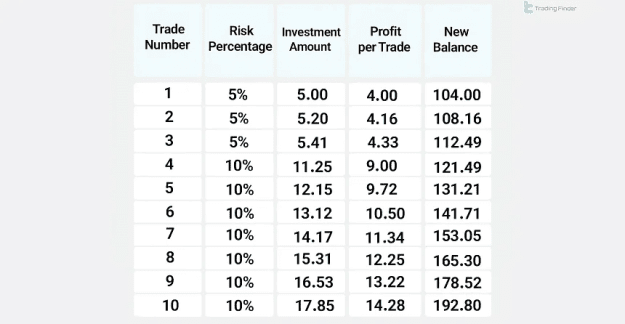
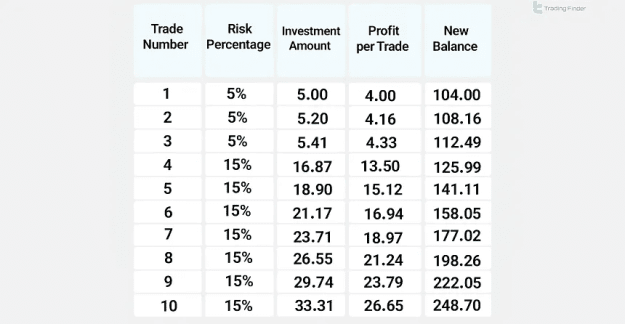
This model increases capital allocation in predetermined phases. For example, a trader might begin with a 5% risk for the first three trades. If all are successful, the risk percentage increases to 10% for the next series of trades. This offers a balance between growth and psychological control.
Aggressive Compounding Strategy
Here, a high percentage of equity (e.g., 20% or more) is risked per trade. While a few consecutive wins can multiply capital dramatically, a single loss can be devastating. This method is suitable only for experienced professionals with very high risk tolerance.
Conservative Compounding Strategy
Built for capital preservation, this model uses a very small percentage (1-2%) of capital per trade. Profit growth is slow but steady, and the account is better protected against severe drawdowns.
Hybrid Compounding Strategy
This adaptive approach blends conservative and aggressive styles. A trader might start with a low risk percentage and increase it incrementally after a series of wins, reverting to the base level after a loss. It seeks an optimal balance between risk and return.
Net-Profit Compounding Strategy
In this capital-preserving method, only the net profits earned are reinvested in subsequent trades. The original principal remains untouched and is never put at risk. This minimizes overall drawdown and is ideal for highly risk-averse traders.
Step-by-Step Tutorial for Trading with Compounding
Executing this strategy requires a disciplined, structured approach to capital management.
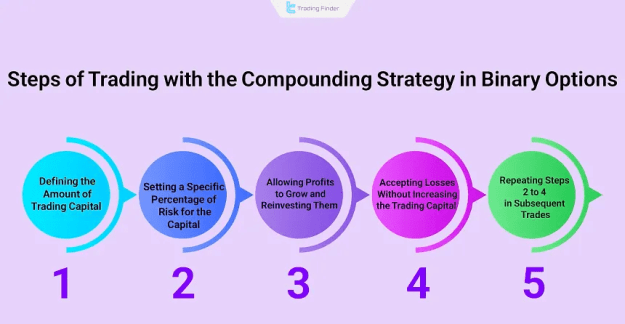
Step 1: Define Your Trading Capital
Establish a fixed amount of capital dedicated solely to this strategy. This forms the foundation of your compounding plan.
Step 2: Set a Specific Risk Percentage
Determine the fixed percentage of your total equity you will risk on each trade. Conservative approaches use 1-2%, while aggressive models may use 5-10%. Adherence to this percentage is non-negotiable.
Step 3: Reinvest Profits to Activate Compounding
After a successful trade, the profit must be added back to the trading capital. This increases the base for the next trade’s calculation, activating the compounding effect.
Step 4: Accept Losses Without Altering the Plan
If a trade results in a loss, you must continue with the next trade using the predefined percentage of the reduced capital. Do not increase trade size to recoup losses immediately, as this introduces uncontrolled risk.
Step 5: Repeat the Cycle Consistently
Consistency is key. Repeatedly execute steps 2 through 4, maintaining strict discipline. This repetition lays the groundwork for sustainable long-term growth.
Compounding vs. Martingale: A Critical Distinction
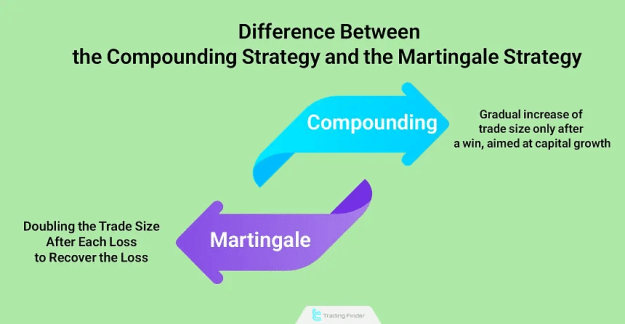
Novice traders often confuse compounding with the Martingale strategy. They are fundamentally opposite in logic and risk.
Compounding increases trade size after a win to accelerate growth. It is a controlled, conservative approach focused on gradual capital appreciation.
Martingale doubles trade size after a loss in an attempt to recover previous losses quickly. It is an extremely high-risk, aggressive approach that can wipe out an account with a short losing streak.
Auxiliary Tools and Indicators
To improve entry precision, the compounding strategy should be combined with technical analysis.
- Momentum & Oscillators: Use the Relative Strength Index (RSI) and MACD to identify overbought/oversold conditions and confirm trend strength.
- Price Action: Analyze candlestick patterns and support/resistance levels to find high-probability, low-risk entry points.
- Trend Filters: Apply Moving Averages to identify the prevailing medium-term trend direction and filter trades accordingly.
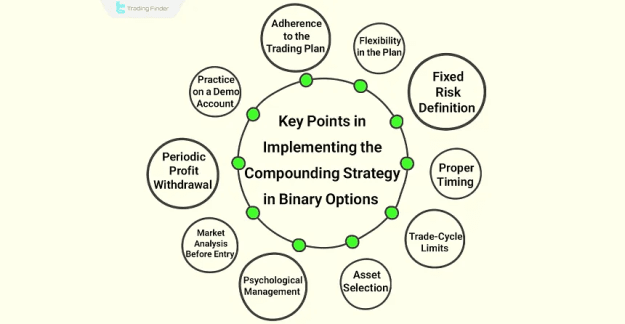
Key Points for Successful Implementation
- Define Fixed Risk: Strictly allocate only 2% to 10% of capital per trade.
- Adhere to the Plan: Predefine your profit-taking point and number of trades per cycle.
- Withdraw Profits Periodically: Secure a portion of compounded profits to protect them from future risk.
- Select Assets Wisely: Focus on liquid assets with stable volatility (e.g., major Forex pairs like EUR/USD).
- Manage Psychology: Maintain emotional discipline as trade sizes—and pressure—increase.
- Limit Trade Cycles: Execute defined cycles (e.g., 5-7 trades) to balance growth and risk.
- Analyze Before Entry: Never trade randomly. Use Price Action and confirmatory indicators.
- Practice on Demo: Thoroughly test your compounding plan in a risk-free demo environment.
- Remain Flexible: Have a rule to stop and reset the cycle after a loss to preserve capital.
Common Mistakes to Avoid
- Starting with excessively high risk percentages without prior experience.
- Attempting to "revenge trade" by increasing size to recover losses.
- Trading without a clearly defined and written plan.
- Applying the strategy in highly volatile, unpredictable markets.
Conclusion
The Compounding Strategy in binary options is a sophisticated capital management technique rooted in the power of compound interest. It holds the potential for exponential capital growth without requiring additional funds. However, this potential can only be realized through meticulous planning, unwavering risk management, and strong psychological discipline. Beginners are advised to start with conservative or net-profit models, while experienced traders may explore hybrid or aggressive approaches. Ultimately, long-term success with this method is a direct function of consistent plan adherence and a rational acceptance of risk.