

Prop Firm DrawDown Protector : Prop Firm Capital Protection Expert MT5 | Forex Money Management: Forex Trade Management Expert MT5 | ICT Concepts Indicator MT5 |Smart Money Concepts Expert MT5 |Get a free Expert Advisor license via Telegram and WhatsApp
Organized by time, country, and market impact, the Forex Economic Calendar helps traders anticipate periods of increased volatility and make more informed trading decisions.
Understanding the Forex Economic Calendar
The Forex Economic Calendar consolidates key economic events from around the world, such as:
- Government and central bank announcements
- Employment and inflation data
- GDP and manufacturing indicators
- Public holidays affecting trading volumes
These events are typically released on a weekly, monthly, quarterly, or annual basis, and each has the potential to influence specific currency pairs, commodities, or indexes.
By reviewing this calendar, traders can evaluate a country’s economic outlook and adjust their positions accordingly.
Key Features and Uses of the Forex Economic Calendar
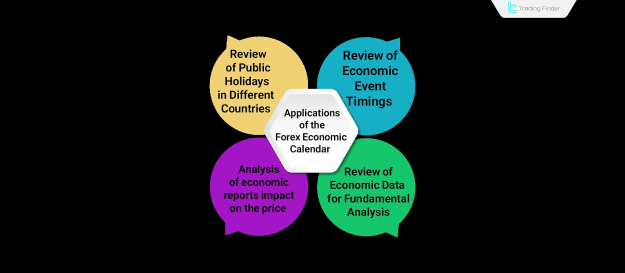
Traders rely on the economic calendar for several reasons. It provides:
- Accurate release times of upcoming economic data
- Country-specific national holidays that may reduce trading activity
- Economic indicators relevant for fundamental market analysis
- Post-release impact analysis to assess market reaction and volatility
By integrating this data into their strategies, traders enhance their ability to predict and respond to market fluctuations.
How to Read and Interpret the Economic Calendar
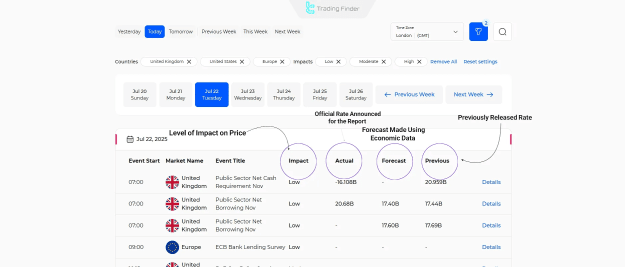
Each entry on the Forex Economic Calendar typically includes three essential figures:
- Actual: The officially released data by the relevant economic authority
- Forecast: The expected figure based on market consensus and analyst projections
- Previous: The value from the prior release for the same report
Advanced calendars also include filters that allow users to customize data by:
- Country
- Asset type
- Date
- Economic impact level
- Specific data categories
Some platforms, such as TradingFinder, offer an in-depth Details section that explains the event, analyzes scenarios, and outlines possible price outcomes.
Most Influential Events in the Forex Economic Calendar
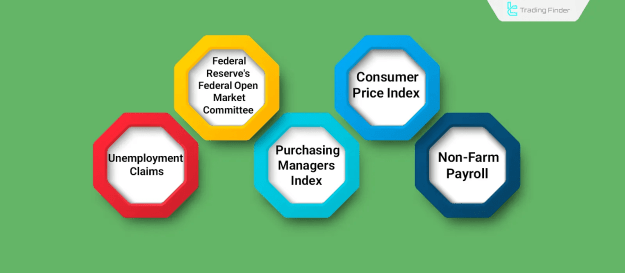
Not all economic data has the same level of influence. Some reports consistently lead to significant price movement:
Non-Farm Payrolls (NFP)
The NFP report is issued monthly by the U.S. Department of Labor and tracks employment changes in the non-agricultural sector. Released on the first Friday of every month, this report is among the most volatile market movers for USD-related pairs.
Consumer Price Index (CPI)
CPI measures inflation by tracking price changes in a fixed basket of goods and services. It is a key factor in determining central bank policy, particularly interest rate decisions.
Purchasing Managers’ Index (PMI)
PMI reflects the health of the manufacturing and services sectors. It is based on surveys conducted with purchasing managers and helps forecast economic performance and market confidence.
FOMC Reports and Announcements
The U.S. Federal Reserve, via the Federal Open Market Committee (FOMC), regularly releases statements and interest rate decisions that directly affect U.S. monetary policy. The tone of these communications—hawkish or dovish—plays a critical role in shaping market expectations.
Unemployment Claims
Released weekly, this report includes:
- Initial Jobless Claims: New applications for unemployment benefits
- Continuing Claims: Ongoing benefit requests from previous applicants
Labor market health is a core economic indicator and is closely monitored by traders and central banks alike.
How Traders Use the Economic Calendar in Strategy
There are two principal trading approaches built around economic releases:
Pre-Report Trading
This strategy involves predicting the outcome of an upcoming release based on past trends and forecasts. Traders use this information to open positions in advance of the report, speculating on market direction.
Post-Report Trading
In contrast, this approach focuses on reacting to actual data. Traders wait for the report to be published, then assess the market’s immediate response before entering long or short positions. This method often uses pre-set stop-loss and take-profit levels to manage risk.
Caution: During high-impact announcements, market behavior can be erratic—leading to wider spreads, gaps, and order execution delays due to high liquidity volume.
Forex Economic Calendar Platforms by TradingFinder
To support a wide range of users, TradingFinder offers its Economic Calendar in three flexible formats:
Browser Extension
The browser-based version allows traders to monitor live charts and economic reports side-by-side, providing seamless functionality without leaving the trading terminal.
Mini App (Telegram Bot)
For mobile traders, the Telegram-based mini app delivers real-time updates and push notifications on key economic events. It offers full calendar functionality with enhanced accessibility.
Website Interface
The TFLAB platform hosts a web-based version of the calendar, requiring no downloads or installations. It offers an intuitive interface with all core features accessible directly through a browser.
Conclusion
The Forex Economic Calendar is an essential resource for understanding how macroeconomic indicators influence asset prices and overall market sentiment. For traders engaged in fundamental analysis, this tool provides critical data points such as:
- Timely release schedules
- Forecast and previous values
- Real-time volatility tracking
- Event impact assessments
Major events such as Non-Farm Payrolls (NFP), CPI, and PMI remain core drivers of market momentum. Whether trading before or after economic releases, the calendar equips traders with the information needed to navigate volatility and make informed decisions.