

Prop Firm DrawDown Protector : Prop Firm Capital Protection Expert MT5 | Forex Money Management: Forex Trade Management Expert MT4 | ICT Concepts Indicator MT5 |Smart Money Concepts Expert MT5 |Get a free Expert Advisor license via Telegram and WhatsApp
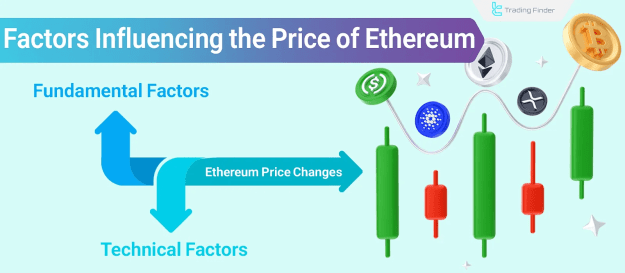
Types of Factors Affecting the Price of Ethereum in Financial Market
Fundamental Factors Impacting Ethereum Price
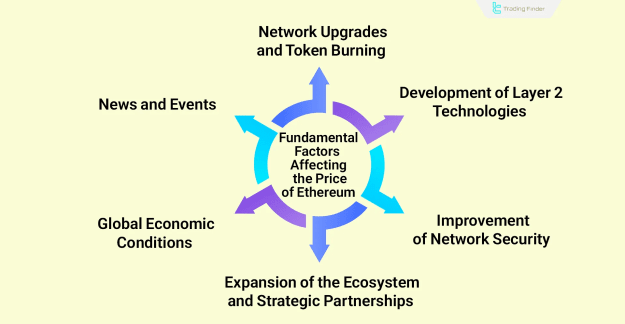
Fundamental factors encompass the underlying health and development of the Ethereum network, as well as broader economic and market conditions. These elements provide insights into Ethereum's intrinsic value and future potential.
- Network Upgrades and Token Burns: Significant upgrades to the Ethereum network, such as the transition to Proof-of-Stake and the implementation of EIP-1559, have fundamentally altered its economic model. Changes to the transaction fee structure enhance user appeal, while the burning of a portion of Ether (ETH) during transactions reduces its circulating supply, potentially leading to price increases due to deflationary pressure. In some instances, the burn rate can exceed the issuance rate, creating a truly deflationary environment.
- Development of Layer 2 Technologies: To address scalability challenges, Layer 2 solutions like Arbitrum and Starknet have emerged. These technologies improve network speed and efficiency, facilitating growth in decentralized finance (DeFi) and non-fungible tokens (NFTs), which in turn enhances Ethereum's overall utility and demand.
- Improved Network Security: Regular updates and ongoing efforts to bolster Ethereum's security are paramount. Enhanced security fosters user confidence and attracts institutional investors by mitigating risks of hacking and network breaches, thereby reducing price volatility linked to adverse security events.
- Ecosystem Expansion and Strategic Collaborations: The expansion of Ethereum's ecosystem, including its integration with various decentralized applications (dApps), and strategic partnerships with major corporations such as Microsoft and JPMorgan, significantly boost its credibility and adoption. Increased use cases and integrations directly contribute to its value proposition.
- Global Economic Conditions: The state of the global economy exerts considerable influence on risk-on assets like cryptocurrencies. During periods of economic strength, investor appetite for higher-risk investments, including Ethereum, tends to increase, positioning it as an attractive option in the crypto market.
- News and Events: Geopolitical events, macroeconomic announcements, and even specific news related to Ethereum or the broader cryptocurrency space can trigger significant price movements. Security incidents, such as network hacks, can also have a notable impact on Ethereum's price.
Technical Factors Affecting Ethereum Price
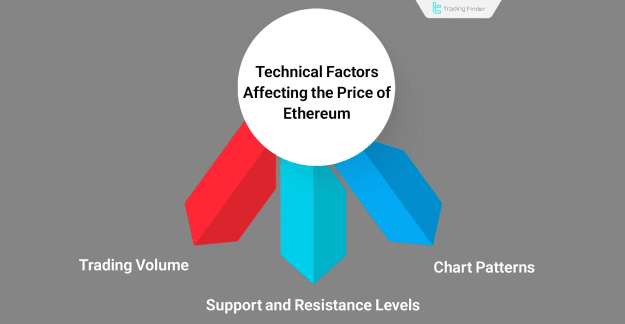
Technical analysis are derived from market activity and are primarily used by traders to predict future price movements based on historical data.
- Trading Volume: Trading volume is a critical indicator of market activity and the strength of price trends. A surge in Ethereum's trading volume often signals strong interest and can contribute to sustained price growth. Conversely, declining volume and diminished trader interest may precede price corrections or declines.
- Support and Resistance Levels: These are price points on a chart where buying or selling pressure is expected to be strong enough to temporarily halt or reverse the prevailing price trend. Traders use these levels to identify potential entry and exit points for their positions.
- Chart Patterns: Various chart patterns, including flags, pennants, head and shoulders, and candlestick patterns, along with divergence formations, provide technical signals to investors. These patterns can indicate potential trend continuations, reversals, or periods of consolidation, offering valuable insights for trading decisions.
Ethereum’s Price Correlation with Bitcoin
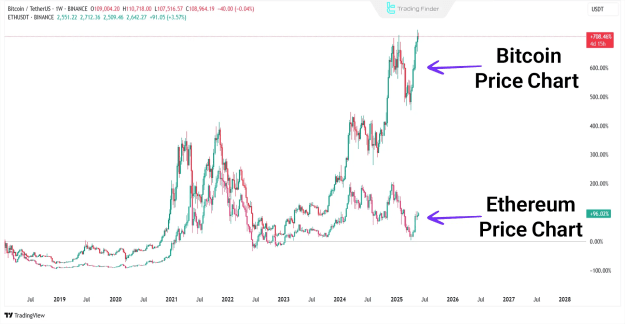
Ethereum's price often exhibits a close correlation with Bitcoin, the largest cryptocurrency by market capitalization. While this correlation suggests that Ethereum frequently follows Bitcoin's price movements, it's important to note that Ethereum can sometimes outperform or underperform Bitcoin depending on specific market conditions and its own fundamental developments. Historical data consistently demonstrates this relationship, with Ethereum often mirroring Bitcoin's behavior during significant price rallies or corrections.
Impact of Ethereum Spot ETF Launch on Price
The approval of Ethereum Spot ETFs by the U.S. Securities and Exchange Commission (SEC) has marked a significant milestone. This development provides a regulated investment channel for large institutional investors, including asset managers like Grayscale and BlackRock. The anticipated influx of institutional capital and enhanced liquidity are expected to reduce price volatility and further legitimize Ethereum as a mainstream investment asset.
Conclusion
The price of Ethereum is a complex interplay of both short-term and long-term fundamental and technical indicators. Key drivers include the influence of news and events, strategic network upgrades, ongoing infrastructure development, and identifiable chart patterns. These diverse factors can exert both immediate and lasting effects on Ethereum's market valuation.