

TP & SL Tool: Risk Reward Ratio Calculator RRR MT5 | Prop Firm Protector: Trade Assist Prop Firm Plus TF Expert MT5 | Money Management + DrawDown Protector: Trade Panel Prop Firm Drawdawn Limiter Pro MT5 |Get a free Expert Advisor license via Telegram and WhatsApp
Introduction to Market Structure Shift (MSS) in ICT
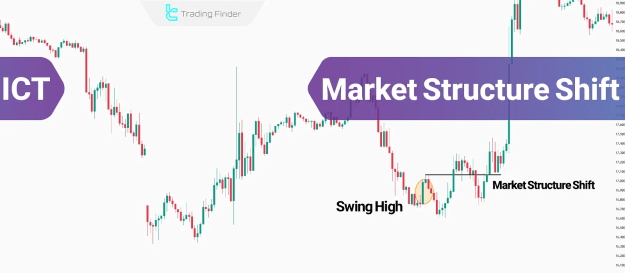
In diverse market trends, the formation of an MSS often indicates a halt in the prevailing trend, a change in price direction, and the establishment of a new short-term trend. In certain instances, this event serves as an early indicator of a long-term trend reversal.
Importance of Understanding Market Structure Shift (MSS)
Accurate identification of the MSS concept empowers traders to pinpoint optimal entry points to capitalize on emerging trends. Applications of MSS in technical analysis include:
- Early detection of trend reversals: MSS provides a prompt signal of potential shifts in market direction.
- Optimized entry points and stop-loss placement: Understanding MSS allows for more precise trade initiation and risk management.
- Connection with major market liquidity to prevent stop hunts: MSS often occurs in conjunction with liquidity absorption, helping traders avoid common market manipulations.
- Integration with other trading setups: MSS can be combined with various other ICT concepts for enhanced analytical power.
Key Features of MSS
To accurately identify a Market Structure Shift, traders should recognize its fundamental characteristics:
- Abrupt break of the last swing high or last swing low: This is a sudden and decisive penetration of a significant price level.
- Accompanied by an aggressive price displacement move: The break is not gradual but forceful, indicating strong market conviction.
- Typically occurs after liquidity grabs or stop hunts: MSS often materializes after the market has absorbed liquidity from stop-loss orders.
Signs of Market Structure Shift (MSS) Formation
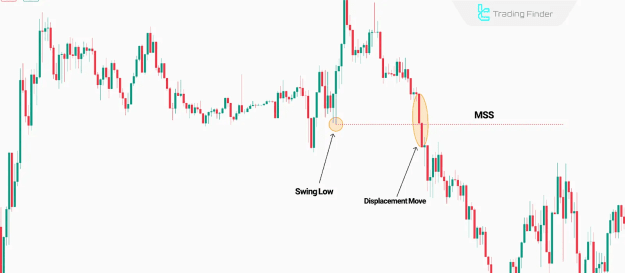
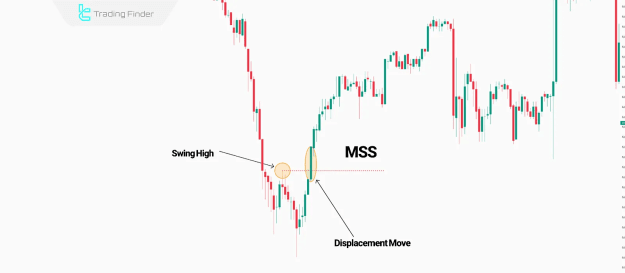
MSS in ICT is confirmed when the last swing high or swing low is breached, accompanied by a forceful price displacement move.
- Swing High: A Swing High represents a point where the price reaches a peak during an upward movement before commencing a decline. It typically acts as a temporary resistance level at the apex of an uptrend.
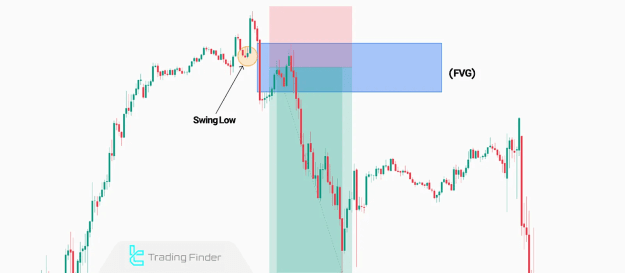
- Swing Low: A Swing Low is a point where the price ceases its decline and initiates an upward movement. It frequently marks a temporary support level at the nadir of a downtrend.
- Displacement Move: A Displacement Move refers to a sudden, powerful, and decisive shift in price. Within the ICT framework, this move signifies a substantial influx of liquidity into the market, driving price aggressively in one direction.
One of the primary confirmation signals for MSS is the decisive break of the last key swing high or low via a strong displacement move.
Trading Guide Based on Market Structure Shift (MSS)
Trading utilizing MSS comprises three principal steps:
#1 Determining ICT Daily Bias
By analyzing the Daily (D1) and H4 timeframes, along with identifying swing highs, swing lows, and liquidity points, traders can ascertain the prevailing daily bias.
#2 Identifying MSS in Lower Timeframes (M5, M15)
The identification of MSS varies between bullish and bearish trends, observable within the MSS completion zones:
- Bullish Trend: MSS is confirmed when a Swing Low is broken with an aggressive displacement move, indicating a potential reversal to a bearish bias.
- Bearish Trend: MSS is confirmed when a Swing High is broken with an aggressive displacement move, signaling a potential reversal to a bullish bias.
#3 Confirmation for Trade Entry
Trade entry confirmations based on MSS can be derived from three primary methodologies:
- Entry after testing the last valid Order Block post-MSS: Price often retests an Order Block (an area of institutional buying or selling) after an MSS, offering a refined entry.
- Entry after filling the Fair Value Gap (FVG): Price frequently revisits an FVG (an inefficiency in price delivery) after an MSS, providing another optimal entry point.
- Entry after confirmation of a Liquidity Grab: If the MSS occurs after a clear liquidity grab, it adds significant validity to the trade setup.
Comparison of MSS with Regular Trend Reversals
A traditional trend reversal typically occurs when the established pattern of higher highs and higher lows (HH & HL) in an uptrend, or lower highs and lower lows (LH & LL) in a downtrend, gradually shifts, signaling the initiation of a new trend.
In contrast, MSS occurs suddenly and is accompanied by a forceful displacement move, often indicative of liquidity manipulation.
Here's a comparison of MSS and traditional trend changes:
- Speed of Change: MSS is sudden and aggressive, whereas regular trend changes are gradual with price corrections.
- Break of Range: MSS involves an abrupt break of a Swing Low or Swing High, while traditional reversals involve a gradual shift in price structure.
- Main Characteristic: MSS is characterized by an aggressive displacement move; regular trend changes occur gradually with pullbacks.
- Liquidity and Market Manipulation: MSS frequently follows liquidity grabs and stop hunts, whereas regular trend changes are primarily driven by supply and demand imbalances.
- Preferred Timeframes: MSS is predominantly identified on Lower Timeframes (LTF), while regular trend changes are often observed on Higher Timeframes (HTF).
- Trading Style: MSS is typically associated with short-term trades, whereas regular trend changes lend themselves to mid-term trades.
Combining MSS with Other ICT Concepts
A significant advantage of MSS lies in its adaptability for integration with other ICT concepts.
Using MSS with Liquidity Pools
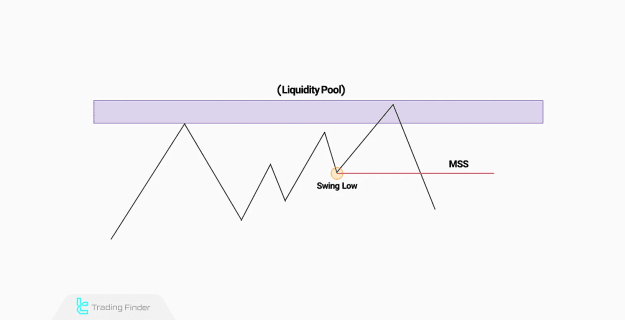
Liquidity Pools are zones in the market where a concentration of stop-loss orders and pending orders accumulates, providing substantial liquidity. When price absorbs liquidity from a liquidity pool, the validity and strength of the MSS are enhanced.
For instance, in a bullish trend, sellers place their stop-loss orders above swing highs, creating a liquidity pool. When the price enters this liquidity pool, activating these pending orders, liquidity is injected into the market. After accumulating sufficient liquidity, the price then breaks the last valid low, confirming the MSS. If price enters a liquidity pool before an MSS, the shift gains greater validity.
Combining MSS with Fair Value Gaps (FVG)
A Fair Value Gap (FVG) is an inefficiency in price delivery, forming a distinct space between the close of the first candlestick and the open of the third in a sequence of three. When a Market Structure Shift (MSS) occurs following the break of a swing high or low, it may be succeeded by the formation of an FVG, providing additional confirmation of the trend shift.
For example, when an MSS forms within an uptrend in conjunction with an FVG, the price will likely retrace into the FVG zone before resuming the new trend. Placing an entry order within the FVG zone offers an optimal trade entry point. A Market Structure Shift combined with an FVG provides an optimal entry point for trades.
Conclusion
The Market Structure Shift (MSS) is an indispensable concept within the ICT trading methodology, representing an abrupt alteration in market direction. This pivotal shift materializes when a swing low or swing high is decisively broken with an aggressive price displacement move, frequently signaling liquidity manipulation and potential trend reversals.