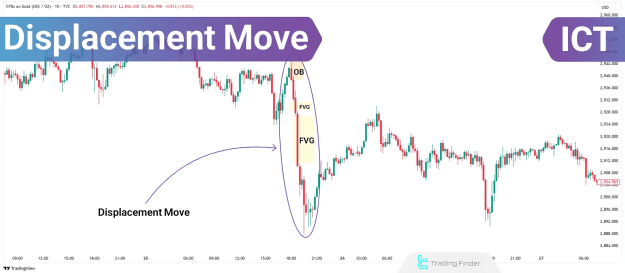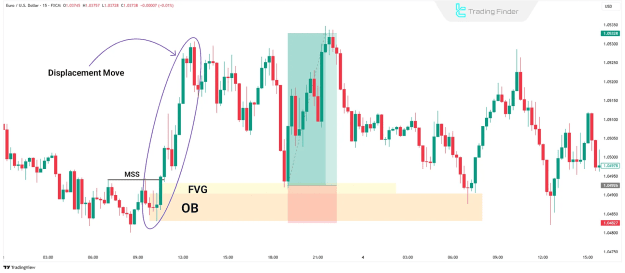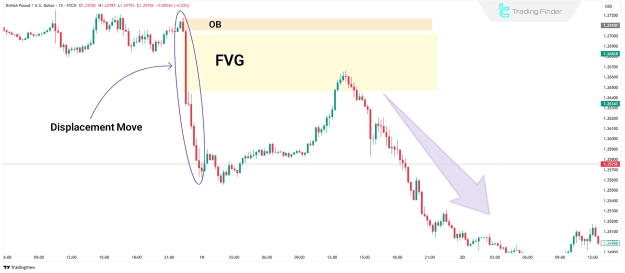


For a displacement move to be deemed valid, it must demonstrate superior strength and momentum compared to preceding price movements, covering a greater distance in a shorter timeframe. Such robust unidirectional price action signals the active participation of market makers and institutional players. These movements are instrumental in identifying the daily bias, confirming Breaks of Structure (BOS), and signaling Changes of Character (CHOCH) within the market.
TP & SL Tool: Risk Reward Ratio Calculator RRR MT4 | Prop Firm Protector: Trade Assist Prop Firm Plus TF Expert MT4 | Money Management + DrawDown Protector: Trade Panel Prop Firm Drawdawn Limiter Pro MT4 |Get a free Expert Advisor license via Telegram and WhatsApp
Key Characteristics of Displacement in ICT
Displacement moves possess distinct characteristics that differentiate them from other price fluctuations:
- Fast and Powerful Movement: These moves are marked by the presence of large-bodied candles with minimal or no wicks. This visual confirmation signifies the complete dominance of either buyers or sellers, indicating a decisive market shift in a single direction.
- Break of Key Levels: A hallmark of displacement is the forceful breaking of established support and resistance levels, prior swing highs and lows, and other crucial market structures. This action lends significant credibility to the move.
- Liquidity Inducement: Often preceding a displacement, the market may orchestrate liquidity inducement, creating scenarios designed to trap retail traders. This strategy attracts liquidity to one side of the market, which Smart Money then leverages for their own strategic entries.
- Creation of Imbalances and Fair Value Gaps (FVGs): Displacement moves frequently result in price delivery imbalances, leading to the formation of Fair Value Gaps (FVGs). These gaps, visually represented on charts, commonly serve as potential corrective zones or re-entry points within the established trend.
- Importance of Higher Timeframe Market Structure: In ICT, it is paramount that every displacement move aligns with the market structure on higher timeframes (HTF). This alignment is crucial for confirming the primary market direction and mitigating the risk of entering invalid trades.
Bullish Displacement Move
A Bullish Displacement Move signifies strong upward price momentum, indicative of significant institutional buying and market-maker activity. Its key features include:
- At least three consecutive bullish candles, each exhibiting large bodies and minimal or no wicks.
- The formation of a Fair Value Gap (FVG) between candles, signaling efficient upward price delivery.
- The absence of significant corrections or irregular price movements during the move, which further confirms the strength and clarity of the bullish trend.
Trading Based on a Bullish Displacement Move
To trade effectively based on a bullish displacement move, a comprehensive approach is required:
- Higher Timeframe Analysis: Begin by analyzing the market structure on higher timeframes to confirm a prevailing bullish trend.
- Premium and Discount Zones: Identify Premium and Discount Zones to pinpoint optimal entry points within the market.
- Waiting for Correction: After a strong bullish displacement, patiently wait for a price correction back into the FVG or an Order Block.
- Confirmation and Entry: Upon confirmation of a Market Structure Shift (MSS) or Break of Structure (BOS), execute a buy trade, targeting liquidity at higher levels.
Bearish Displacement Move
A Bearish Displacement Move indicates widespread selling pressure and signals institutional exit from the market. Its key features include:
- At least three consecutive bearish candles, each with large bodies and minimal or no wicks.
- The formation of an FVG in the downward direction, indicating efficient downward price movement.
- The absence of strong corrections during the move, confirming robust selling pressure.
Trading Based on a Bearish Displacement Move
Trading based on a bearish displacement move follows a similar structured approach:
- Higher Timeframe Analysis: After analyzing the market structure on higher timeframes and confirming a bearish trend, proceed to the next steps.
- Premium and Discount Zones: Identify Premium and Discount Zones to find the most opportune entry point.
- Waiting for Correction: Following a strong bearish displacement move, await a price correction back into the FVG or an Order Block.
- Confirmation and Entry: With confirmation of a Market Structure Shift (MSS) or Break of Structure (BOS), enter a sell trade, targeting liquidity at lower levels.
Risk Management in Displacement Move Trades
While displacement moves present compelling trading opportunities, they inherently carry risks. These include:
- Unexpected Market Volatility: The potential for sudden market reversals.
- Misinterpretation of Market Structure: Leading to inaccurate trade entries.
- Late Entry: Resulting in sub-optimal risk-to-reward profiles.
To effectively mitigate these risks, the consistent application of Stop-Loss orders and sound capital management is indispensable. Furthermore, traders must always analyze displacement moves within the broader context of higher timeframe trends to ensure informed decision-making.
Conclusion
The Displacement Move in ICT methodology is a fundamental concept designed to enhance understanding of price dynamics and the strategic objectives of large market makers. These powerful movements are distinctively characterized by strong candles, decisive breaks of key levels, and the formation of Fair Value Gaps (FVGs), offering valuable insights for traders.