

TP & SL Tool: Risk Reward Ratio Calculator RRR MT4 | Prop Firm Protector: Trade Assist Prop Firm Plus TF Expert MT4 | Money Management + DrawDown Protector: Trade Panel Prop Firm Drawdawn Limiter Pro MT4 |Get a free Expert Advisor license via Telegram and WhatsApp
Trading the Asian Session Dealing Range with the PO3 Strategy
The inherent characteristics of the Asian session, notably its lower volatility and periods of price consolidation, make it an opportune environment for discerning smart money movements.
What is the Asian Trading Session?
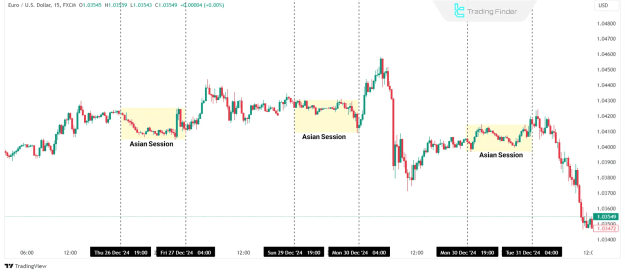
The Asian trading session is one of the three primary Forex trading sessions, alongside the European and North American sessions. It typically operates from 07:00 PM to 04:00 AM New York time (NY time), with the Tokyo market exerting the most significant influence.
Key Characteristics:
- Lower Volatility: In comparison to the European and North American sessions, the Asian session generally exhibits reduced price volatility. This makes it particularly suitable for traders employing strategies that benefit from minimal market noise.
- Consolidation Phase: Many market participants observe that the Asian session frequently serves as a consolidation phase, thereby setting the groundwork for potential breakout opportunities in subsequent sessions.
- Asian Kill Zone (A-KZ): This refers to a specific timeframe within the Asian session, typically from 19:00 to 22:00 Eastern Standard Time (EST), during which trading activity and liquidity are observed to increase.
Price Consolidation in the Asian Session (07:00 PM to 04:00 AM NY time)
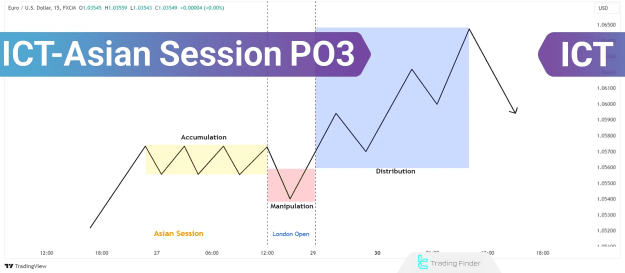
The Power of Three (PO3), also known as the Accumulation, Manipulation, Distribution (AMD) concept, is a fundamental trading strategy centered on these three distinct phases.
Accumulation Phase
During the Asian session, smart money investors often commence accumulating their positions. This phase is characterized by stable prices and low volatility.
Key points to monitor:
- Range-Bound Markets: Identify currency pairs that are trading within a narrow price range.
- Support and Resistance Levels: Mark significant support and resistance zones, as these may indicate potential breakout points.
Manipulation Phase
As the Asian session progresses, market manipulation frequently occurs. Market makers often drive prices to generate false breakouts, aiming to trap retail traders into making premature or incorrect trading decisions.
Key indicators of this phase:
- False Breakouts: Observe temporary price movements that breach established support or resistance levels but quickly reverse direction.
- Volume Analysis: Analyzing trading volume during these manipulation events can offer insights into the strength of the price movement.
Distribution Phase
The distribution phase commences when market makers begin to offload their accumulated positions. This stage typically coincides with the opening of the European session, leading to increased market volatility.
Key considerations:
- Breakouts: A genuine breakout from the accumulation phase may signal a strong directional price move.
- Trend Reversals: Exercise caution regarding potential trend reversals as the market transitions from the Asian to the European session.
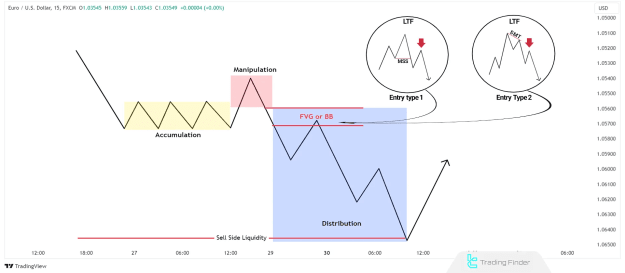
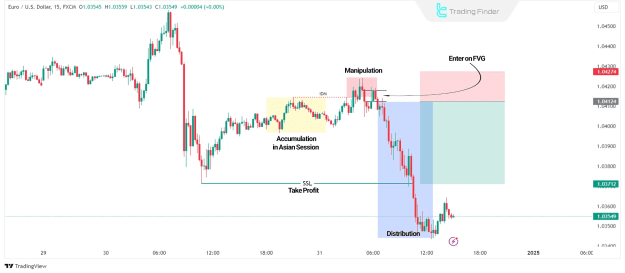
Accumulation, Manipulation, and Distribution (AMD) Phases in the Asian Session Power of Three Setup
Implementing the ICT Asian Session PO3 Strategy
To successfully execute the ICT Asian Session PO3 strategy, traders must adhere to a structured, step-by-step approach. The following guidelines are designed to facilitate the effective application of this strategy:
#1 Identify Market Bias Using the Daily Bias Concept
Prior to any trading activity, it is crucial to determine the market's daily bias, which reflects the overall market direction for the day. This step helps traders understand the dominant trend. To establish daily bias, analyze higher timeframes (e.g., daily or 4-hour charts) to identify prevailing bullish or bearish tendencies.
Key factors in determining Daily Bias:
- Market structure and directional trend.
- Identifying key ICT order blocks or Mitigation Blocks.
- Analyzing the previous day's candlestick to recognize significant turning points.
#2 Identify Key Levels Before the Asian Session Begins
- Support and Resistance Levels: Based on the determined Daily Bias, identify crucial zones that may influence accumulation or subsequent breakouts.
- Appropriate Timeframes: Utilize mid-term timeframes (e.g., 1-hour or 4-hour charts) to pinpoint these key levels.
- Asian Session Awareness: Remain mindful of the Asian Kill Zone (07:00 PM to 04:00 AM NY time).
#3 Monitor Price Movements During the Asian Session
- Accumulation Phase: Identify range-bound price movements that define the consolidation zone.
- Candle Patterns: Look for specific candlestick formations such as Pin Bars or Engulfing Candles, which may indicate accumulation and manipulation.
- Liquidity Inducement: Watch for false breakouts occurring near established support or resistance levels.
#4 Prepare for the European Session & Distribution Phase
- Breaker Block Identification: If the price exits the accumulation zone, analyze breaker block areas for potential trade entries.
- Trade Setup Confirmation: Verify if the price moves towards key levels, such as a Mitigation Block.
- Pullback Entries: Wait for the price to return to significant levels before initiating trades.
#5 Risk Management & Trade Execution
- Stop-Loss Placement: Set stop-losses slightly below the accumulation low or above the high.
- Take-Profit Targets: Utilize higher timeframe support/resistance levels for take-profit (TP) zones.
- Trade Management: Secure partial profits or adjust stop-losses if the market trend shifts.
#6 Document & Improve Strategy Execution
- Trade Logging: Maintain detailed records of all trades, including entry points, stop-losses, timeframes, and results.
- Post-Trade Analysis: Evaluate the strengths and weaknesses of each trade to enhance future strategy execution.
Conclusion
The ICT Asian Session PO3 strategy is a comprehensive and highly structured approach designed for capitalizing on the unique opportunities present within the Asian session of the Forex and Crypto markets. This strategy is primarily focused on the three core phases: Accumulation, Manipulation, and