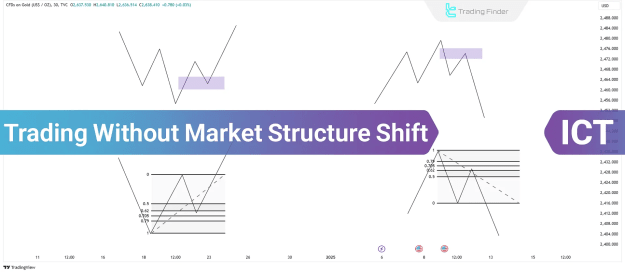


Key Factors in the Strategy
This strategy is built upon two core elements that allow for proactive trade execution:
- Higher Timeframe Points of Interest (POI): This involves identifying significant liquidity zones on higher timeframes (e.g., 15-minute or 1-hour charts). These POIs typically include:
- Previous highs and lows
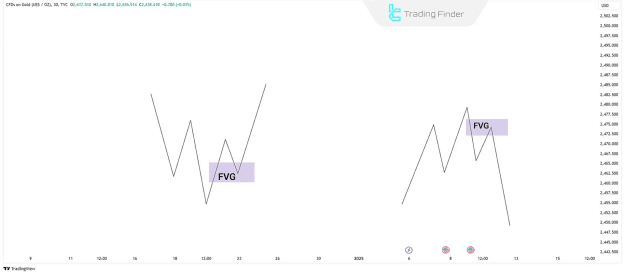
- Fair Value Gaps (FVG)
- Order Blocks
- Other critical liquidity areas When price interacts with these POIs, it signals a potential for a strong directional move.
- Strong Moves After Short-Term High or Low Break (Liquidity Raid): A pivotal aspect of this strategy is observing price action immediately following a liquidity raid. This occurs when the price breaks a short-term high or low and then quickly and emphatically reverses back into its previous range. Such moves frequently lead to trading opportunities within:
- Balanced Price Range (BPR) setups
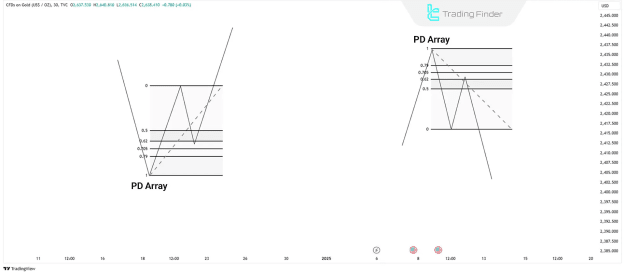
- "Box" setups Optimal Trade Entry (OTE) levels, a key ICT concept, can be utilized to pinpoint precise entry points. These strong reversals often manifest as candles with long wicks (e.g., Hammer or Shooting Star patterns) on higher timeframes, indicating significant market rejection.
How to Identify These Opportunities
To effectively implement this "Trading Without MSS" strategy, follow these systematic steps:
1. Identify Higher Timeframe Points of Interest
- Previous Highs or Lows: Look for significant previous highs or lows on higher timeframes (e.g., 15 minutes or 1 hour).
- Price Reaction: When price reaches these identified points, anticipate a potential strong upward or downward move.
2. Liquidity Raid
- Break and Return: A strong indication of a trading opportunity is a clear break of a short-term high or low, immediately followed by a rapid return to the prior price range. This signifies that liquidity has been swept, and a strong reversal is likely.
- Wick Formation: These types of moves often result in the formation of candles with long wicks on higher timeframes (such as Hammer or Shooting Star patterns), providing visual confirmation of the liquidity raid and subsequent rejection.
Important Notes for Trading Without Market Structure Shift
This strategy is particularly valuable for determining the overall market bias. The most crucial aspect of this model is the identification of potent price movements that occur subsequent to the breach of a short-term high or low.
- Strong Reversal Points: These sharp, decisive moves typically highlight significant market reversal points, offering high-probability trading setups.
- Multi-Timeframe Analysis: To refine entry points, it is essential to utilize various timeframes, such as 1-minute or 5-minute charts. These lower timeframes provide granular detail on market structure and more precise entry opportunities, even when a full MSS or MSB is not present on the higher timeframe.
Example of Trading Without Market Structure Shift
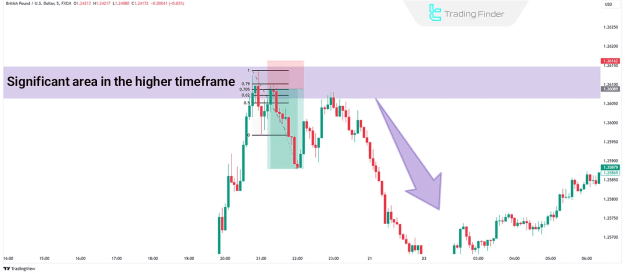
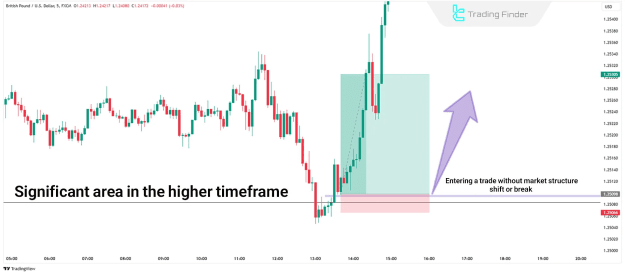
Consider a scenario where the price approaches higher timeframe points of interest. A reaction from these zones is anticipated.
In such a case, trades can be initiated without requiring a formal market structure shift or break. Instead, ICT tools like Fair Value Gaps (FVG), Optimal Trade Entry (OTE), and Order Blocks are employed to define entry and exit points.
For instance, an entry point can be precisely determined using OTE levels, as demonstrated in a GBP/USD 5-minute chart example. Similarly, a strong entry can be identified by leveraging an FVG following a liquidity raid.
Conclusion
The "Trading Without Market Structure Shift" strategy is an advanced approach suited for traders seeking to quickly capitalize on market opportunities and reduce their dependency on conventional market structure changes. By concentrating on higher timeframe points of interest and observing sharp price reversals after liquidity raids, traders can execute trades effectively without waiting for a Market Structure Shift or Market Structure Break, enhancing their agility in dynamic market conditions.