

What is Market Structure?
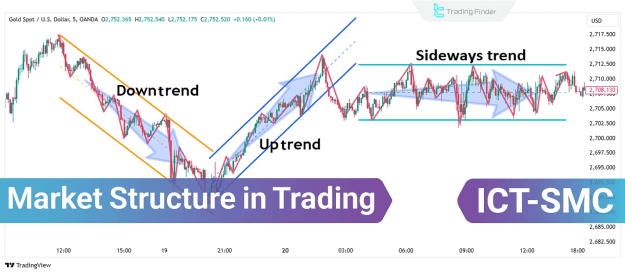
Market structure refers to the actual price behavior, including the formation of reversal points and subsequent price movements. This structure dictates the prevailing market trend, categorizing it as bullish, bearish, or ranging. Accurately identifying these structures is paramount for setting trade direction and determining precise entry and exit points.
Pros and Cons of Using Market Structure in Trading
Leveraging market structure in trading offers distinct advantages, but it also comes with certain limitations:
Pros:
- Accurate Trend Identification: Provides the ability to precisely identify market trends and their shifts.
- Optimal Entry and Exit Points: Facilitates the identification of suitable entry and exit points for trades.
- Improved Risk Management: Enhances risk management by pinpointing key reversal points.
Cons:
- Potential for False Signals: Susceptible to generating false signals in volatile and unstable market conditions.
- Requires Experience: Demands experience and precision for correct interpretation.
- Challenges in Lower Timeframes: Presents difficulties in analyzing lower timeframes due to increased noise.
Types of Market Structure
Market structure primarily manifests in three states: bullish, bearish, and ranging. Each state reflects specific market conditions:
1. Bullish Market Structure
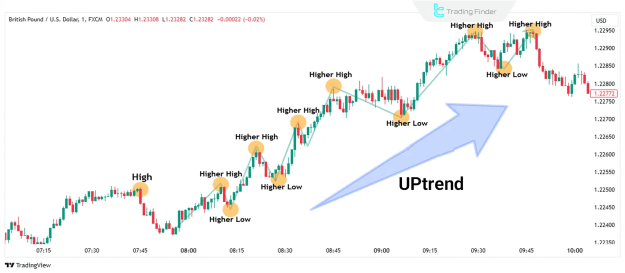
In a bullish market structure, the price forms a series of Higher Highs (HH) and Higher Lows (HL). This uptrend is confirmed by breaking the previous day's high. The formation of a new Lower Low (LL) relative to the preceding low is the initial indicator of a potential trend change in a bullish market.
2. Bearish Market Structure
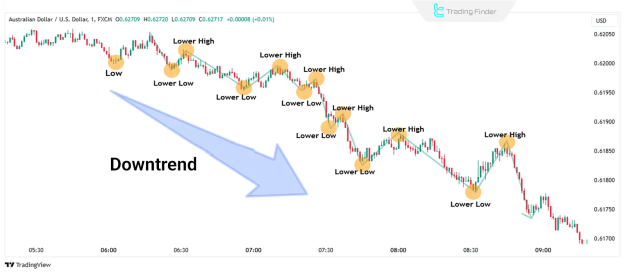
Conversely, a bearish market structure is characterized by the formation of Lower Highs (LH) and Lower Lows (LL). A continuation of the downtrend is signaled by the price breaking the previous low. If a Higher High (HH) forms compared to the previous high, it suggests a potential reversal from a bearish to a bullish trend.
3. Ranging Market Structure
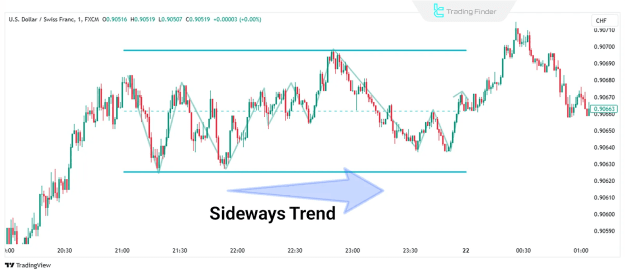
A ranging market structure, also known as a sideways trend, occurs when the price moves within a defined horizontal range, oscillating between fixed highs and lows. This state is often observed in lower timeframes and is suitable for short-term trades. The market's future direction is typically determined by a decisive breakout from this range.
How to Identify Market Structure in Different Timeframes
While market structure is present across all timeframes, its clarity and reliability vary. Higher timeframes generally exhibit more stable and dependable structures. In contrast, lower timeframes are more challenging to analyze due to increased noise and small fluctuations. The most effective approach for accurately identifying market structure is by combining Top-Down Analysis.
Identifying Changes in Market Structure
Changes in market structure are typically identified by breaking key points, such as significant highs (HH) or lows (LL). In an uptrend, a break below the previous low indicates a shift towards a downtrend. Conversely, in a downtrend, a break above the previous high suggests a potential shift to an uptrend. These structural changes are often accompanied by displacement, which refers to rapid and decisive price movements.
Key Points in Market Structure Analysis
For a more precise and robust market structure analysis, consider the following key tips:
- Accurate Identification of Highs and Lows: Focus on accurately identifying actual highs and lows on the chart to determine critical turning points.
- Clear Breakouts: Prioritize clear and decisive breakouts while disregarding minor, insignificant price fluctuations.
- Confirmation with Other Tools: Integrate market structure analysis with other tools, such as ICT PD Array (Premium/Discount Zones), to confirm your analysis.
- Multi-Timeframe Analysis: Compare multiple timeframes to gain a comprehensive understanding of the overall market perspective.
- Volume Analysis: Utilize volume analysis to confirm the validity of breakouts and identify liquidity flow.
- Continuous Practice: Consistently practice identifying market structure under various market conditions.
- Alignment Across Timeframes: Ensure that market structure aligns across both higher and lower timeframes for increased confidence in your analysis.
Conclusion
Market structure stands as a fundamental concept within the technical analysis of financial markets. It provides a framework for examining price behavior and discerning market direction based on the formation of highs and lows. This vital structure manifests in three primary forms—bullish, bearish, and ranging—each representing distinct market conditions. Understanding and effectively utilizing market structure is crucial for traders seeking to improve their analytical capabilities and refine their trading strategies.