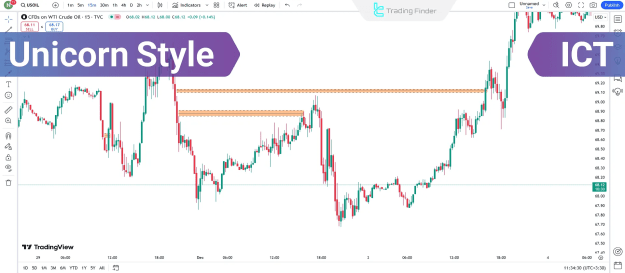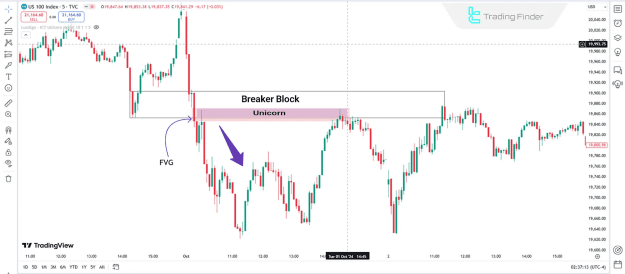


Understanding the ICT Unicorn Trading Strategy
The ICT Unicorn strategy offers a precise framework for identifying high-probability trading opportunities. For those interested in utilizing this model, specialized indicators are available across various trading platforms:
Unicorn Indicator MT4
Unicorn Indicator MT5
Key Concepts Within the ICT Unicorn Style
The effectiveness of the ICT Unicorn style hinges on the interplay of two core components:
- Breaker Block: A Breaker Block signifies a previously established order block that has been decisively breached, leading to a market structure shift (MSS) or a change of character (CHoCH). These areas typically emerge when price action penetrates a significant support or resistance level, indicating a new directional bias.
- Fair Value Gap (FVG): An FVG denotes a region on the price chart characterized by rapid, impulsive price movements, resulting in a visible gap between candlesticks. These gaps inherently reflect an imbalance between supply and demand, often serving as magnet points for price rebalancing.
Advantages of Adopting the ICT Unicorn Style
The ICT Unicorn trading style offers several notable benefits to traders:
- Enhanced Precision: The synergistic combination of Breaker Blocks and FVGs provides highly effective signals for entering trading positions.
- Precise Support and Resistance Identification: This methodology assists in accurately identifying critical support and resistance levels within the market.
- Broad Market Applicability: The ICT Unicorn model demonstrates efficacy across a diverse range of financial markets, including forex, stocks, commodities, and cryptocurrencies.
Types of ICT Unicorn Models
The ICT Unicorn style categorizes price movements into distinct bullish and bearish patterns, fundamentally rooted in liquidity principles and institutional order flow.
1. Bullish Unicorn Model
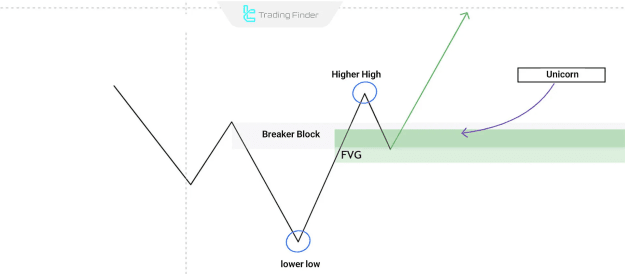
This pattern typically materializes following a bearish trend, initiated by the formation of a Lower Low (LL), succeeded by a Higher High (HH). In this scenario, a bullish Breaker Block converges with a bullish FVG, creating a high-probability reversal zone.
2. Bearish Unicorn Model
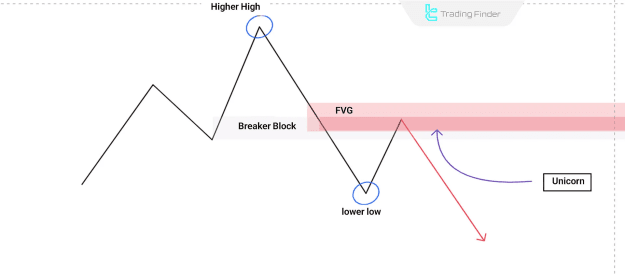
Conversely, the bearish model forms at the culmination of a bullish trend, marked by a Higher High (HH) followed by a Lower Low (LL). Here, a bearish Breaker Block overlaps with a bearish FVG, signaling a potential downward reversal.
Identifying the ICT Unicorn Model
The defining characteristic of the ICT Unicorn pattern is the overlap between a Breaker Block and an FVG. This confluence generates a zone with a high probability of price reversal. The identification process involves the following steps:
- Break of Structure: Observing a definitive break of a significant high or low.
- Breaker Block Formation: Identifying the subsequent formation of a Breaker Block.
- FVG Overlap: Confirming the overlap of the formed Breaker Block with an FVG.
Trading Strategies Using the ICT Unicorn Style
The ICT Unicorn style empowers traders to capitalize on market price movements with greater precision.
1. Focus on Timeframes
Initiate analysis by discerning the overarching trend and key levels on higher timeframes (e.g., 1-hour or daily charts). Subsequently, refine entry and exit points by drilling down to lower timeframes.
2. Identify Market Structure
Crucially, identify key liquidity points (such as swing highs, swing lows, and price gaps) and leverage order blocks to anticipate zones where price reversals are likely to occur.
3. Entry and Exit Points
- Entry: Consider opening positions when the price approaches established key areas, such as order blocks or FVGs.
- Exit: Aim to close positions before the price reaches significant resistance or support levels, securing profits and managing risk.
Optimal Timeframes for Unicorn Style
The Unicorn style is particularly effective on shorter timeframes. Therefore, timeframes of 15 minutes or less are generally recommended for detailed analysis and identifying precise entry points.
Best Assets for the Unicorn Style
Introduced in 2022, the ICT Unicorn pattern initially gained prominence in its application to indices like the Dow Jones and Nasdaq. Its efficacy has since been demonstrably proven in the forex market, particularly with major currency pairs such as EUR/USD and GBP/USD. Traders have also achieved notable success applying this model to precious metals like XAU/USD (gold) and XAG/USD (silver), as well as the U.S. Dollar Index (DXY). Furthermore, the Unicorn model has exhibited outstanding performance within the cryptocurrency market.
Example of Buy Trades in Unicorn Style
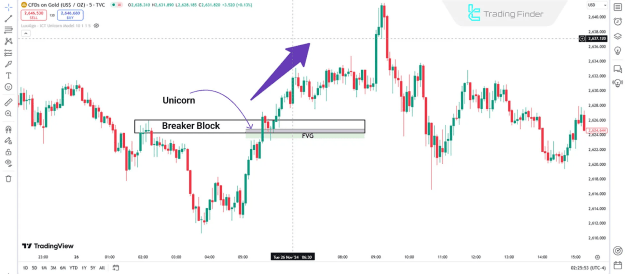
When a market structure change occurs, and a bullish Breaker Block overlaps with a bullish FVG, it presents an opportune moment for a buy trade. Upon the price returning to the bullish FVG zone, a buy position can be initiated with the objective of targeting significant resistance levels.
Example of Sell Trades in Unicorn Style
Conversely, when a market structure change unfolds, leading to a bearish Breaker Block overlapping with a bearish FVG, it signals a favorable setup for a sell trade. As the price reverts to the bearish FVG zone, a sell position can be executed, aiming for significant support levels.
Conclusion
The ICT Unicorn is a highly regarded and popular strategy within the trading community. It is meticulously designed to identify high-probability trading opportunities by meticulously analyzing liquidity, order blocks, and price action. This versatile style is applicable across a wide array of financial assets, including indices, forex, metals, and cryptocurrencies, emphasizing the importance of shorter timeframes and precise market structure analysis for optimal results.