

TP & SL Tool: Risk Reward Ratio Calculator RRR MT5 | Prop Firm Protector: Trade Assist Prop Firm Plus TF Expert MT5 | Money Management + DrawDown Protector: Trade Panel Prop Firm Drawdawn Limiter Pro MT5 |Get a free Expert Advisor license via Telegram and WhatsApp
Understanding Forex and Futures
What is Forex?
Forex, short for Foreign Exchange, is a decentralized (OTC) market dedicated to the trading of currency pairs. It is primarily a speculative market where participants aim to profit from the constant fluctuation of exchange rates. Traders typically engage with spot rates of currency pairs through Contracts for Difference (CFD) agreements. This means that while traders don't physically own the underlying currency, they can capitalize on its price movements. In a CFD contract, a trader agrees to exchange the difference in the price of an asset from when the contract is opened to when it is closed.
What are Futures?
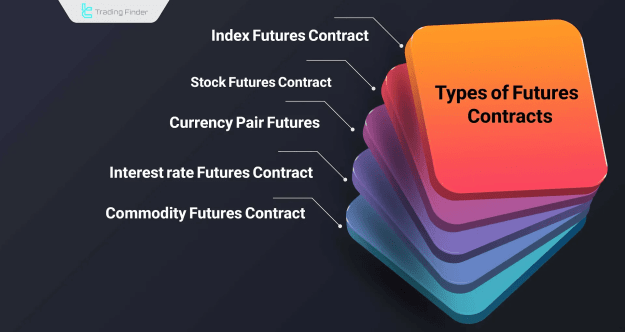
In contrast, the futures market involves the trading of futures contracts. A futures contract is a legally binding agreement between two parties to buy or sell a specific asset at a predetermined price on a specific date in the future. The futures market is a centralized market, with trading conducted on official exchanges such as the Chicago Mercantile Exchange (CME) and the New York Mercantile Exchange (NYMEX).
Key Differentiators: Forex vs. Futures
While both markets offer significant opportunities, their fundamental differences dictate their optimal use cases.
- Asset Type: Forex exclusively deals with currency pairs. Futures, however, offer a broader spectrum of assets, including currency pairs, commodities, cryptocurrencies, and bonds.
- Market Structure: Forex operates as a decentralized over-the-counter market, meaning transactions occur directly between participants. Futures markets are centralized, with trades executed through regulated exchanges.
- Trading Hours: The Forex market operates 24 hours a day, five days a week (24/5), reflecting its global nature. Futures trading hours vary depending on the specific asset and the exchange.
- Costs: Forex trading typically involves spreads, commissions, and swap fees. Futures trading incurs spreads and exchange fees.
- Liquidity: Forex is the most liquid financial market globally, with daily trading volumes estimated between $5-7 trillion. Futures liquidity is generally lower than Forex and varies significantly by asset.
- Leverage: Forex often provides very high leverage (up to 1:500 or more), amplifying both potential profits and losses. Futures leverage is more restricted, usually up to 1:100.
- Transparency and Regulation: Due to its centralized exchange structure, Futures trading generally offers greater transparency and regulation compared to the decentralized Forex market.
Hedging and Risk Management
One of the most crucial distinctions between the Forex and Futures markets lies in their approaches to hedging and risk management.
Hedging in Futures
Hedging is a significant advantage in the Futures market due to the possibility of price fixation. This allows participants to lock in a future price for an asset, providing protection against adverse price movements.
- Example: An airline concerned about future oil price increases can enter into an oil futures contract. By doing so, they can secure a specific price (e.g., $75) for a future oil purchase, mitigating the risk of higher costs.
Hedging in Forex
Hedging in Forex operates differently, primarily focusing on protection against short-term currency fluctuations.
- Example: A European company exporting goods to Switzerland is vulnerable to the depreciation of the Swiss Franc against the Euro. To hedge this risk, the company could purchase EUR/CHF, aiming to offset potential losses from a weakening Franc.
Comparison of Hedging Approaches
- Time Horizon: Forex hedging is suitable for short-term currency pair exposure. Futures hedging is more appropriate for longer-term hedging across a broader range of assets.
- Swap Fees: Forex hedging may involve swap fees. Futures contracts typically do not have swap fees.
- Price Fixation: Futures contracts allow for price fixation, providing certainty for future transactions. Forex hedging does not involve price fixation in the same manner.
Trading Hours: Forex vs. Futures
The operational hours of the Forex and Futures markets vary considerably.
Trading Hours in Forex
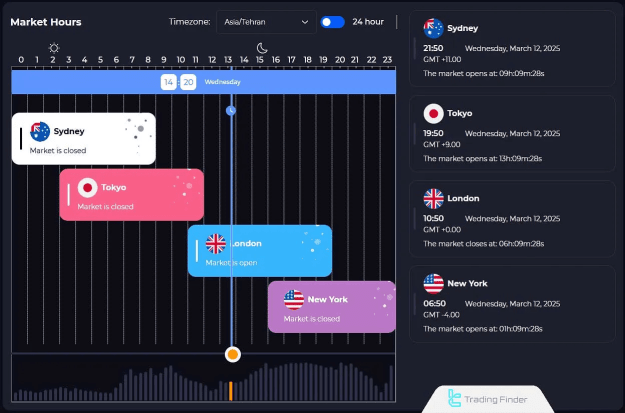
The Forex market operates 24 hours a day, five days a week, closing only on Saturdays and Sundays. Its global nature leads to trading sessions overlapping across major financial centers:
- Sydney Session
- Tokyo Session
- London Session
- New York Session
These overlapping sessions ensure continuous liquidity throughout the trading week.
Trading Hours in Futures
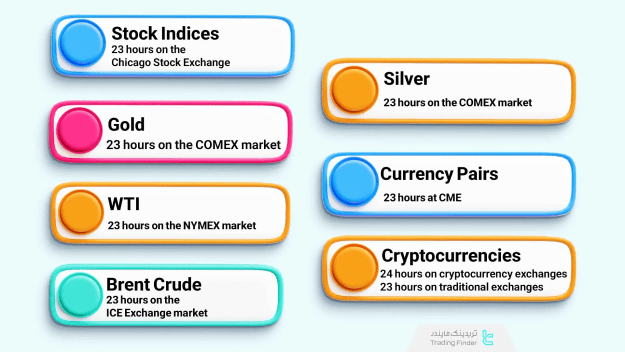
Futures market trading hours are specific to the asset being traded (e.g., oil, gold, indices, currencies) and the broker facilitating the trade. While some exchanges may have brief breaks for liquidity management and observe holidays, certain crypto futures markets (like Binance Futures) operate 24/7.
Leverage and Trading Volume
The scale of the Forex and Futures markets in terms of trading volume and leverage also presents key differences.
- Daily Trading Volume: The Forex market is the largest financial market by trading volume, with an estimated $5-7 trillion traded daily. Futures markets have varying volumes by asset, with some highly liquid contracts like S&P500, gold, and oil reaching significant volumes (e.g., total daily volume around $30-40 billion for the entire futures market).
- Liquidity: Forex maintains exceptionally high liquidity, especially for major currency pairs. Futures liquidity, while high for certain assets, is generally lower than the Forex market.
- Slippage: Due to its immense liquidity, slippage is generally lower in Forex. In Futures, particularly for lower-volume assets, slippage can be higher.
Conclusion
The inherent differences in nature, structure, and trading characteristics between the Forex and Futures markets lead to distinct applications and trading styles.
- Futures, with their ability to fix prices at a specific future date, serve as a highly effective tool for hedging against price fluctuations for both commercial entities and individual traders.
- Forex, characterized by its high trading volume and 24/5 activity, remains a particularly suitable market for speculation on short-term currency movements.