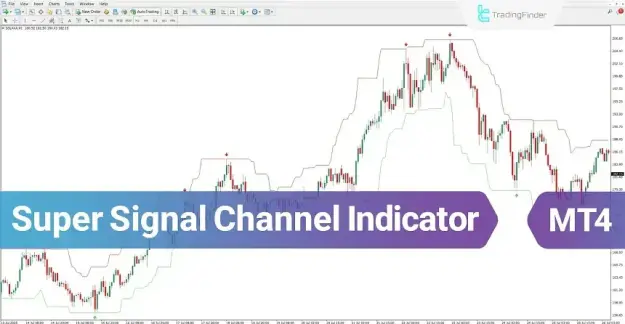


In addition to generating signals, the indicator establishes a dynamic channel using two colored boundaries, typically green and red. These channel lines function as essential price interaction zones and can be effectively utilized for setting accurate take-profit and stop-loss levels.
 You can download it from this link:
https://cdn.tradingfinder.com/file/5...4-by-tflab.zip
 For instructions on how to install:
https://www.forexfactory.com/thread/...-in-metatrader
Prop Firm DrawDown Protector : Prop Firm Capital Protection Expert MT4 | Forex Money Management: Forex Trade Management Expert MT4 |ICT Concepts Indicator MT4 | Smart Money Concepts Expert MT4| Smart Money Trap Scanner | Get a free Expert Advisor license via Telegram and WhatsApp
Key Specifications of the Super Signal Channel Indicator
The Super Signal Channel indicator is defined by the following attributes:
- Indicator Categories:
- Signal & Forecast MT4 Indicators
- Bands & Channels MT4 Indicators
- Levels MT4 Indicators
- Platform Compatibility:
- MetaTrader 4
- Trading Skill Level:
- Suitable for beginners
- Indicator Type:
- Reversal Indicator
- Timeframe:
- Multi-Timeframe support
- Trading Styles:
- Day Trading
- Scalping
- Swing Trading
- Supported Markets:
- Forex
- Cryptocurrency
- Stocks
Super Signal Channel Indicator Overview
The indicator enhances technical chart analysis by displaying directional arrows that signal potential trading opportunities:
- Green arrows: Indicate buy (long) opportunities
- Red arrows: Indicate sell (short) opportunities
These signals are derived from price behavior relative to the channel boundaries and the internal computational model, providing a structured approach to identifying entry and exit levels.
Buy Signal Strategy
Identifying Buy Opportunities
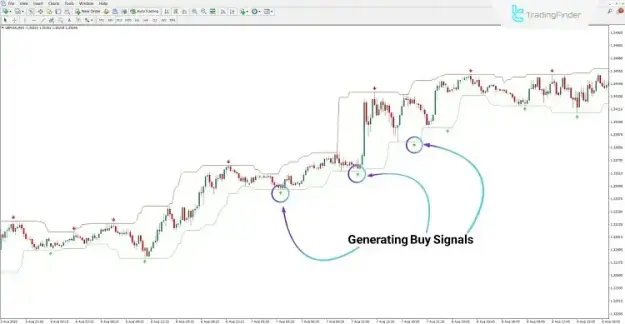
In bullish market environments, the indicator highlights buy signals with green arrows. For example, on a GBP/USD chart using the 15-minute timeframe:
- A green arrow marks a potential entry point for a long position
- Traders may execute a buy trade at the indicated level
- Stop-loss placement is typically set below the lower channel boundary
- It is advisable to confirm the prevailing trend before entering the trade
Application in Uptrend Conditions
- Buy signals align with upward price momentum
- The lower channel line acts as a dynamic support level
- Price retracements toward this boundary may strengthen entry confirmation
Sell Signal Strategy
Identifying Sell Opportunities
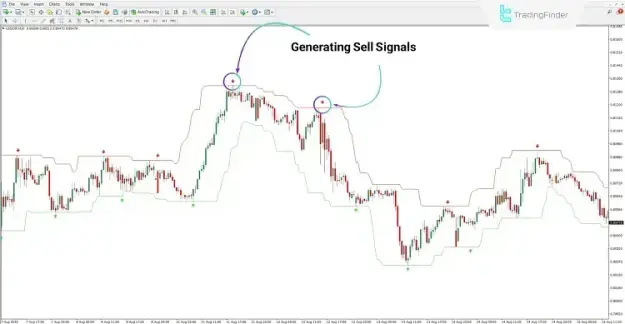
During bearish market conditions, sell signals are represented by red arrows. For instance, on a USD/CHF chart in the 30-minute timeframe:
- A red arrow signals a potential short entry
- Traders may open a sell position at the signal point
- Stop-loss levels are generally placed above the upper channel boundary
- Assessment of the overall market trend is recommended prior to execution
Application in Downtrend Conditions
- Sell signals correspond with declining price movement
- The upper channel boundary acts as dynamic resistance
- Price pullbacks toward this level can provide additional confirmation for entry
Super Signal Channel Indicator Settings
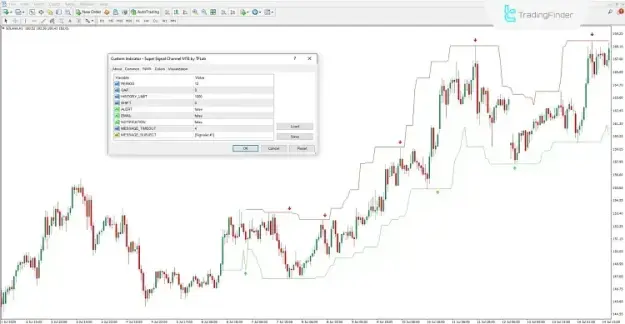
The indicator includes a range of adjustable parameters to accommodate different trading strategies:
- PERIOD: Specifies the number of periods used for calculations
- GAP: Defines the distance between price and channel lines
- HISTORY_LIMIT: Determines the number of historical candles analyzed
- SHIFT: Controls the horizontal displacement of signals
- ALERT: Enables or disables alert notifications
- EMAIL: Activates email-based alerts
- NOTIFICATION: Enables push notifications
- MESSAGE_TIMEOUT: Sets the interval between alerts
- MESSAGE_SUBJECT: Defines the notification title
Conclusion
The Super Signal Channel indicator is a practical and efficient tool for identifying trend reversals and optimizing trade entry and exit points across various financial markets. By integrating visual signal indicators with a dynamic channel framework, it delivers a clear and disciplined approach to technical analysis.
This indicator can be seamlessly incorporated into multiple trading strategies, improving analytical precision and supporting consistent decision-making across different timeframes and asset classes.