

By tracking every trade along with strategic and psychological notes, traders gain clearer insights into their habits, strengths, and weaknesses—especially in fast-changing, high-volatility markets.
Prop Firm DrawDown Protector : Prop Firm Capital Protection Expert MT5 | Forex Money Management: Forex Trade Management Expert MT4 | ICT Concepts Indicator MT5 |Smart Money Concepts Expert MT5 |Get a free Expert Advisor license via Telegram and WhatsApp
What Is a Stock Market Journal?
A stock market journal is a personalized record where traders document all actions related to their trading strategy. It typically includes:
- Time and size of trades
- Entry and exit reasons
- Indicators and analysis
- Market context
- Emotional state and decision-making process
The goal is to build a personal dataset that supports better strategy optimization and long-term performance.
Why Traders Use a Stock Trading Journal
Global markets react daily to economic data, earnings reports, central bank policies, and geopolitical events. In such environments, a journal helps traders maintain structure and evaluate their performance over different periods.
Professional traders often track:
- Symbol/ticker
- Entry & exit prices
- Position size
- Strategy type (Swing, Intraday, Position)
- Indicators used
- Dominant emotions during the trade
Modern platforms such as TraderSync and Edgewonk automate data import and provide advanced statistics and charts.
Benefits of Keeping a Stock Market Journal
1. Identifies Errors and Reveals Patterns
Recording past trades makes it easier to spot timing mistakes, weak strategies, or recurring emotional reactions like FOMO or hesitation.
2. Improves Discipline and Reduces Emotional Trading
Writing down trade logic encourages planning and rule-based execution, rather than impulsive decisions during volatility.
3. Strengthens Risk Management
A journal highlights loss patterns, risk-to-reward ratios, and the impact of external events, allowing for better capital allocation.
4. Builds a Long-Term Performance Database
Over time, the journal becomes a personal reference system that reveals hidden behavioral tendencies and supports more informed decision-making.
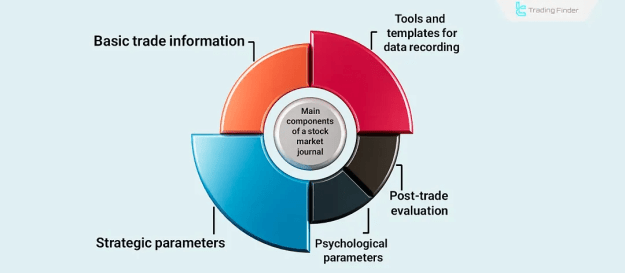
Key Components of a Stock Market Journal
A well-designed journal has a clear structure that supports analysis.
1. Basic Trade Information
- Date and time
- Symbol
- Buy or sell
- Entry/exit price
- Trade size
- Profit or loss
2. Strategic Details
- Strategy or signal
- TP/SL levels
- Timeframe
- Market conditions (trend, volume, news)
3. Psychological Notes
- Mental state at entry
- Reactions to price movements
- Compliance with trading rules
4. Post-Trade Evaluation
- Did the trade follow the plan?
- What caused profit or loss?
- Mistakes to avoid
- Lessons learned
5. Tools for Recording
- Notebook
- Excel or Google Sheets
- Professional journal software
Consistency is more important than the format.
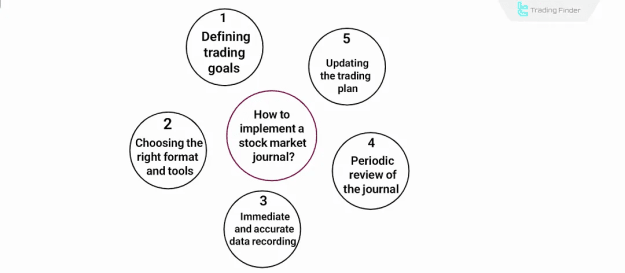
How to Use a Stock Market Journal Effectively
Step 1: Define Your Goals
Examples: Improve R/R, reduce overtrading, evaluate a specific strategy.
Step 2: Select a Format
Choose based on trading frequency and experience.
Step 3: Record Trades Immediately
Instant recording ensures accuracy and prevents memory errors.
Step 4: Review Weekly or Monthly
Calculate performance metrics and identify recurring behavioral or technical issues.
Step 5: Adjust Your Trading Plan
Use journal insights to revise strategies, entries, exits, and position sizing rules.
Example of a Stock Market Journal in Practice
A trader buys a stock after a breakout at 4,500, sets SL at 4,300 and TP at 5,000.
Price hits the target within three days, generating an 11% gain.
After three months:
- 25 trades recorded
- 16 wins → 64% win rate
- Most common mistake: entering too early before confirmation
This discovery leads to more disciplined and systematic execution.
Conclusion
A stock market journal is more than a record of trades—it is a continuous learning system. By combining quantitative data, strategic notes, and psychological insights, it helps traders improve discipline, reduce mistakes, and enhance long-term profitability.
Consistent journaling transforms everyday market activity into actionable knowledge and supports steady progress in the financial markets.