



Prop Firm DrawDown Protector : Prop Firm Capital Protection Expert MT4 | Forex Money Management: Forex Trade Management Expert MT4 |ICT Concepts Indicator MT4 | Smart Money Concepts Expert MT4| Smart Money Trap Scanner | Get a free Expert Advisor license via Telegram and WhatsApp
What is a Forex Journal?
A Forex journal is an analytical and introspective tool utilized for recording the comprehensive details of every trade executed in the international currency market. Beyond simply listing the entry and exit points, this journal encapsulates critical information such as:
- Reasons for entry (technical or fundamental conditions)
- Trade volume and risk management applied
- The trader's psychological state at the moment of decision-making
The principal objective of maintaining such a journal is optimization—to create full transparency in the trading process and to provide reliable data necessary for an impartial evaluation of individual trade performance.
Advantages and Disadvantages of a Forex Journal
Empirical studies among active Forex traders demonstrate a compelling correlation: those who consistently use a trading journal have been able to reduce their repetitive mistakes by more than 30% within three to six months. However, the journal also presents certain limitations.
Key Benefits (Advantages)
- Increased discipline and consistency in trading execution.
- Accurate identification of the strengths and weaknesses within the implemented strategies.
- Enhanced control over emotions and improved management of trader psychology.
- Measurable improvement in long-term performance and the quality of decision-making.
Potential Drawbacks (Disadvantages)
- Requires significant time and attention to record granular details.
- Risk of inconsistency and incomplete data entry if neglected.
- Possibility of misleading analysis if the recorded data is inaccurate or biased.
- May feel restrictive to some traders who prefer a high degree of spontaneity.
What Information Should Be Recorded in a Forex Journal?
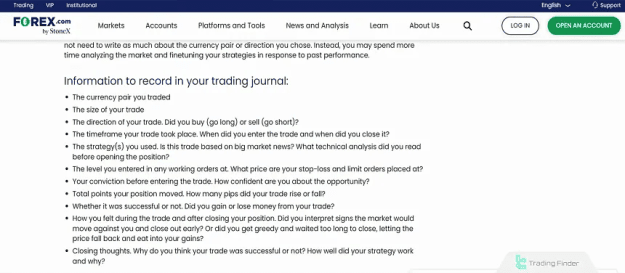
A Forex journal becomes truly effective only when key data from each trade is recorded regularly and accurately. This data forms the essential foundation for analyzing personal trading performance and subsequent strategy adjustments.
Essential Data Points for Recording
- Date and Time of Trade: Helps identify the timeframes exhibiting the highest success/error rates and allows for a review of the precise market conditions at that moment.
- Currency Pair or Traded Asset: Recording the symbol helps determine which assets yield the best performance for the trader's specific strategy.
- Trade Volume and Risk Level: Documents the application of capital management and verifies whether the position size was appropriate relative to the total capital.
- Reasons for Entering the Trade: Includes detailed explanations rooted in technical, fundamental, or mixed analysis, crucial for separating logical decisions from emotional ones.
- Trade Result (Profit or Loss): Recording outcomes numerically and as a percentage enables a statistical evaluation of the strategy's effectiveness.
- Trader Emotions and Thoughts During the Trade: This section is vital for personal psychology management, as most incorrect decisions are rooted in feelings of excitement or stress.
Formats and Tools for a Forex Journal
The effectiveness of recording and analyzing Forex trades hinges on utilizing the right format and tools, which should align with the trader's style, volume, and analytical depth.
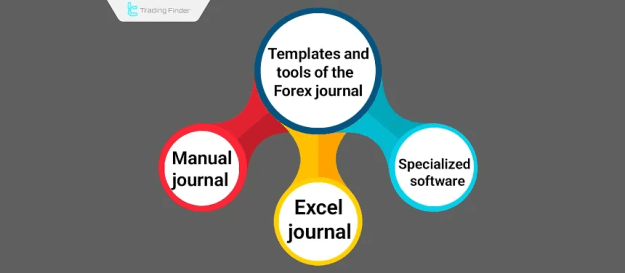
Types of Forex Journal Formats and Tools
- Manual Journal (Notebook or Trading Diary):
- A traditional method effective for traders who prioritize detailed introspection.
- Manual recording enhances mental accuracy and strengthens personal discipline.
- Limitation: Data analysis is time-consuming and prone to calculation errors.
- Excel or Google Sheets Journal:
- The most common digital format among professional traders due to flexibility.
- Allows creation of a precise, analyzable structure using columns for date, symbol, entry/exit points, Risk-to-Reward (R/R) ratio, and result.
- Advantage: Flexibility and the capability to automatically calculate statistical indicators (e.g., Win Rate or Expectancy).
- Specialized Forex Journal Software:
- Platforms like TraderSync, Edgewonk, and Myfxbook are powerful solutions.
- These programs automatically import trading account data, calculate statistical ratios, and provide detailed, visualized reports on performance, recurring mistakes, and strengths.
- Main Advantage: Automation of trade recording and specialized psychological analysis.
- Limitation: Often requires a paid subscription or API connection.
Tips for Improving a Forex Journal for Continuous Growth
The Forex journal must function beyond a mere record-keeping tool; it should be a dynamic system for feedback and personal development. The goal is to transform raw data into a practical methodology for consistent profitability.
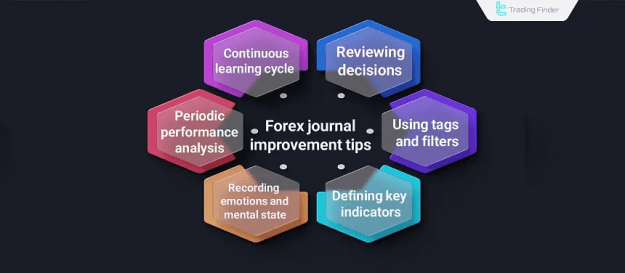
Key Practices for Journal Optimization
- Periodic Performance Review: Review trading results at least weekly. Examining the Win Rate, R/R ratio, and account growth percentage helps identify structural and behavioral patterns, facilitating early correction of weaknesses.
- Recording Emotions and Mental State Before a Trade: Crucial for emotional control. Documenting stress level, confidence, and mental condition helps pinpoint when most decision-making errors occur.
- Defining Personal Key Performance Indicators (KPIs): Metrics like the "ratio of disciplined trades to total trades" or "percentage of entries strictly following the plan" offer a more accurate assessment of progress.
- Using Tags and Analytical Filters: Tagging trades based on strategy, timeframe, or market condition can reveal hidden performance patterns. Filtering data helps understand which market environments yield the highest returns.
- Reviewing Non-Systematic Decisions: Separately analyze all trades executed outside the established strategy. This data is fundamental for understanding "emotional behaviors." The aim is to systematically reduce such actions.
- Creating a Continuous Learning Feedback Loop: Adjusting parameters (e.g., changing stop-loss levels, modifying timeframes, or removing low-quality setups) should lead to clear, actionable decisions. This cycle is the basis of real growth, making decisions more logical and systematic over time.
Conclusion
A Forex journal is fundamentally an analytical tool for engineering trading behavior and improving decision-making quality, not just a record of transactions. Traders who consistently document their trades develop a profound insight into their strategy weaknesses, psychological errors, and the structure of their decision-making process. An effective journal yields tangible results only when it is actively treated as a learning system. Regular data analysis, adherence to measurable metrics, and the vital connection between trade results and the trader's emotions and mental states transform trading from a series of random actions into a systematic, controllable, and profitable process.
 What is a Forex Journal_ Recording Trading Information.pdf
2.2 MB
|
29 downloads
|
Uploaded Dec 5, 2025 5:53am
What is a Forex Journal_ Recording Trading Information.pdf
2.2 MB
|
29 downloads
|
Uploaded Dec 5, 2025 5:53am