

Prop Firm DrawDown Protector : Prop Firm Capital Protection Expert MT4 | Forex Money Management: Forex Trade Management Expert MT4 |ICT Concepts Indicator MT4 | Smart Money Concepts Expert MT4| Smart Money Trap Scanner | Get a free Expert Advisor license via Telegram and WhatsApp
Understanding Binary Options Capital Management
Capital management in binary options is a defined set of rules implemented to strictly control the size of each trade and limit overall risk exposure. The high-risk, two-state structure of binary options necessitates a rigorous approach to Binary Capital Management to prevent consecutive losses from rapidly depleting an account. The primary goal is to set a small, specific percentage of the total equity for each position, thus mitigating severe account drawdowns or equity swings.
Essential Rules for Capital Management in Binary Options
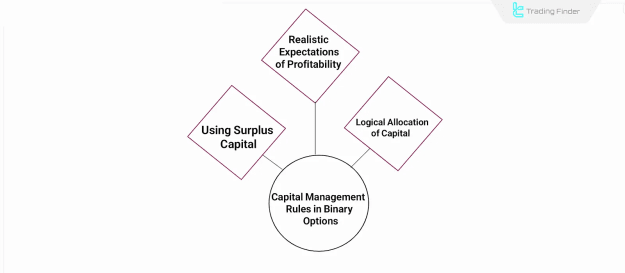
Binary options thrive in a high-risk, high-volatility environment. Without precise rules, even a robust analytical strategy can fail due to rapid account drawdown. The following rules are critical for protecting principal capital:
- Utilize Discretionary Income: Only risk capital that is not essential for daily living or emotional security. Trading with financially or emotionally dependent funds compromises rational decision-making and promotes risky behaviors like overtrading in Binary Options Trading.
- Implement Moderate Allocation: The size of any individual trade should constitute a small percentage of the total account—typically recommended between 1% and 3%. Excessive risk makes recovery exponentially harder (e.g., a 10% loss demands an 11.1% gain to recover). Proper allocation is key to Risk Reduction and trading stability.
- Maintain Realistic Growth Expectations: Sustainable profitability in Binary Investment is a gradual process, constrained by the market's payout structure. Accepting this prevents unreasonable increases in trade volume and the assumption of irreversible risks. Focus on consistent, gradual growth to build a stable equity curve.
Example of Capital Management: A trader with a $1000 account applies a 3% daily risk limit. This sets the maximum daily loss at $30. Because a binary investment results in either a high-percentage profit or a total loss of the risked amount, this strategy ensures that even after 10 consecutive days of losses, $700 of the original capital remains, demonstrating the protective value of capital management.
Common Capital Management Strategies in Binary Options
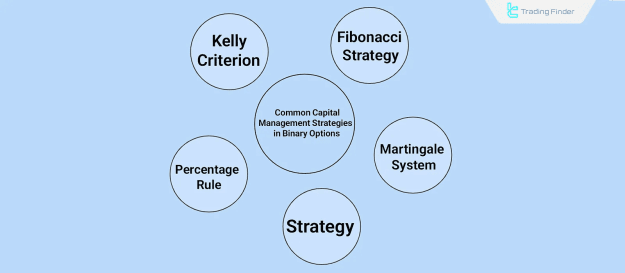
Beyond the basic rules, specific strategies are employed for advanced risk control and account growth in Binary Options Capital Management.
The Percent Rule
This strategy involves allocating a fixed percentage (commonly 1% to 3%) of the total capital to every trade.
- Advantage: Provides consistent risk control and significantly reduces the chance of a total wipeout during losing streaks, promoting stability.
- Drawback: Can lead to slower balance growth compared to more aggressive methods in Binary Options Trading.
Doubling Up Strategy
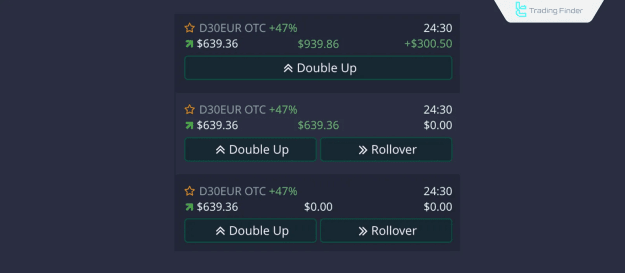
Offered by some brokers, this allows a trader to double the size of an already profitable position shortly before its expiry.
- Application: It should only be used when a trading signal has high confidence and the account has sufficient equity to absorb the doubled risk should the market reverse. This is an advanced technique in Binary Capital Management.
Martingale System
The Martingale system involves doubling the trade size after every loss so that the next win theoretically recovers all previous losses.
- Risk: The continuous growth of losses during a prolonged negative streak presents a severe risk of an account call.
- Alternative: The Anti-Martingale system reverses this, decreasing position size after a loss and increasing it after a win to maintain a more consistent Fixed Risk relative to Floating Risk.
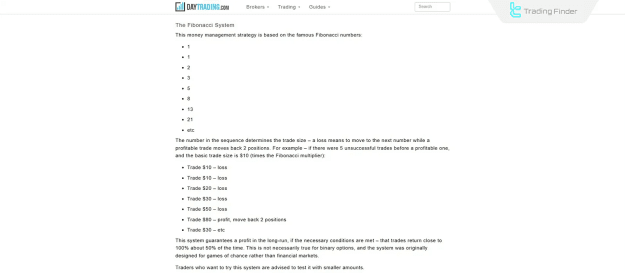
Fibonacci Strategy
Position size is determined by the Fibonacci sequence (1, 1, 2, 3, 5, 8...).
- Execution: After a loss, the trade size increases (moves right along the sequence); after a win, it decreases (moves left).
- Challenge: While it allows for gradual loss recovery, a prolonged negative streak can induce significant financial and psychological pressure, especially during high Price Volatility of the Underlying Asset.
Kelly Criterion
This is a mathematical formula used to calculate the optimal risk percentage ($f$) based on the estimated probability of winning ($p$) and the trade payout ratio ($b$).
The formula is given by:
$$f = p - \frac{(1-p)}{b}$$
- Goal: To maximize long-term capital growth.
- Difficulty: Requires the trader to accurately estimate the win probability in the real market, which is often challenging.
Lesser-Known Capital Management Strategies in Binary Options
Professional traders often use supplementary strategies to optimize returns in specific market conditions:
- Capital Efficiency Strategy: Focuses on optimizing the utilization of capital to reduce incidental trading costs and enhance overall returns.
- Liquidity Management Strategy: Involves reserving a portion of capital as a buffer. This ensures the trader has sufficient funds during adverse conditions or unexpected market opportunities, regardless of the fluctuating Number of Trades.
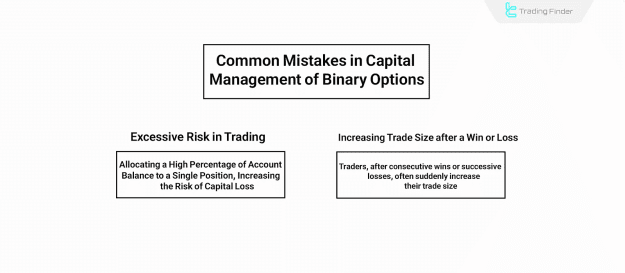
Common Mistakes in Binary Options Capital Management
Effective capital management demands avoiding common behavioral and computational errors. Heavy losses often result from these mistakes, regardless of the analytical strategy used.
- Excessive Risk per Trade: Allocating a high percentage of the account balance to a single position dramatically increases the probability of a rapid wipeout over just a few losing trades. Maintaining balanced position size is critical due to the two-outcome nature of the market.
- Sudden Position Size Increase After a Win or Loss:
- Winning Streak: Can lead to false confidence and over-leveraging.
- Losing Streak: Can result in increasing size for recovery (revenge trading).
Both are driven by emotional decisions, putting equity at serious risk due to weakened Emotional Control.
Diversification in Binary Options
Diversification is a crucial technique in Binary Capital Management. By limiting capital exposure to a single Underlying Asset, the overall risk is reduced.
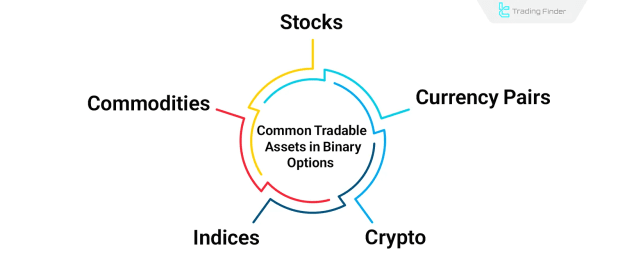
- Execution: A trader should allocate capital across various assets, such as currencies, stocks, commodities, or indices, allowing losses in one sector to be potentially offset by gains in others.
Conclusion
Capital Management in Binary Options is the definitive factor for survival and sustainable profitability. Adherence to basic rules—using discretionary capital, moderate allocation, and maintaining realistic expectations—forms the foundation of financial discipline in Binary Options Trading. While strategies like the Percent Rule, Martingale, Fibonacci, and the Kelly Criterion are effective practical tools, their success is contingent upon a full understanding of their limitations and a firm commitment to avoiding common mistakes such as excessive risk-taking.