

Prop Firm DrawDown Protector : Prop Firm Capital Protection Expert MT4 | Forex Money Management: Forex Trade Management Expert MT4 |ICT Concepts Indicator MT4 | Smart Money Concepts Expert MT4| Smart Money Trap Scanner | Get a free Expert Advisor license via Telegram and WhatsApp
Advantages and Disadvantages of Scaling in Trading
The application of scaling in trading facilitates risk management and optimizes entry and exit points. Nevertheless, insufficient experience or inadequate emotional discipline during scaling can result in a margin call.
Advantages
- Improves risk and emotional management
- Reduces psychological pressure in trading
- Optimizes trade entry and exit points
- Increases profit potential and reduces loss potential
Disadvantages
- Requires high experience and skill
- Full control over emotions is necessary
- Risk of margin call if applied incorrectly or emotionally
- Time-consuming
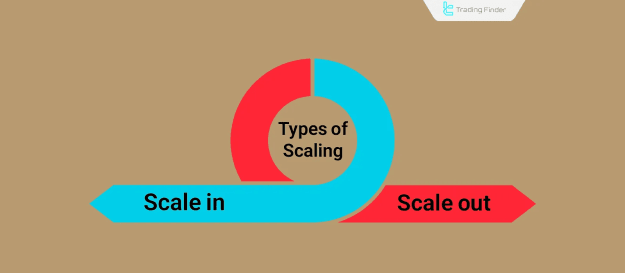
Types of Scaling in Trading
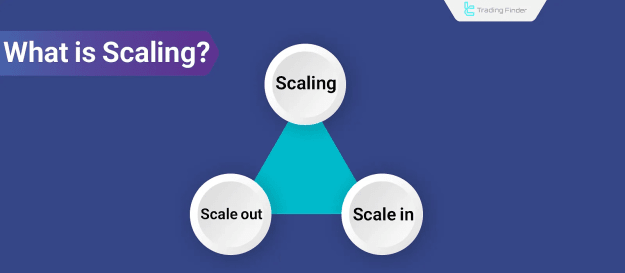
Broadly, scaling in trading encompasses two primary categories, each addressing either gradual entry into trades (Scale In) or gradual exit from trades (Scale Out):
- Scale In: Gradual entry into trades
- Scale Out: Gradual exit from trades
Scaling When Entering a Trade (Scale In)
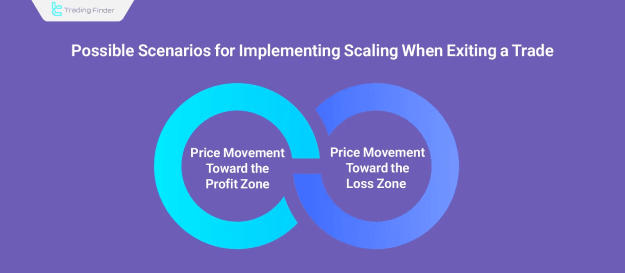
There are two principal scenarios for scaling during trade entry:
- Price movement toward the profit zone
- Price movement toward the loss zone
Price Movement Toward the Profit Zone
In this scenario, a fraction of the allocated capital is committed at the designated entry point. Should the price advance as anticipated, the residual capital is introduced via one or more orders at distinct price levels aligned with the trade direction.
Each order necessitates an independent stop loss and take profit to uphold comprehensive risk and capital management. The most secure stop loss positioning is at the entry price of each order, minimizing potential losses in the event of a market reversal.
Price Movement Toward the Loss Zone
If the price deviates from the initial projection and enters the loss zone, a robust technical justification and evident reversal signal must precede the addition of remaining capital. Absent such indicators, further commitments will expedite capital depletion and heighten the risk of a margin call.
Scaling When Exiting a Trade (Scale Out)
The exit strategy in scaling varies according to whether the price progresses toward profit or loss. In either case, scaling out diminishes the ultimate loss but also curtails the ultimate profit.
Price Movement Toward the Loss Zone
When scaling out amid losses, potential reversal zones must be predetermined. Upon breach of these zones, a segment of the position is liquidated to decelerate equity drawdown. If the price subsequently reverses toward profit, the retained position may recoup a portion of the prior loss.
Price Movement Toward the Profit Zone
In this context, critical support and resistance levels—such as Fibonacci retracements, swing highs, and swing lows—are identified along the profit trajectory. Contingent on the trading strategy, portions of the position are closed at these levels, securing gains and augmenting realized profit to the account margin.
By realizing partial profits and relocating the stop loss to breakeven, the trade attains a risk-free status. Although this diminishes the final profit potential, it concurrently lowers trading risk and promotes sustained account growth.
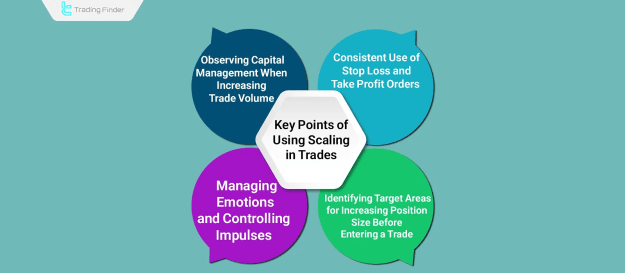
Key Points in Using Scaling in Trading
Employing scaling as a risk management technique entails inherent risks. Disregarding these considerations may elevate the probability of a margin call.
Conclusion
The scaling technique in trading enables the attainment of optimal average entry and exit prices. When implemented correctly, it can amplify profit potential from individual trades.
In volatile markets, traders encounter intensified psychological pressure and an elevated risk of emotional decision-making.