

You can access the Indicator from this link:
https://tradingfinder.com/products/i...imodo-pattern/
You can access the Indicator on the TradingView website:
https://www.tradingview.com/script/H...and-Shoulders/
Prop Firm DrawDown Protector : Prop Firm Capital Protection Expert MT5 |Forex Money Management: Forex Trade Management Expert MT5 | ICT Concepts Indicator MT5 |Smart Money Concepts Expert MT5 | Smart Money Trap Scanner |Get a free Expert Advisor license via Telegram and WhatsApp
Indicator Overview and Key Features
This indicator serves as a crucial tool for price action trading, providing clear signals for potential price reversals. By automatically identifying the QM pattern on a chart, it helps traders pinpoint optimal entry points, as well as logical take-profit and stop-loss levels. The indicator's effectiveness is enhanced by its compatibility with various trading styles and instruments.
- Indicator Categories: The Quasimodo Pattern Indicator falls under Price Action TradingView Indicators, Signal & Forecast TradingView Indicators, and Chart & Classic TradingView Indicators.
- Trading Skills: This indicator is best suited for intermediate traders.
- Indicator Types: It functions as a Reversal TradingView Indicator, a Leading TradingView Indicator, and a Non-Repaint TradingView Indicator.
- Timeframe: The indicator is a Multi-Timeframe TradingView Indicator, making it versatile for different trading strategies.
- Trading Styles: It supports a wide range of trading approaches, including Fast Scalper TradingView Indicators, Day Trading TradingView Indicators, Scalper TradingView Indicators, and Swing Trading TradingView Indicators.
- Trading Instruments: The indicator is applicable across various markets, including Forex, Cryptocurrency, Stock, Commodity, and Indices TradingView Indicators.
Understanding the QM Pattern in an Uptrend
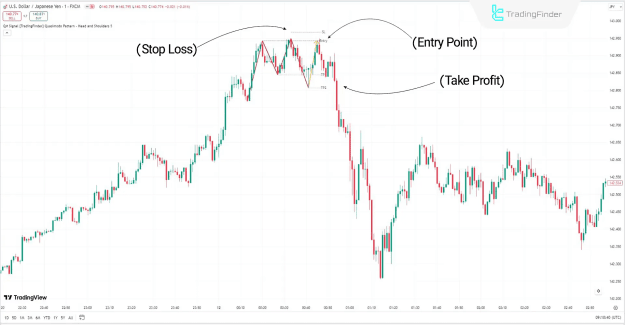
In an uptrend, the QM pattern signals a potential bearish reversal. The indicator identifies this sequence of events:
- A sustained uptrend leads to the formation of a left shoulder.
- The price then creates a new peak, known as the head, which is higher than the left shoulder's peak.
- The price drops, breaking below a previous low to create a CHOCH (Change of Character).
- The price then rallies back up to a level approximately equal to the peak of the left shoulder.
Once this pattern is complete, the indicator signals a potential sell trade.
- Take-Profit and Stop-Loss: For a bearish QM pattern, the indicator sets the stop-loss above the highest point (the head) and the take-profit at the last low where the CHOCH occurred.
Understanding the Inverse QM Pattern in a Downtrend
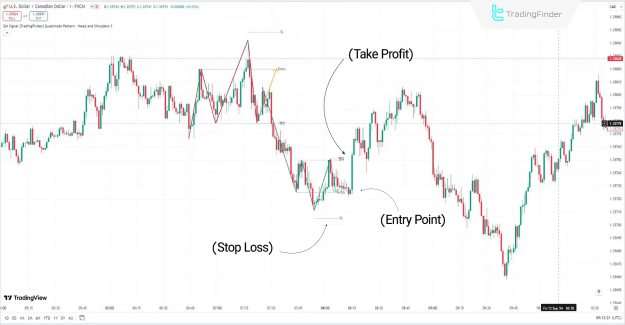
Conversely, the Inverse QM pattern signals a potential bullish reversal during a downtrend. The indicator detects the following:
- A sustained downtrend leads to the formation of a left shoulder.
- The price then creates a new valley, the head, which is lower than the left shoulder's valley.
- The price rises, breaking above a previous high to create a CHOCH.
- The price then pulls back down to a level approximately equal to the valley of the left shoulder.
When this pattern is complete, the indicator suggests a potential buy trade.
- Take-Profit and Stop-Loss: For a bullish Inverse QM pattern, the indicator sets the stop-loss below the lowest point (the head) and the take-profit at the last high where the CHOCH occurred.
Indicator Settings
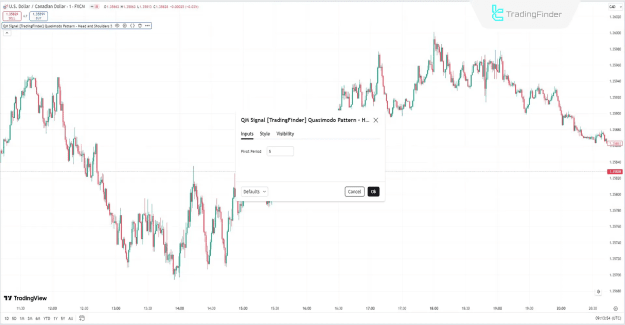
The Quasimodo Pattern Indicator offers customizable settings. The primary setting is the Pivot Period, which is typically set to 5. This allows the indicator to adjust its sensitivity to different market conditions and timeframes.
Conclusion
The Quasimodo Pattern, or QM, is a reliable and frequently occurring technical analysis pattern. This price action indicator automates the identification of the QM pattern, removing the need for manual chart analysis. By utilizing this indicator, traders can focus on confirming their trades with other tools such as trend direction, support and resistance levels, and supply and demand zones, thereby increasing the likelihood of successful trading decisions.