

Prop Firm DrawDown Protector : Prop Firm Capital Protection Expert MT4 |Forex Money Management: Forex Trade Management Expert MT4 |ICT Concepts Indicator MT4 | Smart Money Concepts Expert MT4| Get a free Expert Advisor license via Telegram and WhatsApp
What is an A-Book Broker?
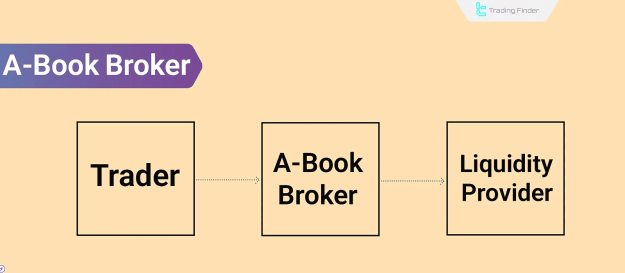
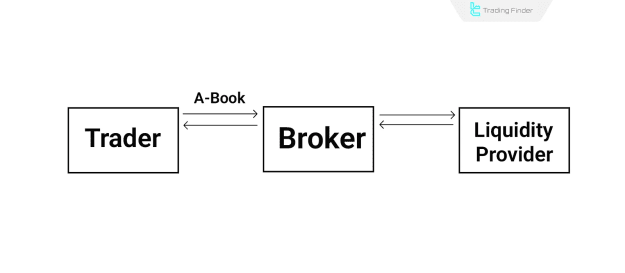
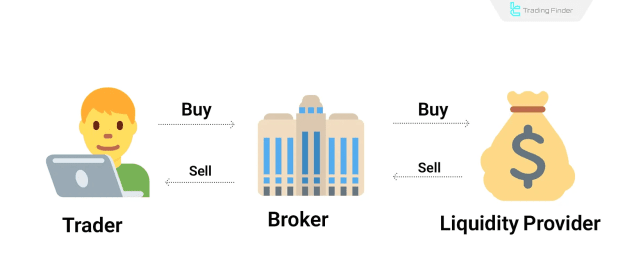
An A-Book broker is a firm that, upon receiving a client's trade order, simultaneously opens a corresponding and offsetting position with a Liquidity Provider (LP). This action is designed to remove market exposure from the broker’s own books, shifting the risk to the LP.
Within this framework, the broker functions primarily as a conduit, generating income from spreads or commissions charged on trades. This is fundamentally different from a B-Book broker, which internalizes client orders and profits directly from client losses.
Understanding Risk Transfer and Hedging in the A-Book Model
In the A-Book model, the process of eliminating market risk is known as hedging or risk transfer. To achieve this, the broker opens a reverse position with a reputable counterparty. This counterparty, or Liquidity Provider, can be a major bank, a non-bank market maker, a hedge fund, or another institutional broker that consistently provides tradable quotes.
The broker's hedging action ensures that its own financial position is shielded from the volatility of the market and the outcome of the client’s trade.
How Trades are Executed with an A-Book Broker
When a client places an order with an A-Book brokerage, the following sequence of events occurs:
- The broker logs the client's order internally, acting as the immediate counterparty.
- Simultaneously, the broker opens an equivalent and parallel position with a Liquidity Provider.
- This external position is referred to as a "Hedge Position."
This dual-positioning strategy places the broker in a net-zero exposure state. Any profit or loss generated by the client's trade is precisely offset by the opposing result from the hedge position with the liquidity provider.
Example: A Trader's EUR/USD Buy Order
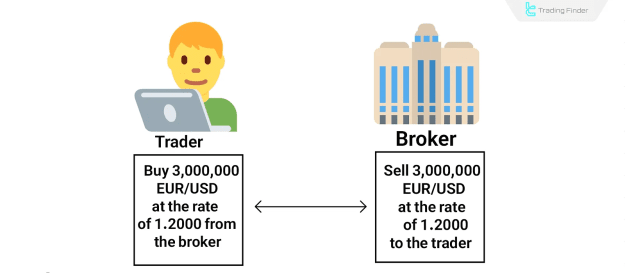
Consider a trader who initiates a buy order for 3 million euros against the US dollar (EUR/USD) at a price of 1.2000. Under the A-Book model, the broker would:
- Hold a short position against the trader.
- Simultaneously, hold a long position with the Liquidity Provider.
This structure ensures that the broker's position is neutralized, regardless of subsequent price movements.
Analysis of Price Scenarios
The broker's balanced position means their P&L remains at zero, regardless of whether the price rises or falls.
- Price Rise: If the EUR/USD price increases, the trader profits. The broker, as the counterparty, must pay this profit. However, the broker's long position with the LP also generates an identical profit. The broker's net result is zero.
- Price Fall: If the EUR/USD price falls, the trader incurs a loss, which the broker gains. Simultaneously, the broker's long position with the LP results in a matching loss. The broker's net result is again zero.
The A-Book Broker as a Counterparty
A common misconception is that an A-Book broker directly forwards a client's order to the liquidity provider. In reality, the transaction remains between the trader and the broker. The broker is the official counterparty to the trade. The process is not a "direct transfer of an order" but a "position mirroring" where the broker opens a separate, parallel position with an LP to hedge its own risk.
Advantages and Disadvantages of the A-Book Structure
The A-Book model, like any execution method, has distinct advantages and disadvantages that traders must consider.
- Advantages:
- Execution Transparency: The model provides a clear view of trade execution.
- No Conflict of Interest: The broker's earnings are not dependent on a client's losses, which builds trust.
- Risk Management: The model aligns with sound risk management principles by hedging exposure.
- Suitability for Scalping: Its transparent and swift execution makes it ideal for high-frequency trading styles like scalping.
- Disadvantages:
- Dependence on Liquidity: The quality of execution is heavily reliant on the liquidity provider.
- Slippage and Requotes: In volatile markets, traders may experience slippage or requotes.
- Higher Operational Costs: The infrastructure and partnerships required for hedging lead to higher structural costs for the broker.
- Order Rejection: In periods of extreme market stress or high volume, some orders may be rejected.
Conclusion
The A-Book model represents a transparent, risk-hedging mechanism where brokers transfer market risk to liquidity providers. By opening a parallel position with an LP, the broker eliminates any conflict of interest with the client. The broker remains the direct counterparty to the trade, effectively mirroring the client's position with the LP. While this model offers key benefits such as genuine execution and transparency, it also presents challenges like a dependency on liquidity and the potential for slippage.