

Prop Firm DrawDown Protector : Prop Firm Capital Protection Expert MT4 |Forex Money Management: Forex Trade Management Expert MT4 |ICT Concepts Indicator MT4 | Smart Money Concepts Expert MT4| Get a free Expert Advisor license via Telegram and WhatsApp
What is the Martingale Strategy?
The Martingale strategy is a position scaling method designed to help traders recover from losses by systematically increasing investment volume after each losing trade. The objective is to return to profitability and offset previous losses with a single successful trade. A typical execution involves doubling the trade volume at each entry level, as shown below:
- First Entry: 10 units
- Second Entry: 20 units
- Third Entry: 40 units
- Fourth Entry: 80 units
- Fifth Entry: 160 units
Crucial Note: It is essential for traders to predetermine the total number of entry levels and ensure that cumulative losses remain within their defined risk capacity. Failing to do so can lead to a complete loss of capital and a margin call.
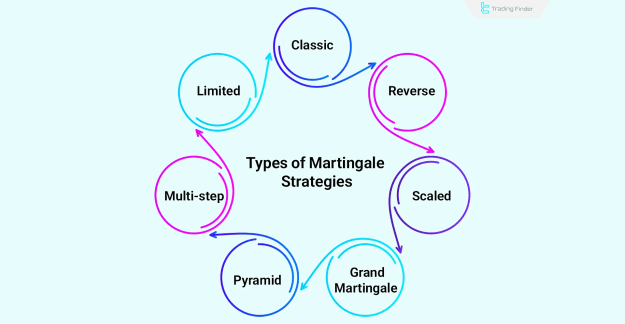
Types of Martingale Strategies
There are several variations of the Martingale strategy, each with a distinct approach to risk and volume management.
Classic Martingale
This is the most straightforward and highest-risk variant. Position size is doubled after every losing trade, aiming for a single winning trade to recoup all prior losses. Due to the rapid escalation of risk, this method is highly dangerous during extended losing streaks and requires disciplined risk and capital management.
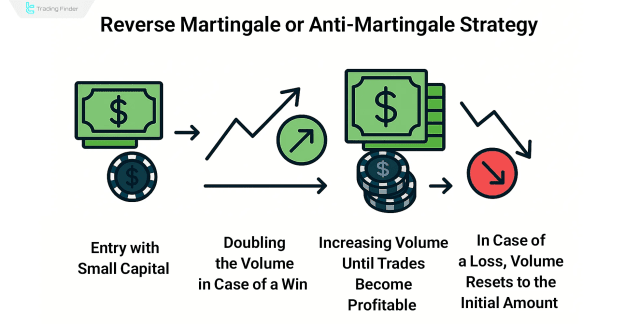
Reverse Martingale (Anti-Martingale)
In contrast, the Reverse Martingale strategy involves increasing position size after a winning trade and decreasing it after a loss. This approach seeks to maximize profits by capitalizing on strong market trends (both bullish and bearish) while minimizing losses during unfavorable periods.
Scaled Martingale
With this method, trade volume is increased by a fixed percentage after losses, rather than being doubled. This creates a smoother volume curve, making it a less aggressive approach to recovering losses. Consecutive losses must be carefully analyzed to avoid total account depletion.
Limited Martingale
This variation introduces a predefined limit on the number of doubling steps. Traders establish a fixed number of steps based on their capital management strategy to keep risk within acceptable boundaries and prevent catastrophic losses.
Multi-step Martingale
This discretionary approach allows the trader to vary trade volume at each step based on detailed market analysis. The decision on the appropriate volume for each new entry is informed by key technical levels, such as support and resistance.
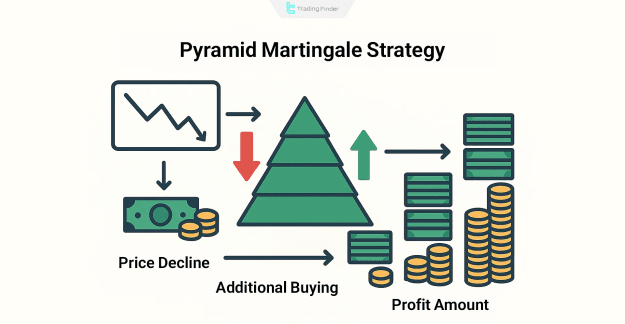
Pyramid Martingale
The Pyramid Martingale is particularly effective in trending markets. A trader increases the position size on subsequent successful trades in the direction of the trend. This is done to maximize profits from the trend's continuation.
Grand Martingale
The Grand Martingale is an advanced form of the strategy. After each losing trade, the position size is not only doubled but also increased by an additional fixed unit. This accelerated approach aims to recover losses more quickly but also carries a significantly higher risk compared to the classic method.
Advantages and Disadvantages of the Martingale Strategy
The Martingale method offers notable benefits but also carries substantial risks.
- Advantages:
- Facilitates rapid recovery of previous losses.
- Offers high potential for significant returns.
- Relatively simple to implement at a basic level.
- Disadvantages:
- Exposes capital to an extremely high risk of loss.
- Requires a large amount of capital to sustain multiple losses.
- Can have a negative psychological impact on traders due to high-stakes decisions.
- Prone to misuse without proper risk management.
- Provides no guarantee of long-term profitability.
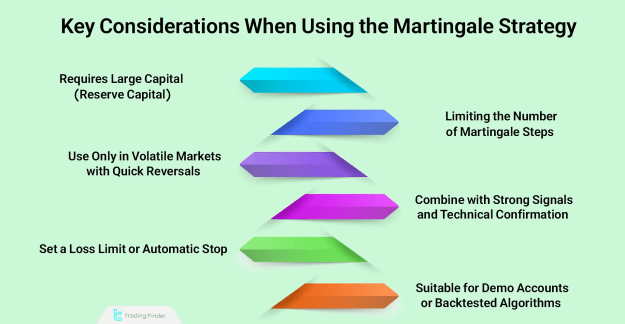
Key Considerations for Using the Martingale Strategy
The Martingale strategy is a high-risk technique that must be implemented with strict discipline and a robust risk management framework.
- Capital Requirements: A substantial capital reserve is essential to withstand multiple consecutive losses and avoid margin calls.
- Limiting Steps: To mitigate risk, it is highly recommended to limit the number of Martingale steps to a maximum of 3 to 5.
- Market Conditions: This strategy is most effective in volatile markets with frequent price reversals, such as forex or cryptocurrencies, and is ill-suited for strongly trending environments.
- Technical Confirmation: The initial trade entry must be based on solid technical analysis and not solely on the Martingale concept.
- Loss Caps: Always define a strict loss threshold or stop-limit to prevent a full account wipeout.
- Testing: Always test the strategy on a demo account or through backtesting before applying it to live trading.
Conclusion
The Martingale strategy is a powerful capital management technique used in financial trading to recover losses by increasing position size after losing trades. While its various forms, including the Classic, Pyramid, and Grand Martingale, can be effective in restoring profitability, the method is inherently high-risk. Successful implementation requires a deep understanding of market dynamics, disciplined risk control, and a substantial capital reserve. Its application, particularly in volatile markets like forex and crypto, demands technical proficiency and emotional discipline.