

Prop Firm DrawDown Protector : Prop Firm Capital Protection Expert MT4 |Forex Money Management: Forex Trade Management Expert MT4 |ICT Concepts Indicator MT4 | Smart Money Concepts Expert MT4| Get a free Expert Advisor license via Telegram and WhatsApp
What Is the ICT 30 Pip Trading Setup?
The ICT 30 Pip Trading Setup utilizes a Top-Down Analysis to systematically define the daily bias and identify precise entry and exit points. This process involves:
- Higher Timeframes (HTF): Used to determine the overall market bias and to identify significant swing points.
- Lower Timeframes (LTF): Employed to pinpoint the exact trade entries and exits after the bias has been established.
The Role of Key ICT Concepts
This strategy is fundamentally dependent on a few core ICT principles that govern price action analysis.
Draw On Liquidity (DOL)
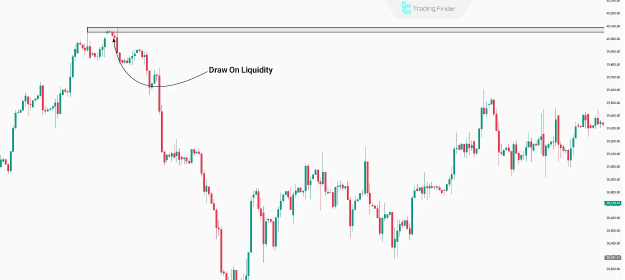
In the ICT methodology, price is analyzed based on its movement toward areas of concentrated liquidity. Draw On Liquidity (DOL) refers to this phenomenon, where price is attracted to regions with the highest available liquidity. In the context of the ICT 30 Pips a Day Strategy, DOL is primarily used to identify take-profit levels. Potential DOL zones can include:
- Equal Highs or Lows
- Previous highs or lows
- Significant support or resistance levels
Optimal Trade Entry (OTE)
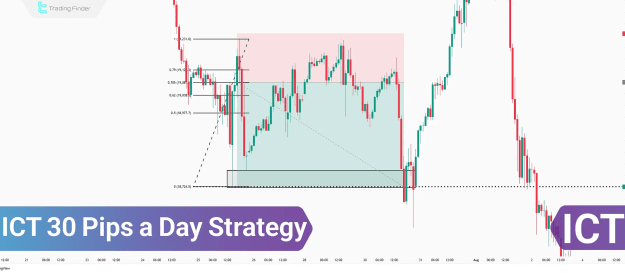
Optimal Trade Entry (OTE) zones are considered the most efficient areas to enter a trade within the ICT framework. These zones are defined using a Fibonacci retracement tool and represent a favorable area for a price reversal to occur. The key Fibonacci levels used to identify the OTE are:
- 0
- 0.5
- 0.62
- 0.705
- 0.79
- 1
Steps for Trading the ICT Daily 30 Pips Strategy
This strategy follows a three-step process, moving from high-level market analysis down to a specific trade entry.
Step 1: Identifying the Daily Bias
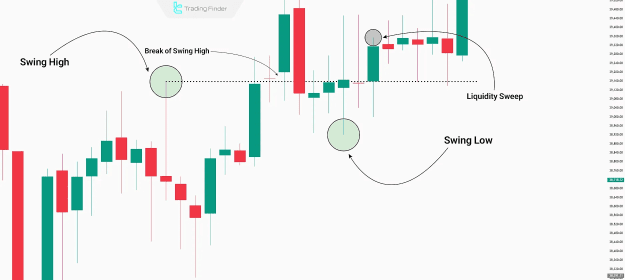
The process begins by observing the daily timeframe for a break of a Swing High or Swing Low.
- Bullish Bias: A bullish bias is established after a Swing High is broken. The trader then waits for a Swing Low to form without breaking the prior low. Confirmation is sought through a liquidity sweep above the high of the third candle following the Swing Low.
- Bearish Bias: A bearish bias is established after a Swing Low is broken. The trader then waits for a Swing High to form without breaking the prior high. Confirmation is sought through a liquidity sweep below the low of the third candle following the Swing High.
Step 2: Identifying the Next Probable DOL
Once the daily bias is confirmed, the trader identifies the next probable Draw On Liquidity (DOL) zone in the direction of the bias. This DOL serves as the primary target for the trade.
Step 3: Entering the Trade Using OTE
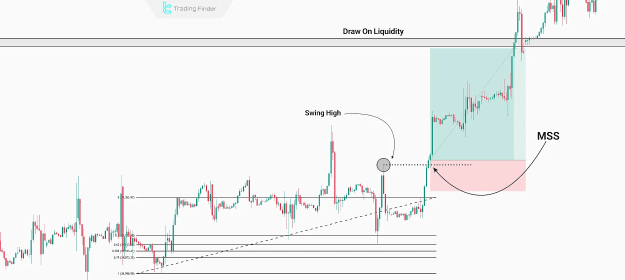
With the daily bias and DOL target defined, the trader waits for a price retracement back into the Optimal Trade Entry (OTE) zone of the third candle after the swing. A trade is only entered upon confirmation by an ICT reversal concept, such as a Market Structure Shift (MSS) or a Change in Delivery (CISD).
- For a Bullish Bias: Enter a long position after the retracement and confirmation via a Market Structure Shift.
- For a Bearish Bias: Enter a short position after the retracement and confirmation via a Change in Delivery.
Additional Notes for Using the ICT 30 Pip Trading Setup
To maximize the effectiveness of this strategy, consider the following best practices:
- Trading Time: The setup is most effective when applied during the London and New York "Kill Zones," which are periods of high market liquidity.
- Risk Management: Given the scalping nature of the strategy, risk should be strictly limited to 1–2% per trade.
- Risk-Reward Ratio: Only enter trades that offer a minimum risk-reward ratio of 1:2 or greater.
Advantages and Disadvantages
This strategy offers several benefits but also comes with certain limitations that traders must be aware of.
Advantages
- High potential win rate.
- Directly applies and reinforces core ICT concepts.
- Offers favorable risk-reward ratios.
Disadvantages
- The setup process can be time-consuming, sometimes taking several days to form.
- Requires a deep understanding of ICT concepts and considerable experience to execute effectively.
- The number of trading opportunities per week is typically low.
Conclusion
The ICT 30 Pips a Day Strategy is a day trading and scalping method built upon core ICT concepts such as Optimal Trade Entry (OTE), Draw on Liquidity (DOL), and Market Structure Shift (MSS). By employing a Top-Down Analysis approach, this strategy aligns trade entries with the daily trend, which enhances the probability of success and the overall quality of trades. Its disciplined application, particularly during key trading sessions like the London and New York Kill Zones, and adherence to a strict risk management protocol, makes it an effective framework for traders seeking to consistently capture a minimum of 30 pips per trading opportunity.