

Prop Firm DrawDown Protector : Prop Firm Capital Protection Expert MT4 |Forex Money Management: Forex Trade Management Expert MT4 |ICT Concepts Indicator MT4 | Smart Money Concepts Expert MT4| Get a free Expert Advisor license via Telegram and WhatsApp
What Is Money Management?
Money management serves as a cornerstone of account control in trading. It involves employing diverse strategies to maximize account returns while simultaneously minimizing risk. This comprehensive approach considers several key factors to control potential losses and plan for anticipated profits.
Key Components of Money Management
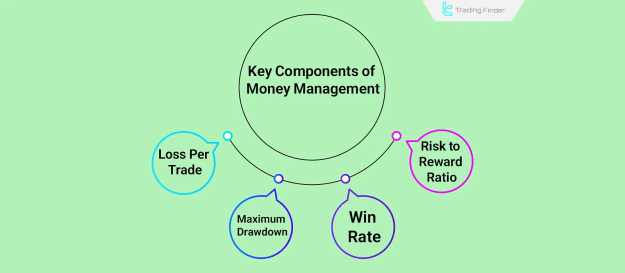
To establish robust money management rules, traders must analyze several critical factors:
- Risk-to-Reward Ratio: This fundamental ratio indicates the potential profit units for every unit of risk taken.
- Strategy Win Rate: This metric represents the percentage of winning trades compared to losing trades.
- Maximum Drawdown: This defines the maximum acceptable loss the total capital can endure.
- Loss Per Trade: This specifies the permissible loss for each individual trade.
Benefits of Money Management in Trading
Effective money management offers significant advantages for traders, fostering sustained market activity and enhancing the overall return rate of trading strategies. Key benefits include:
- Market Continuity: Ensures long-term participation in financial markets.
- Capital Preservation: Safeguards a substantial portion of capital, especially during periods of losing trades.
- Reduced Stress and Pressure: Alleviates emotional burden during trading activities.
- Increased Account Return Rate: Contributes to improved profitability over time.
Why Is Money Management Important?
Given that no trading strategy guarantees a 100% success rate, the possibility of price movements contrary to a trader's analysis always exists. In such scenarios, effective money management becomes indispensable for preserving capital, creating opportunities for subsequent trades, and offsetting prior losses. It is vital for increasing overall profits and maintaining the ability to continue operating in the market.
Factors Influencing Money Management
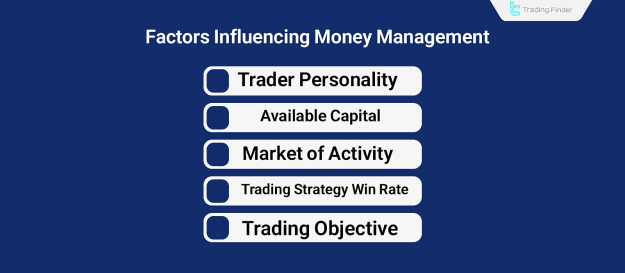
The implementation of money management strategies is highly customizable and depends on several individual and market-related factors:
- Trader Personality: A trader's risk tolerance directly influences trade size and chosen markets.
- Capital Size: The amount of available capital dictates market activity and reasonable risk levels per position.
- Market Type: Different markets exhibit varying levels of volatility and risk, impacting how risk is assessed and managed.
- Win Rate: The success rate of a trading strategy influences the appropriate money management techniques.
- Trading Goals: Whether the objective is long-term growth or short-term gains, trading goals shape money management styles.
Difference Between Money Management and Risk Management
While often used interchangeably, money management and risk management have distinct focuses:
- Money Management: A broader concept encompassing both profits and losses in trading. It dictates how capital is allocated and utilized.
- Risk Management: A more specific approach primarily focused on managing losses and preserving assets during adverse market conditions.
Types of Money Management Methods
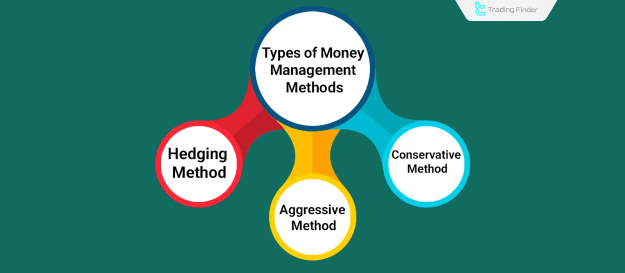
Money management strategies are typically categorized into three main types based on a trader's risk appetite:
- Conservative Method: Emphasizes reducing investment risk through asset diversification across various markets and instruments. A significant portion of capital is often held in cash to ensure liquidity for opportune trades.
- Aggressive Method: Focuses on maximizing profits by accepting higher levels of risk. This involves investing in high-risk assets and allocating a larger portion of capital per trade, often utilizing leverage to amplify returns, thereby increasing associated risks.
- Hedging Method: Utilizes various trading styles, such as hedging, to mitigate risk and enhance investment returns. This may involve investing in markets with negative correlation, where a profit from one trade can offset a loss from another.
Popular Money Management Techniques
Several popular techniques can be employed to tailor money management to specific trading strategies, each varying in risk tolerance and expected return:
- The 2% Rule: This rule dictates risking no more than 2% of the account balance per trade, regardless of previous outcomes. This approach promotes consistent account growth during profitable periods and slows capital depletion during losing streaks.
- Martingale Technique: A high-risk technique where the position size is doubled after every losing trade. The aim is for a winning trade to recover prior losses and generate profit. However, consecutive losses can quickly lead to margin calls.
- Anti-Martingale Technique: In contrast, this technique involves halving the position size after a losing trade. This significantly reduces the rate of capital depletion and minimizes the risk of a margin call, though it requires more winning trades to fully recover previous losses.
- Portfolio Rebalancing: This method involves adjusting the allocation of capital within a portfolio. For instance, if one investment becomes highly profitable, a portion of the profit is reallocated to other underperforming or newly identified opportunities to maintain a desired asset distribution.
Conclusion
Effective money management is defined by various elements of a trading plan, including the trader's personality, trading objectives, strategy win rate, and capital size. Factors such as the risk-to-reward ratio, Maximum Drawdown, and per-trade stop-loss are critical for its effectiveness. Generally, money management in trading is categorized into conservative, aggressive, and hedging approaches, each offering different risk tolerances and return potentials.