

TP & SL Tool: Risk Reward Ratio Calculator RRR MT5 | Prop Firm Protector: Trade Assist Prop Firm Plus TF Expert MT5 | Money Management + DrawDown Protector: Trade Panel Prop Firm Drawdawn Limiter Pro MT5 |Get a free Expert Advisor license via Telegram and WhatsApp
By eliminating internal market risk, STP brokers avoid conflicts of interest and do not profit from client losses. This structure ensures price transparency, access to authentic market rates, and generally efficient trade execution.
Defining STP Brokers
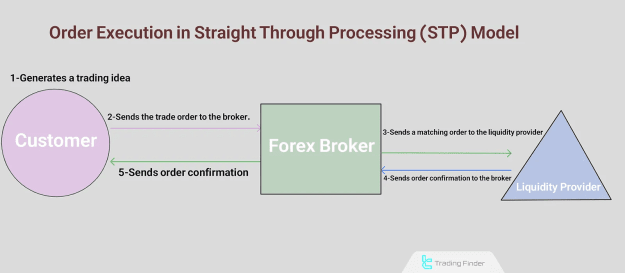
STP brokers operate through a fully automated system that processes orders instantly with no human interference. When a trader places an order, the broker simultaneously matches it with a Liquidity Provider to hedge risk before execution.
Key characteristics of STP brokers include:
- Pre-Trade Hedging: Risk is transferred to the LP prior to order execution.
- No Dealing Desk: Orders are processed electronically without manual intervention.
- Reduced Broker Exposure: Brokers minimize market risk by hedging client trades.
- Possible Increased Slippage: Execution speed may be marginally slower compared to other models, potentially increasing slippage.
Comparing STP with the A-Book Model
The primary distinction between STP and A-Book models lies in the timing of the broker’s hedging:
- STP (Pre-Trade Hedging): The broker hedges the client’s order with an LP before executing the trade.
- A-Book (Post-Trade Hedging): The broker executes the client order first, then hedges the resulting risk afterward.
Comparison Highlights:
- Execution Speed: STP typically offers slower execution; A-Book is faster.
- Slippage Risk: STP may have higher slippage risk; A-Book usually experiences less.
- Broker Market Risk: STP brokers have minimal market risk; A-Book brokers assume maximum risk.
- Price Transparency: Both models maintain high transparency.
- Revenue Generation: Both earn via commission or markup fees.
Leading STP Brokers in the Market
Several brokers are recognized for offering reliable STP execution, including:
- Axiory
- InstaForex
- FxGlory
- FXOpen
These brokers provide STP accounts with transparent pricing and competitive spreads suitable for various trader profiles.
Advantages of Trading with STP Brokers
STP brokers provide numerous benefits for traders and brokers alike:
- Risk-Free Broker Model: Brokers transfer market risk to LPs through pre-trade hedging.
- Transparent Pricing: Traders receive prices that closely reflect the real market.
- Aligned Interests: Brokers earn from trade volume rather than client losses, fostering better alignment with trader success.
- Reduced Conflict of Interest: Since brokers do not profit from client losses, incentives are aligned.
What is Slippage?
Slippage refers to the difference between the expected trade price and the actual execution price. It may be positive or negative depending on market conditions.
STP brokers minimize losses due to slippage by securing matching trades with LPs prior to executing client orders. For example, if a trader wishes to buy at 1.1000, the broker ensures the LP can provide the asset at a close price, such as 1.0999.
The Riskless Nature of STP Trading
STP brokers engage in what is called riskless principal trading by simultaneously conducting two offsetting transactions:
- Purchasing the asset from the Liquidity Provider.
- Selling the asset to the client at the same price plus a markup or commission.
Thus, the broker’s market risk is virtually eliminated, as all client trades are hedged immediately.
Broker Roles: Agent vs. Principal
Brokers may act in two capacities when handling orders:
- Agent Broker: Simply routes client orders to LPs without taking a position.
- Principal Broker: Acts as the counterparty to the client’s trade.
While STP brokers technically become principals by taking the opposite side, they effectively operate as agents by hedging immediately with LPs, avoiding market exposure.
Revenue Generation in STP Brokerage
STP brokers generate income transparently through two primary methods:
- Markup: Adding a small spread to the LP’s quoted price (e.g., offering EUR/USD at 1.1002 when the LP price is 1.1000).
- Commission: Charging a fixed fee per trade, common in ECN/STP account types.
Key Points on STP Broker Earnings:
- Brokers do not profit from client losses.
- Their earnings increase as traders place more orders.
- The model encourages brokers to support trader profitability.
Summary
The Straight Through Processing (STP) model is designed to provide a transparent, efficient, and risk-averse trading environment. By pre-hedging client orders with Liquidity Providers, brokers eliminate market risk and conflicts of interest. STP brokers earn revenue exclusively through markups and commissions, aligning their success with that of their clients.