

TP & SL Tool: Risk Reward Ratio Calculator RRR MT5 | Prop Firm Protector: Trade Assist Prop Firm Plus TF Expert MT5 | Money Management + DrawDown Protector: Trade Panel Prop Firm Drawdawn Limiter Pro MT5 |Get a free Expert Advisor license via Telegram and WhatsApp
What Are Elliott's Corrective Waves?
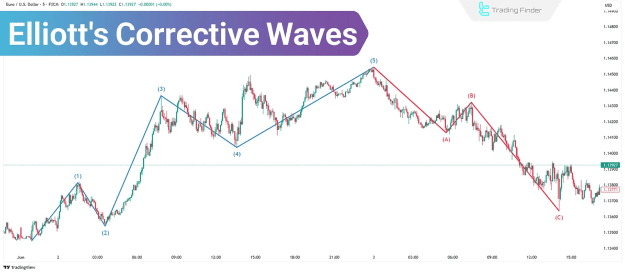
Corrective Waves represent temporary reversals or retracements of the primary price movement. While they move contrary to the main trend, they are not powerful enough to alter its overall direction. Their purpose is to reverse a portion of the main trend before the primary movement resumes. Typically, corrective waves consist of three sub-waves and are denoted as A-B-C.
Advantages and Disadvantages of Elliott Corrective Waves
Corrective waves offer both opportunities and analytical challenges for traders.
Advantages
- Optimal entry opportunities: Identifying the completion of a corrective wave can signal ideal moments to enter trades in the direction of the main trend.
- Trend forecasting: Understanding corrective patterns helps in predicting the continuation of the underlying trend.
- Trend health assessment: Corrective waves provide insights into the strength and sustainability of the primary trend.
Disadvantages
- Complexity in identification and analysis: The varied and often intricate nature of corrective patterns makes them difficult to accurately identify.
- Uncertainty in retracement depth: The extent to which a corrective wave will retrace the prior impulse is often unpredictable.
- Potential for misleading signals: Incorrect identification can lead to erroneous trading decisions.
- Requires advanced tools and knowledge: Successful application demands a deep understanding of Elliott Wave principles and often specialized analytical tools.
Types of Elliott's Corrective Waves
Corrective Wave Patterns are generally categorized into two main types, reflecting different aspects of market correction. These structures offer insights into future price movements.
Time Corrections
Time-based Corrective Waves refer to corrections where the duration plays a significant role. Longer corrective periods often result in wider price retracements, indicating a more prolonged consolidation phase.
Price Corrections
Conversely, Price Corrections are typically faster and sharper, occurring over shorter time intervals. These are divided into several distinct patterns, each with its own internal structure:
- Zigzag Corrective Wave:
- This is a three-wave structure (A-B-C) that moves sharply against the primary trend, often indicating deep market corrections and strong reversal points.
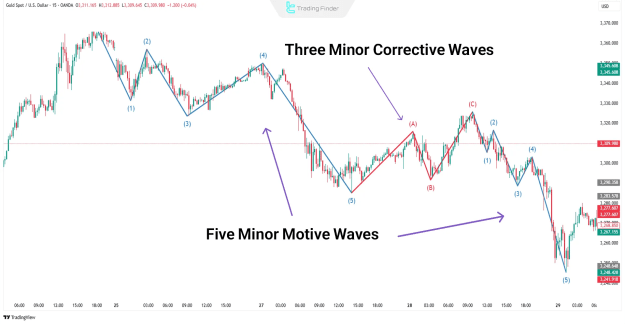
- Waves A and C are five-wave motive patterns.
- Wave B is a three-wave corrective structure.
- Flat Corrective Wave:
- In a Flat Corrective Wave Pattern, price moves horizontally within a relatively defined range, signaling a pause in price action.
- This pattern is a three-wave corrective structure (A-B-C).
- Waves A and C can consist of either three or five smaller waves.
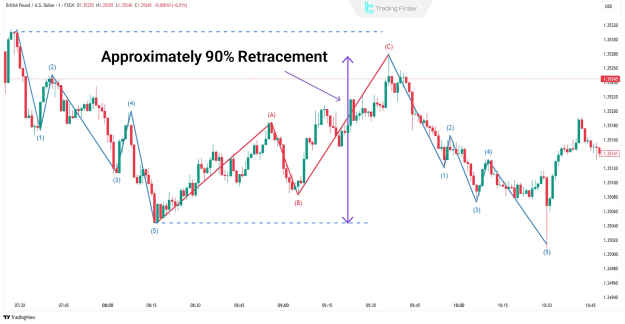
- Wave B is a three-wave corrective move that typically retraces approximately 90% of Wave A.
- Triangle Corrective Wave:
- Triangle Corrective Waves frequently form during price consolidation, acting as a trend continuation formation.
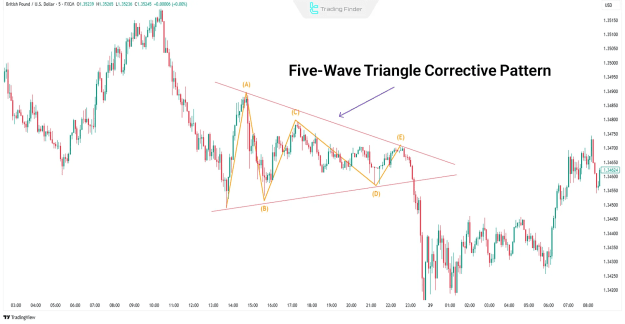
- They consist of five smaller corrective waves (A-B-C-D-E) that converge to form a triangle shape, bounded by support and resistance lines.
- Upon breakout from the triangle, the main trend is expected to resume.
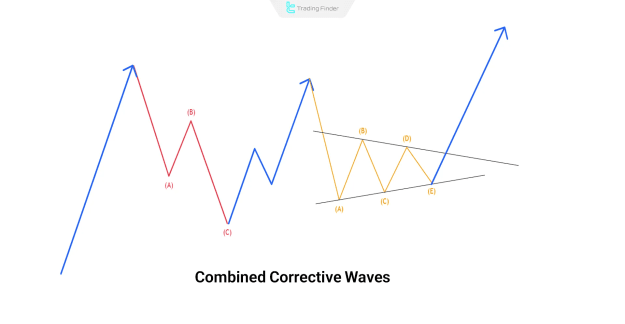
- Combined Corrective Waves:
- When multiple corrective patterns occur simultaneously or sequentially, they form Combined Corrective Waves.
- These involve two or three different corrective structures linked by connecting waves (often labeled 'X'), creating complex and extended corrections.
Rules of Elliott Corrective Waves
Despite their inherent complexity, Elliott's Corrective Waves adhere to specific rules that aid in their identification and interpretation in technical analysis:
- Corrective waves never retrace 100% of the preceding main trend. If a complete retracement occurs, it indicates a change in the primary trend rather than a correction.
- In most cases, corrective waves form a three-wave structure (A-B-C). While variations exist (e.g., triangles with five waves), the three-wave core structure is fundamental.
- Wave B cannot be larger than Wave A. As a corrective move, Wave B should not exceed the length of Wave A.
Difference Between Corrective and Motive Waves
Understanding the distinctions between Corrective Waves and Motive Waves is fundamental to applying Elliott Wave Theory effectively.
- Movement Direction: Corrective Waves move opposite to the main trend, whereas Motive Waves move in line with the main trend.
- Wave Structure: Corrective Waves typically consist of three waves (A-B-C), while Motive Waves are composed of five waves.
- Strength and Momentum: Corrective Waves are generally weaker and lack the strong momentum seen in Motive Waves.
- Formation Duration: Corrective Waves can be long-lasting, representing prolonged consolidation, while Motive Waves tend to form more quickly.
- Role in Market Trend: Corrective Waves act as a pause for trend continuation, whereas Motive Waves indicate the core move of the trend.
Conclusion
Elliott's Corrective Waves manifest in various forms, consistently moving against the primary trend. Crucially, they do not reverse the main trend but rather retrace a portion of it, most commonly appearing as a three-wave pattern (A-B-C). These corrective movements prepare the market for the continuation of the underlying trend and strictly adhere to established rules of corrective wave structures, providing valuable insights for traders in financial markets.