

TP & SL Tool: Risk Reward Ratio Calculator RRR MT4 | Prop Firm Protector: Trade Assist Prop Firm Plus TF Expert MT4 | Money Management + DrawDown Protector: Trade Panel Prop Firm Drawdawn Limiter Pro MT4 |Get a free Expert Advisor license via Telegram and WhatsApp
Pros and Cons of Using the Exponential Moving Average
While many traders favor the EMA for its effectiveness, especially in swing trading strategies, it's important to understand its advantages and disadvantages.
Pros:
- Quick reaction to sudden market changes: The EMA's sensitivity allows it to react faster to price shifts compared to other indicators.
- Ideal for short-term trading: Its responsiveness makes it a powerful tool for scalpers and intraday traders.
- Effective in crossover strategies: The EMA is a key component in moving average crossover strategies to generate buy and sell signals.
Cons:
- Complexity in interpretation: The indicator can be more challenging for traders to interpret due to its rapid fluctuations.
- Higher risk of false signals: In weak or sideways trends, the EMA is more prone to generating misleading signals.
- Requires precise settings: The effectiveness of the EMA is highly dependent on using the correct period settings, which may vary across different markets and strategies.
How to Calculate and Apply the Exponential Moving Average
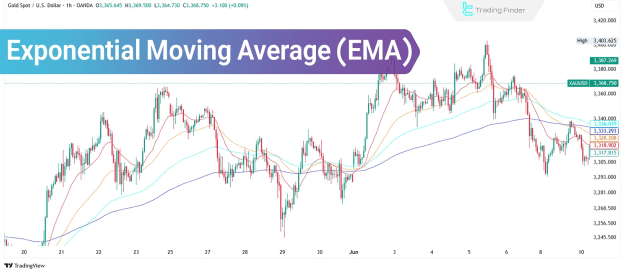
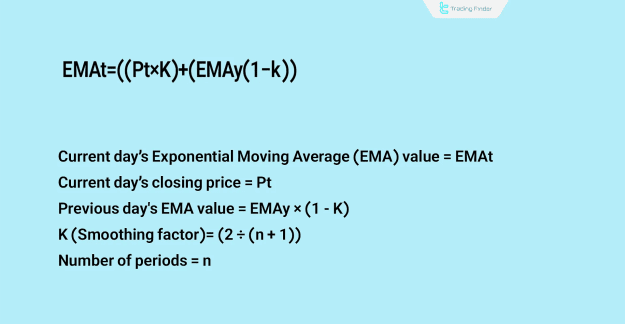
The Exponential Moving Average uses a more complex formula than the Simple Moving Average (SMA). While the specific formula involves several variables, its main application in technical analysis is to identify trends and dynamic support and resistance levels. The EMA can also generate buy and sell signals when it crosses over the price chart.
It is crucial to note that relying solely on the EMA is not recommended due to the high risk of error. For optimal performance, the EMA should be combined with other technical analysis tools to confirm signals and validate trading decisions. A common practice is to use multiple EMAs simultaneously, where crossovers between the lines provide entry and exit signals.
EMA Trading Example: Generating a Sell Signal
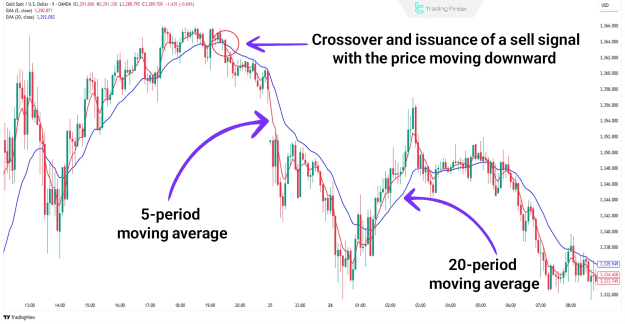
A classic example of an EMA trading strategy involves using two different periods, such as a 5-period EMA and a 20-period EMA.
- A sell signal is generated when both EMAs are positioned above the asset's price, and the shorter-period EMA (the 5-period) crosses below the longer-period EMA (the 20-period).
This configuration suggests a potential shift to a bearish trend, providing a clear signal for a short position.
Popular EMA Trading Strategies
The responsiveness of the Exponential Moving Average makes it a versatile indicator for various trading strategies, particularly those suited for short-term and scalping styles.
- EMA with Other Indicators: Combining the EMA with tools like the Relative Strength Index (RSI) or Stochastic Oscillator for signal confirmation.
- Multiple EMAs: Utilizing several EMAs (e.g., 5-period, 20-period, 50-period) to identify trend strength and potential crossover signals.
- EMA and Price Action: Integrating the EMA with price action analysis to confirm trend direction and identify key support/resistance areas.
- Golden Cross Strategy: A long-term EMA strategy where a short-term EMA crossing above a long-term EMA signals a strong bullish trend.
EMA vs. SMA: Key Differences
The core difference between the Exponential Moving Average (EMA) and the Simple Moving Average (SMA) lies in their sensitivity to price changes.
- EMA: Highly sensitive and responsive, making it ideal for short-term, volatile markets where rapid trend changes are common.
- SMA: Less reactive and smoother, which makes it more suitable for long-term timeframes and identifying the overall, overarching market trend.
Best EMA Settings for Different Timeframes
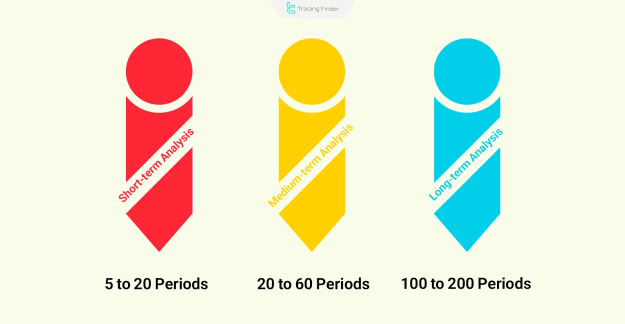
Choosing the right EMA settings is critical for effective trading. Different periods are recommended based on the analysis timeframe:
- Short-term analysis (scalping/day trading): Use periods from 5 to 20.
- Medium-term analysis (swing trading): Use periods from 20 to 60.
- Long-term analysis (trend following): Use periods from 100 to 200.
These recommended settings help traders tailor the indicator to their specific trading strategy and market conditions.
Conclusion
The Exponential Moving Average (EMA) is an essential tool for trend-following traders, offering a significant advantage over the Simple Moving Average (SMA) due to its faster reaction to price changes. Its responsiveness allows it to generate multiple signals, especially in short-term periods, making it highly useful for capturing numerous trading opportunities. By combining the EMA with other analytical tools and strategies, traders can create a robust and effective approach to navigating various financial markets.