

TP & SL Tool: Risk Reward Ratio Calculator RRR MT5 | Prop Firm Protector: Trade Assist Prop Firm Plus TF Expert MT5 | Money Management + DrawDown Protector: Trade Panel Prop Firm Drawdawn Limiter Pro MT5 |Get a free Expert Advisor license via Telegram and WhatsApp
Definition of the Diamond Pattern
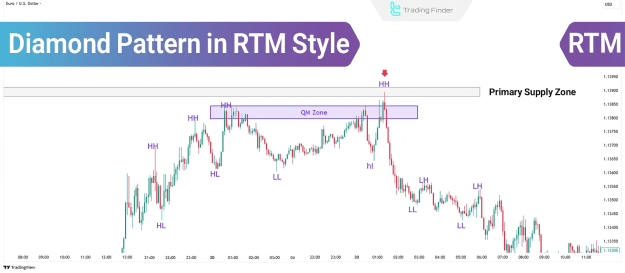
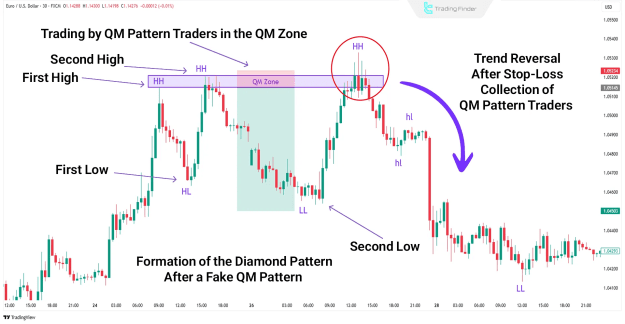
The RTM diamond pattern emerges as a reversal setup, commonly appearing after a Quasimodo (QM) pattern has been violated. Its formation is contingent on price revisiting the QM Zone without a typical Quasimodo reaction. Instead, price sweeps through traders' stop-losses within this zone. Following this liquidity grab, the price reverses, and the diamond pattern materializes.
During the formation of an RTM diamond pattern, stop-losses of five distinct groups of traders are typically triggered:
- Sellers at the first high
- Buyers at the first low
- Sellers at the second high
- Buyers at the second low
- Sellers within the QM Zone
How to Spot a Diamond Pattern
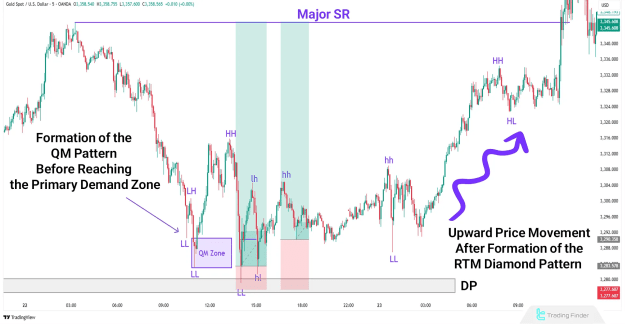
Identifying the RTM diamond pattern requires a strong understanding of RTM supply and demand zones, ensuring that the setup is only acted upon when it appears in a valid price area. The pattern commonly surfaces when price has not yet reached the primary supply or demand zone, and a Quasimodo setup fails to confirm. This means a fake QM forms before price taps the primary zone. After liquidity is taken, the diamond forms, leading to a trend reversal.
Trading Steps for the Diamond Pattern
To effectively trade the RTM diamond pattern, follow these systematic steps:
1. Identify Primary Supply and Demand Zones
Mastering elements such as FTR (Failure to Return), Flag, and DP (Drop-Base-Rally/Rally-Base-Drop) is crucial for accurately marking core RTM zones. Once a zone is plotted, confirm that price has indeed entered it, even if by a single pip.
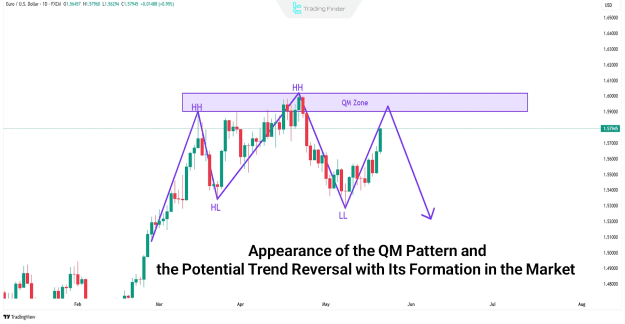
2. Spot the QM Pattern
Next, price should form a Quasimodo pattern before reaching the established zones. Traders who are less confident in their level identification often trade the Quasimodo. When their stops are hit, the probability of an RTM diamond pattern forming significantly increases. A QM stop-out can often serve as a key clue for the diamond pattern's formation.
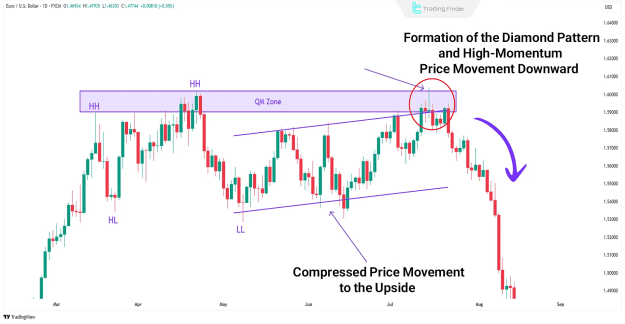
3. QM Violation and Compressed Price (CP) Move Inside the QM Zone
In most instances, during the QM violation, price exhibits a compressed price (CP) move within the QM Zone before sweeping stops. A CP move in this context is a strong indicator that an RTM diamond pattern may subsequently form.
4. Fake Break or Aggressive Reaction
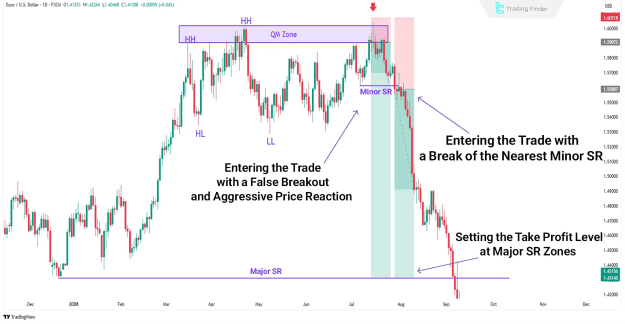
Following the violation of the QM, price must sweep stops through either a fake break or aggressive candles with long wicks. This stop sweep provides the essential liquidity that banks and institutions require, subsequently initiating a new trend.
5. Enter in the New Trend Direction
After the fake break, price typically reverses with significant momentum. Traders can enter the market using candle confirmation or technical indicators, placing their stop-loss behind the high/low created by the fake break. The take-profit target for the RTM diamond pattern is generally set at subsequent SR (Support and Resistance) levels, anticipating a sustained trend reversal.
Key Points When Using the Diamond Pattern
When employing the RTM diamond pattern in your trading strategy, keep the following crucial points in mind:
- The RTM diamond pattern becomes highly probable when the QM has not yet reached the primary supply/demand zones (e.g., FL, DP, FTR).
- If confidence is low that price will hit the primary zone, trading the QM is often recommended.
- Professional traders, once stopped out on the QM, actively look for and trade the RTM diamond pattern.
- For confirmation, wait for the nearest minor SR break. Additional technical analysis signals can also be utilized.
- After sweeping QM stops, price typically reverses with higher momentum, providing another strong clue that the Diamond Pattern in RTM Style is forming.
Conclusion
The RTM diamond pattern is a powerful reversal setup, commonly appearing at major market highs and lows. It is a clear reflection of sophisticated liquidity-gathering tactics employed by large financial institutions. This pattern emerges after a Quasimodo violation; once QM stops are swept, price often initiates a new trend with significant force. When traded correctly, the RTM diamond pattern offers attractive risk-to-reward (R:R) opportunities.