

TP & SL Tool: Risk Reward Ratio Calculator RRR MT5 | Prop Firm Protector: Trade Assist Prop Firm Plus TF Expert MT5 | Money Management + DrawDown Protector: Trade Panel Prop Firm Drawdawn Limiter Pro MT5 |Get a free Expert Advisor license via Telegram and WhatsApp
What Is the Bread and Butter Sell-Setup?
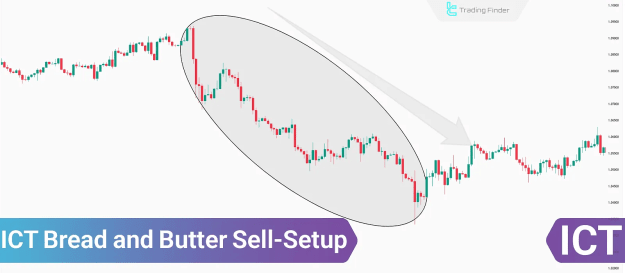
The Bread and Butter Sell-Setup thrives in scenarios where the Daily Bias is bearish. Under such conditions, price action frequently opens near or above the previous day's high at the commencement of a new trading day. This often foreshadows a liquidity grab above the preceding daily high, which then acts as a catalyst for a subsequent bearish price movement. This ICT trading strategy is precisely engineered to identify optimal short-selling entries by meticulously analyzing liquidity behavior within a prevailing bearish trend.
Advantages and Disadvantages of the ICT Bread and Butter Trading Strategy
Like all trading methodologies, the ICT Bread and Butter Sell-Setup presents a distinct set of advantages and disadvantages for traders. While it offers a relatively high frequency of entry points, its risk-to-reward ratio often remains below 1.2.
Advantages:
- High signal frequency: Provides a good number of trading signals daily.
- Comprehensive session coverage: Generates entry signals across all three major trading sessions (London, New York, and Asia).
- Trend alignment: Trades strictly in the direction of the established Daily Bias.
- Multi-timeframe analysis: Incorporates multi-timeframe analysis and structure awareness for robust decision-making.
Disadvantages:
- Lower risk-to-reward ratio: The typical risk-to-reward profile can be limited.
- In-depth knowledge required: Demands a deep understanding of liquidity behavior and ICT concepts.
- Time-dependent execution: Relies on specific times of the day for optimal signal generation.
- Signal quality variability: The quality of entry signals can be influenced by the success of preceding setups.
Role of IPDA in the ICT Bread and Butter Sell-Setup
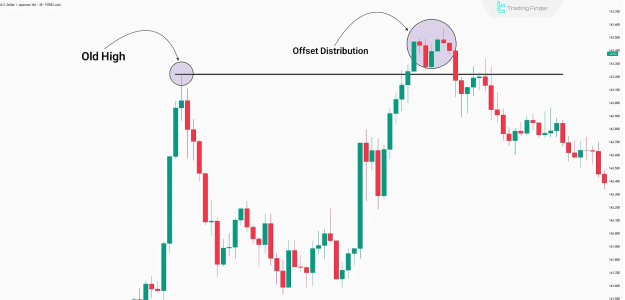
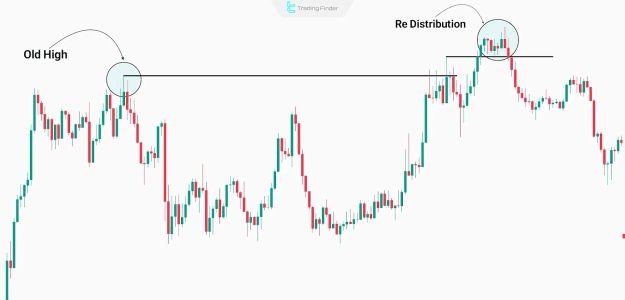
The Interbank Price Delivery Algorithm (IPDA) is a cornerstone of this strategy, operating through two distinct models: Offset Distribution and Re-Distribution.
Offset Distribution
In the Offset Distribution model, IPDA orchestrates an upward manipulation of prices beyond a prior high. This maneuver serves to halt ongoing selling pressure and accumulate the necessary liquidity to fuel the primary bearish move. This is a critical component of understanding IPDA-based price action.
Re-Distribution
The Re-Distribution model involves price movement toward buy-side liquidity, enabling Smart Money to engage at premium levels (often identified as a PD Array). This temporary bullish surge triggers the stop-losses of existing short positions, thereby supplying the essential liquidity required for the main bearish leg of the trade. This mechanism highlights the intricate interplay of liquidity pools and Smart Money entry.
Entry Signals in the ICT Bread and Butter Sell-Setup
This scalping strategy issues precise entry signals during the New York, Asian, and London trading sessions.
London Session Entry
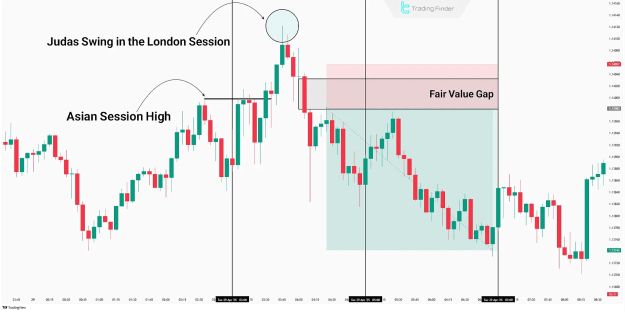
With a confirmed bearish bias, the daily high often consolidates during the London session. Typically, a bullish price move precedes the main bearish leg immediately following the 00:00 GMT open. Traders look for an entry into a Fair Value Gap (FVG) after a Judas Swing during this session.
New York Session Entry
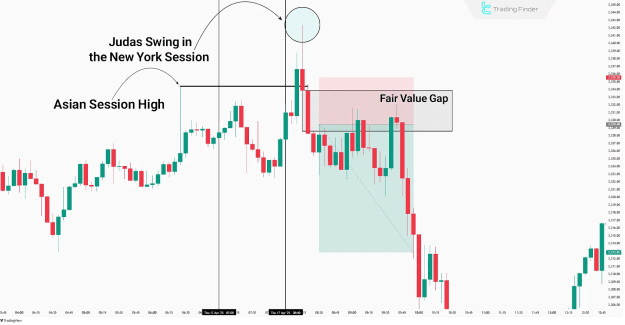
Should the daily high be confirmed in the London session, the New York session is expected to continue the bearish momentum. At the CME open (8:30 AM NY time), a Judas Swing frequently forms within the NY Kill Zone, presenting another prime sell entry opportunity. The take-profit target for these trades is commonly a Discount Array found on higher timeframes (H1, H4, or Daily charts).
Asian Session Entry
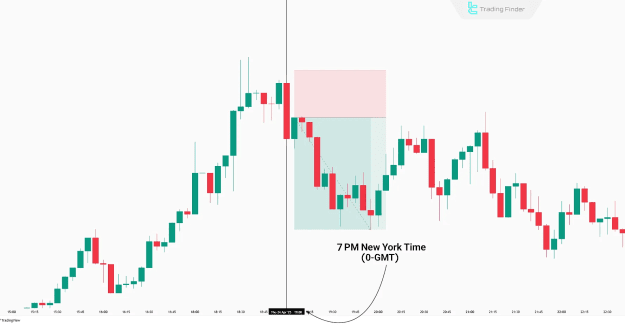
If the bearish bias is unequivocally confirmed through the London and New York sessions, initiating a short position around 7 PM NY time (0 GMT) before the Asian Session commences becomes a viable option. Due to the characteristically lower volume and slower price action in the Asian session compared to London and New York, the profit target is typically limited to 15–20 pips.
Key Features of the ICT Bread and Butter Sell-Setup
The ICT Bread and Butter Sell-Setup is optimized for scalping, providing multiple short entries daily. Its key characteristics include:
- Trade Duration: Typically 1 to 2 hours per trade.
- Trade Range: Aims for 30 to 50 pips per trade.
- Analysis Timeframe: Primarily utilizes the 5-minute chart (M5) for analysis and execution.
- Trades per Day: Generates 1 to 3 setups on average.
- Risk-to-Reward Ratio: Varies depending on specific price zones and market conditions.
- Recommended Risk: Advises a risk allocation of 0.5% to 1% per individual trade.
Conclusion
The ICT Bread and Butter Sell-Setup offers a robust and effective approach to short-term trading. By meticulously evaluating the Daily Bias, it delivers a dedicated scalping entry for each of the London, New York, and Asian sessions. With its provision of multiple daily entries and a target of 30–50 pips per trade, it stands as a formidable strategy for traders focusing on short-duration positions. This setup expertly integrates core ICT concepts, including IPDA, the Judas Swing, and Liquidity Grab mechanics, to guide precise trade execution.