

TP & SL Tool: Risk Reward Ratio Calculator RRR MT4 | Prop Firm Protector: Trade Assist Prop Firm Plus TF Expert MT4 | Money Management + DrawDown Protector: Trade Panel Prop Firm Drawdawn Limiter Pro MT4 |Get a free Expert Advisor license via Telegram and WhatsApp
Understanding Arbitrage Trading and Its Mechanisms
Arbitrage trading involves exploiting price differences for the identical asset across various markets. This strategy is deployed when an asset is traded at disparate prices across two or more markets. Arbitrage plays a crucial role in enhancing market efficiency by enabling traders to equalize asset prices between markets through their actions. Successful arbitrage demands high execution speed, precision, and careful consideration of transaction costs.
How Arbitrage Operates
Executing arbitrage trades necessitates a blend of predefined rules, specialized tools, and a thorough market understanding. Key factors in arbitrage include transfer costs, transaction confirmation time, and price volatility risk.
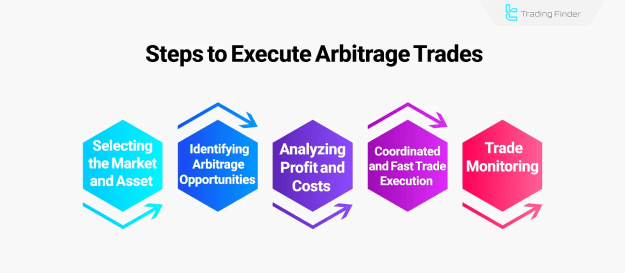
Steps to Perform Arbitrage Trades:
1. Selecting the Market and Asset:
The chosen market must exhibit high liquidity and frequent price discrepancies between platforms. Cryptocurrency markets, due to their decentralized nature and diverse exchanges, are particularly suitable for arbitrage. The selected asset directly influences the arbitrage's stability, profitability, and overall success.
2. Identifying Arbitrage Opportunities:
At this stage, traders utilize price comparison platforms and API tools to pinpoint discrepancies in buy and sell prices across markets. Latency and withdrawal limits on exchanges must be factored in when identifying such opportunities.
3. Analyzing Profit and Costs:
A precise evaluation of trading fees, withdrawal fees, and potential cross-chain transfer costs in Blockchain is essential. One must also consider spreads and real-time exchange rates in markets like Forex. Arbitrage is only viable when the price difference yields a positive net arbitrage profit after all costs are deducted.
4. Coordinated and Fast Execution:
Employing trading bots or automated arbitrage algorithms significantly enhances precision and speed during this stage. Successful execution requires seamless coordination between active accounts on two or more trading platforms.
5. Risk Control and Continuous Monitoring:
Arbitrage inherently carries various risks, such as system failures or execution issues. Exchange withdrawal suspensions, rapidly changing prices, or human errors can lead to losses.
Diverse Arbitrage Strategies
Different arbitrage strategies are dictated by market structure, asset type, and the available tools.
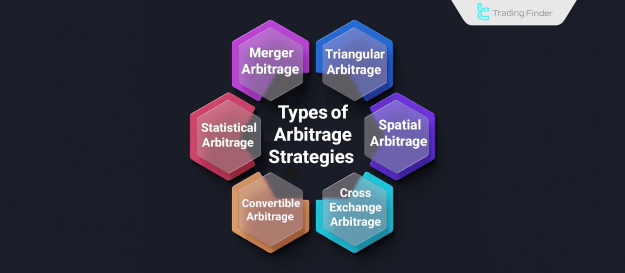
Common Arbitrage Strategies:
- Cross-Exchange Arbitrage: In this strategy, a trader purchases an asset from one exchange at a lower price and sells it on another exchange at a higher price. This form of arbitrage is prevalent in the cryptocurrency market due to its high liquidity and frequent price disparities between exchanges.
- Spatial Arbitrage: This strategy exploits price differences for an asset across different geographic markets. For instance, if a price gap exists, one might buy Bitcoin on a US-based exchange and sell it on a Canadian-based one. However, this may involve legal restrictions and international transfer costs.
- Statistical Arbitrage: This method identifies arbitrage opportunities using mathematical and statistical models. Traders employ algorithms and data-driven analysis to detect unusual price disparities and profit from them.
- Merger Arbitrage: In this strategy, a trader acquires shares of a target company involved in a merger or acquisition, anticipating that the stock price will increase after the announcement. This form of arbitrage carries risks such as failed mergers or changes in deal terms.
- Convertible Arbitrage: Here, a trader purchases convertible bonds and simultaneously sells the related stock. The objective is to profit from the bond and stock price difference. Successful execution demands detailed market analysis and effective risk management.
- Triangular Arbitrage: This involves trading between three different currency pairs within a single exchange. For example, converting USD to EUR, then EUR to GBP, and finally GBP back to USD, if exchange rates create a profitable cycle.
Arbitrage Execution Across Different Markets
Arbitrage execution varies across markets due to differences in transaction costs, liquidity levels, execution speed, and price spreads.
Arbitrage in Specific Markets:
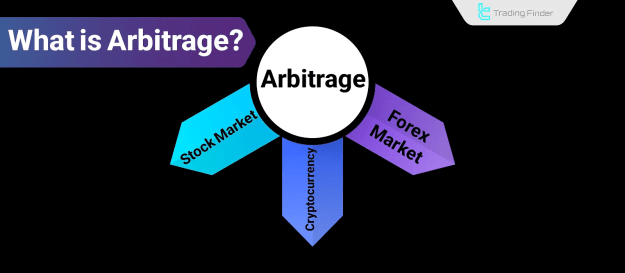
- Cryptocurrency Market Arbitrage: Given its decentralized structure and the high number of exchanges, the cryptocurrency market provides an ideal environment for cross-exchange arbitrage. Price discrepancies in this market stem from differences in liquidity, trade volume, and exchange fee policies. To perform arbitrage in this space, factors such as transfer fees, transaction confirmation times, and withdrawal limits must be meticulously evaluated.
- Forex Market Arbitrage: In the Forex market, arbitrage occurs through exchange rate differences between liquidity providers or trading accounts. This type of arbitrage investment relies on price update delays across platforms and necessitates infrastructure like low-latency VPS connections to brokers' data centers. However, brokers may restrict arbitrage through slippage or order rejections.
- Stock Market Arbitrage: In stock trading, arbitrage can arise from price differences for the same stock listed on multiple exchanges or between a stock and its futures contracts. For instance, traders can profit from the gap if a company’s stock trades at different prices on the NYSE and LSE. This strategy requires a precise understanding of market structure, transaction costs, and timing.
Advantages and Disadvantages of Arbitrage Trading
While arbitrage trades are generally categorized as relatively low-risk, their execution demands close attention to technical infrastructure, fast order execution, and awareness of legal constraints.
Advantages:
-
- Profiting from momentary price differences without needing to predict market trends.
- Ability to use automated trading bots for precise execution.
- Independent from technical or fundamental analysis.
- Enhances market efficiency by eliminating price disparities.
- Applicable in various markets such as crypto, forex, and stocks.
- Disadvantages:
- Requires fast execution to capitalize on fleeting opportunities.
- Increased risk due to transfer delays or order rejections.
- High impact of transfer and trading fees on net profit.
- Legal restrictions in some countries or platforms.
- Requires simultaneous access to multiple accounts or exchanges and real-time asset management.
Arbitrage Bots: Automated Trading Solutions
Arbitrage bots are automated programs that utilize advanced algorithms to identify price discrepancies of an asset across different markets or exchanges and execute buy and sell orders instantly. These bots connect to exchanges via APIs, receive real-time price data, and execute trades based on predefined strategies.
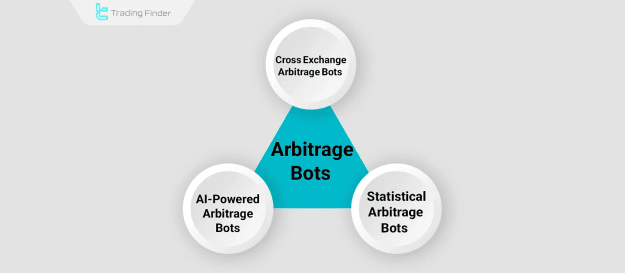
Types of Arbitrage Bots:
Given the critical importance of speed in arbitrage trades, trading bots capable of quickly detecting price gaps are indispensable.
- Cross-Exchange Arbitrage Bots: These bots detect price differences between one or more exchanges and simultaneously buy the asset from the cheaper one and sell it on the pricier one.
- Statistical Arbitrage Bots: These bots leverage statistical models and historical data analysis to identify price patterns and execute arbitrage strategies accordingly.
- AI-Powered Arbitrage Bots: Utilizing artificial intelligence, these bots can process massive amounts of price data in real-time, identify arbitrage opportunities, and execute trades instantly.
Top Arbitrage Bots Across Different Financial Markets:
Due to variations in structure, technology, and volatility across financial markets, the performance of arbitrage bots may differ.
- Forex Market: Due to the high liquidity and variety of currency pairs in the forex market, arbitrage bots must be capable of analyzing real-time rates and executing fast trades.
- Recommended arbitrage bots for forex: HaasOnline, Trality, 3Commas, AlgosOne.
- Recommended arbitrage bots for forex: HaasOnline, Trality, 3Commas, AlgosOne.
- Cryptocurrency Market: Due to the decentralized nature of crypto exchanges and high price volatility, crypto arbitrage bots must be capable of connecting to many APIs and managing automated trades across platforms.
- Recommended crypto arbitrage bots: Cryptohopper, Bitsgap, WunderTrading, Pionex Arbitrage Bot, Arbismart, Coinrule.
- Recommended crypto arbitrage bots: Cryptohopper, Bitsgap, WunderTrading, Pionex Arbitrage Bot, Arbismart, Coinrule.
- Stock Market: In the stock market, arbitrage opportunities typically arise from price differences between exchanges or derivatives and their underlying assets. Bots suited for this market must offer structured analysis tools and access to accurate market data. Some of the forex bots listed above are also suitable for the stock market.
Regulatory Framework for Arbitrage
Although arbitrage is a legal trading strategy, it is subject to specific regulations depending on the market and jurisdiction.
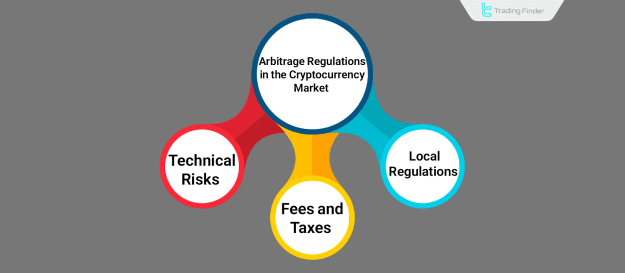
Arbitrage Regulations in the Crypto Market:
In many countries, arbitrage in crypto is legal and considered a legitimate way to earn profits. However, the following factors must be reviewed:
- Key Regulatory Considerations for Arbitrage in Crypto Markets:
- Understanding local cryptocurrency laws and compliance requirements.
- Adherence to Anti-Money Laundering (AML) and Know Your Customer (KYC) regulations.
- Awareness of tax implications on arbitrage profits.
- Reviewing specific exchange terms of service regarding arbitrage.
Arbitrage Regulations in the Forex Market:
In forex trading, arbitrage is also legal, but various regulations monitor it:
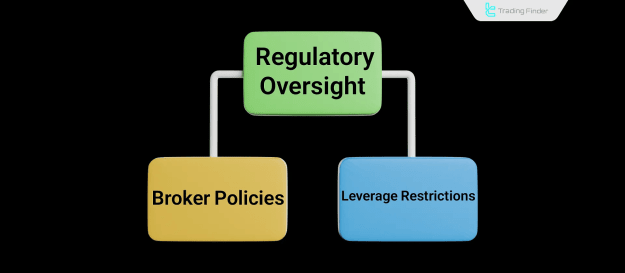
- Key Rules for Arbitrage in the Forex Market:
- Regulatory Oversight: In the U.S., it's regulated by the CFTC; in Europe, by organizations like ESMA.
- Leverage Limits: Restrictions on leverage may impact arbitrage strategies.
- Broker Policies: Some brokers limit arbitrage trading or offer specialized accounts.
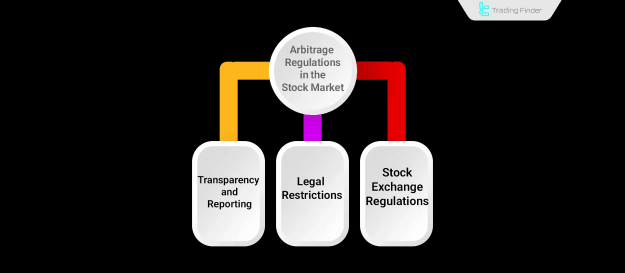
Arbitrage Regulations in the Stock Market:
In stocks, arbitrage occurs between exchanges or between derivatives and underlying assets.
- Reviewing Arbitrage Regulations in the Stock Market:
- Compliance with securities laws and exchange rules.
- Understanding regulations related to high-frequency trading.
- Awareness of insider trading restrictions, even if inadvertently impacting arbitrage.
Why Prices Differ Across Platforms
These differences are attributable not only to market volatility but also to several other structural and regulatory factors.
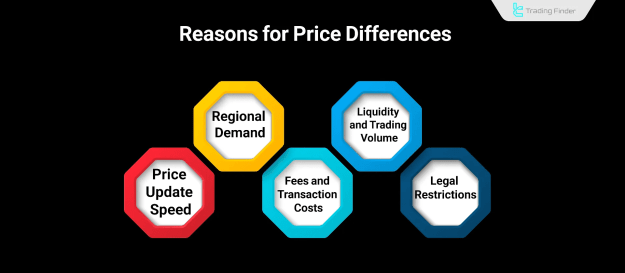
Reasons for Price Discrepancies Across Trading Platforms:
- Liquidity and Trading Volume Differences: Each platform possesses varying levels of liquidity and trade volume. Higher volume platforms tend to have more stable prices, while low-volume platforms may exhibit greater volatility, leading to price differences.
- Regional Demand and User Behavior: Trading platforms operate in diverse geographic areas, serving users with varied preferences. This variation in demand can affect the price of an asset across platforms.
- Market Volatility and Price Update Delays: In highly volatile markets, asset prices change rapidly. If platforms update prices with a delay, it may cause price mismatches for the same asset.
- Fees and Transaction Costs: Each platform has its own fee structure. These fees can influence the final purchase or sale price, creating discrepancies between platforms.
- Legal and Regulatory Constraints: National regulations can impact pricing across platforms. For instance, trading or tax restrictions may cause price differences on a given exchange.
Conclusion
Arbitrage is a trading strategy predicated on exploiting temporary price differences across markets. To execute this strategy effectively, a trader must comprehend market structures, transaction costs, regulatory limitations, and the utility of automation tools. Arbitrage can be applied in crypto, forex, and stock markets, each with its unique execution methods. It necessitates an accurate analysis of opportunities and the utilization of specialized trading bots. Success in arbitrage hinges on a trader's ability to manage risk and adapt to technical and regulatory changes.