

TP & SL Tool: Risk Reward Ratio Calculator RRR MT4 | Prop Firm Protector: Trade Assist Prop Firm Plus TF Expert MT4 | Money Management + DrawDown Protector: Trade Panel Prop Firm Drawdawn Limiter Pro MT4 |Get a free Expert Advisor license via Telegram and WhatsApp
What Is Stop Loss?
A stop loss is a vital risk management tool that automatically closes a trade when the price moves contrary to the initial analysis, thereby preventing excessive losses.
Types of Stop Loss Orders
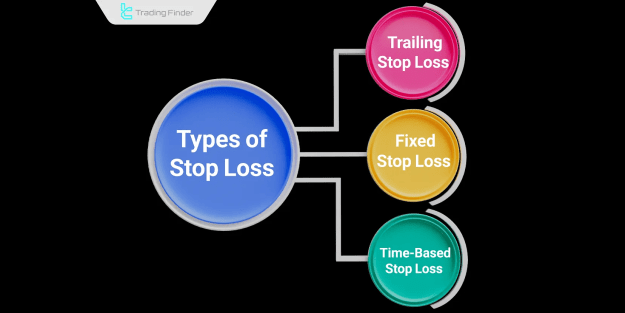
Different types of stop loss orders cater to specific market conditions and price action, aligning with various trading strategies (e.g., technical, time-based, fundamental). Stop loss orders are broadly categorized into fixed, trailing, and time-based types.
- Trailing Stop Loss: This dynamic stop loss adjusts with the price when the market moves in a profitable direction, locking in gains. If the price reverses, the trailing stop loss remains fixed, closing the trade at a predetermined level. This feature allows for trade management without constant monitoring.
- Fixed Stop Loss: In this strategy, a predetermined percentage of capital is risked per trade. Before entering a position, the position size is calculated based on this predefined risk, and the price level at which that amount would be lost is identified. A fixed stop loss is then placed at this precise level, ensuring that no single trade results in a loss exceeding the predefined risk limit.
- Time-Based Stop Loss: This method uses time analysis to determine optimal trading hours. Certain trades may need to be closed before market peak hours, while others are only valid during high-liquidity sessions. A time-based stop loss closes a trade at a specific hour or date, irrespective of price movement.
What Is Take Profit?
A take profit (TP) order is executed when the market moves in the anticipated direction. It automatically closes the trade at a favorable price level, realizing the profit and adding it to the trading account balance.
Types of Take Profit Orders
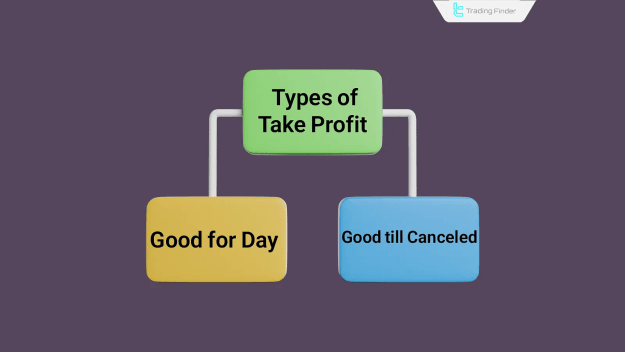
Take profit orders are generally classified into two categories, depending on the analysis and trade duration:
- Good for Day (GFD): If the target price is not reached by the end of the trading day, the position is automatically closed.
- Good till Canceled (GTC): This order remains active until the price target is met or the trader manually cancels it.
Advantages and Disadvantages of SL and TP Orders
Utilizing stop loss and take profit orders is fundamental for effective risk and capital management in trading. However, these orders can also limit the maximum potential profit of a winning trade.
Advantages:
- Enhanced risk and capital management: SL and TP orders provide a structured approach to managing trading capital and potential losses.
- Facilitates long-term performance tracking: By defining risk and reward parameters, traders can accurately evaluate their strategy's performance over time.
- Protects against large losses: Stop loss orders are critical in preventing significant capital depletion during adverse market movements.
- Defines risk-to-reward ratios: These orders allow traders to predetermine their acceptable risk for a given potential reward.
Disadvantages:
- Limits the profit potential of winning trades: Automatically closing a profitable trade at a fixed TP level can prevent further gains if the market continues to move favorably.
- Prone to stop hunting: In some volatile markets, prices may briefly touch common stop loss levels to trigger orders before reversing, a phenomenon known as "stop hunting."
- May be triggered at inaccurate prices during high volatility: During periods of high market volatility, stop loss orders might be executed at prices less favorable than the specified level due to slippage.
- SL may trigger even if price doesn’t reach the specified level precisely: Similar to the above, rapid price movements can lead to SL activation slightly before or after the exact specified price.
How to Calculate Stop Loss and Take Profit Levels
The calculation of stop loss and take profit levels is highly dependent on the specific trading strategy and the type of market analysis used, such as fundamental or technical analysis.
Calculation Based on Fundamental Analysis
In fundamental analysis, various factors of an asset are evaluated to estimate its intrinsic value. If the current market price significantly deviates from this calculated intrinsic value, a trade might be initiated. The SL and TP levels are then determined based on this estimated fair value.
Calculation Based on Technical Analysis
Technical analysis involves examining market behavior through liquidity and price patterns. By identifying key support and resistance levels, traders can set appropriate stop loss and take profit orders that align with the prevailing market structure.
Practical Examples of Setting Stop Loss and Take Profit
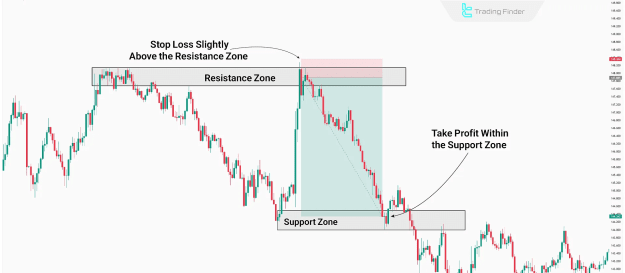
Consider a scenario where the price moves towards a resistance zone after forming a range, and a candlestick pattern confirms a reversal into a downtrend. In this setup, the stop loss would typically be placed just above the resistance zone and the wick of the last bullish candle. The take profit target would then be set within the first valid support zone. This approach leverages key market structures to define SL and TP points.
Importance and Application of SL and TP
The primary function of stop loss and take profit orders is to support robust risk and capital management. By setting precise SL and TP levels, the risk-to-reward ratio of each trade is clearly defined, which is essential for maintaining a consistently growing trading account over time.
Capital Management
Stop loss and take profit orders directly influence how much of the total trading capital is exposed to risk in each trade and how much profit will be added to the account if the trade is successful. Effectively managing these amounts enables traders to accurately evaluate their long-term performance.
Risk Management
Given the inherent uncertainty of financial markets, it is critical to manage the risk exposure of each trade using a stop loss. Without proper risk control, consistent long-term performance tracking becomes unreliable and unsustainable.
Defining Risk-to-Reward Ratio
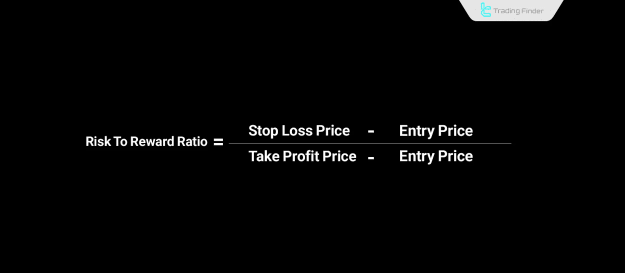
The risk-to-reward ratio is calculated using the following formula:
Risk-to-Reward Ratio=Potential Risk (Entry Price - Stop Loss)Potential Reward (Take Profit - Entry Price)
Based on the win rate of various trading styles, it is generally advisable to avoid trades with a risk-to-reward ratio below 1:1.
Set and Forget Trading System
The Set and Forget strategy involves entering a trade after thorough market analysis and then disengaging from constant market monitoring. In this system, both stop loss and take profit orders are meticulously defined at the time of entry. The trade remains active until the price reaches either the SL or TP level, whichever occurs first.
Combining Stop Loss and Take Profit with Other Technical Analysis Tools
To further refine the placement of stop loss and take profit orders, traders can integrate various technical indicators. These tools assist in identifying optimal SL and TP levels based on liquidity behavior and historical price movement averages.
Using Moving Averages to Set SL and TP
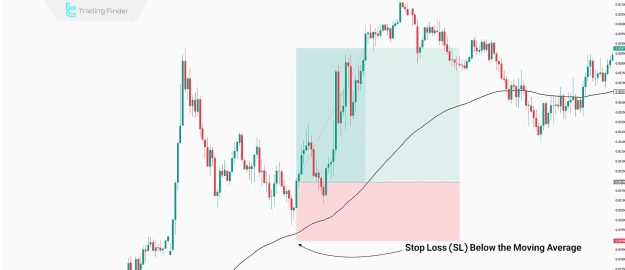
A moving average line often acts as dynamic support or resistance, depending on the price’s position relative to it. When the price is trading below the moving average, the stop loss is typically set above it. Conversely, when the price is above the moving average, the stop loss is placed below the line.
Using the ATR Indicator to Set SL and TP
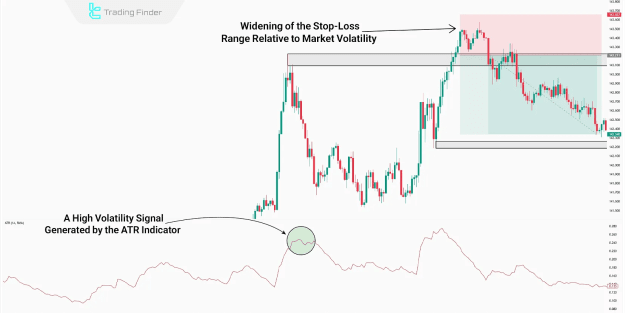
The Average True Range (ATR) indicator measures the market’s current volatility. If the ATR indicates high volatility, it suggests that longer price swings are likely. Consequently, the distance between the entry point and the SL/TP levels should be wider than usual to accommodate these larger fluctuations.
Common Mistakes in Setting Stop Loss and Take Profit
Accurately placing stop loss and take profit orders requires extensive experience with specific trading styles, a deep understanding of market structure, and detailed observation of liquidity behavior. Common mistakes that often lead to premature stop-outs, even with otherwise correct analysis, include:
- Using only a single time frame for analysis, which can provide an incomplete market picture.
- Failing to adequately assess the direction of liquidity, which can lead to misjudging market momentum.
- Entering trades emotionally, without final confirmation from objective analysis.
- Placing the stop loss too close to the entry point, increasing the likelihood of being prematurely stopped out by minor price fluctuations.
- Positioning the stop loss within key zones such as established support or resistance levels, making it susceptible to "stop hunting."
Conclusion
A stop loss order is strategically placed at a specific price level to automatically close a losing trade, thereby limiting further losses when the market moves against the initial analysis. Conversely, a take profit order is executed at a predefined level when the market moves in favor of the trade, securing realized profits into the trading account. By diligently using stop loss and take profit orders, traders are better equipped to evaluate the long-term performance and viability of their trading strategies.