

TP & SL Tool: Risk Reward Ratio Calculator RRR MT5 | Prop Firm Protector: Trade Assist Prop Firm Plus TF Expert MT5 | Money Management + DrawDown Protector: Trade Panel Prop Firm Drawdawn Limiter Pro MT5 |Get a free Expert Advisor license via Telegram and WhatsApp
What is a CFD Contract?
A CFD contract is essentially an agreement between a trader and a broker to exchange the difference in the price of an asset from the time the contract is opened until it is closed. This means that instead of buying or selling the actual asset, you're trading on the expectation of its price rising or falling. The primary advantage of CFDs is their ability to enable traders to capitalize on market volatility without the need for direct investment in commodities, stocks, or other assets.
Key Features of CFD Contracts
CFDs are popular among market participants due to several distinct features. While offering significant opportunities, some features, like high leverage, also entail increased risk.
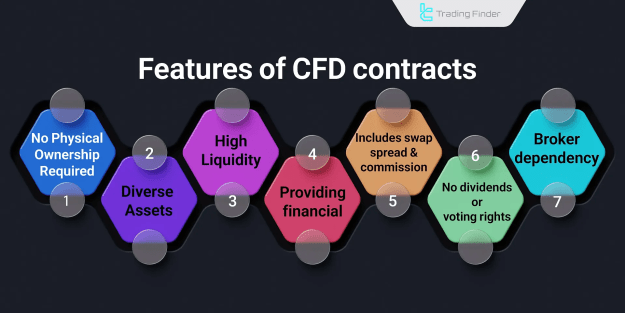
- No Physical Ownership Required: The core principle of CFDs is that traders engage solely with price changes. This eliminates concerns like storage costs for commodities or the complexities of stock transfer.
- Two-Way Trading: CFDs provide the flexibility of both long (buy) and short (sell) positions. This means traders can profit from both rising and falling markets.
- Leverage: Leverage allows traders to control a larger position with a relatively smaller amount of capital. For instance, a 1:10 leverage means you can open a position worth $1,000 with only $100 of your own capital. While this can amplify profits, it also significantly increases potential losses.
- Diverse Assets: CFDs offer exposure to a vast array of financial assets, including:
- Stocks
- Forex pairs
- Cryptocurrencies
- Stock indices
- Commodities
- Bonds
- Interest rates
- Exchange-Traded Funds (ETFs)
- High Liquidity: The high liquidity of the CFD market generally translates to faster trade executions and tighter spreads, which can be beneficial for traders.
- Trading Costs: While avoiding some traditional ownership costs, CFD trades typically incur:
- Spreads: The difference between the buy and sell price.
- Swaps: Overnight financing fees for holding positions open.
- Commissions: Some brokers may charge a commission per trade.
- No Dividends or Voting Rights: As there is no physical ownership of the underlying asset, CFD traders do not receive dividends from stocks or possess voting rights in a company.
- Trading Hours: CFDs generally offer extensive trading hours, often available 24 hours a day, 5 days a week, aligning with the global financial markets.
- Broker Dependency: The availability and quality of CFD offerings are entirely dependent on the broker. Therefore, selecting a reliable and reputable broker is paramount for CFD trading.
Pros and Cons of CFD Contracts
CFD trading presents a unique set of advantages and disadvantages for investors.
Pros of CFD Contracts:
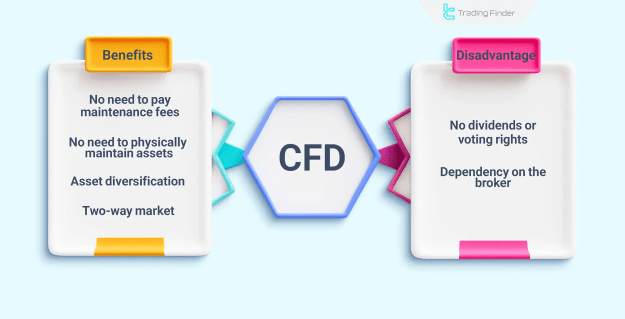
- Avoidance of Physical Ownership Costs: Traders are not subject to asset holding costs, such as storage fees for commodities or certain taxes associated with physical asset ownership.
- Profit from Both Rising and Falling Markets: The ability to go both long and short allows for more diverse trading strategies.
- Leverage Potential: The use of leverage can amplify returns on successful trades.
- Access to Diverse Markets: CFDs offer a convenient way to trade a wide range of global financial instruments from a single platform.
Cons of CFD Contracts:
- No Dividends or Voting Rights: The lack of asset ownership means foregoing these benefits.
- High Risk Due to Leverage: While leverage can boost profits, it can also magnify losses, potentially leading to losses exceeding initial deposits.
- Overnight Financing Costs (Swaps): Holding positions overnight incurs swap fees, which can accumulate over time.
- Broker Dependency and Counterparty Risk: The success of CFD trading is tied to the reliability and solvency of the chosen broker.
It's crucial to note that tax regulations for CFD profits can vary significantly by country:
- Exemption from Capital Gains Tax: In some jurisdictions, like the UK, CFD profits may not be subject to Capital Gains Tax as they are considered derivative instruments rather than direct asset ownership.
- Income Tax: In other European countries and regions, CFD profits may be subject to income tax. Traders should always consult local tax regulations.
Types of CFD Contracts
The versatility of CFDs extends across nearly all financial asset classes, allowing traders to gain exposure to various markets.
- Forex CFDs (Currency Pairs): These allow speculation on the exchange rate fluctuations between different currencies, benefiting from the high liquidity and analyzability of the Forex Market.
- Stock CFDs: Traders can profit from stock price movements without holding the actual shares, thereby avoiding holding costs but foregoing dividends and voting rights.
- Index CFDs: These track the performance of major stock market indices, such as the S&P 500 or Nikkei 225. Overnight swap fees typically apply.
- Commodity CFDs: Speculate on the price changes of physical commodities like gold, oil, silver, and agricultural products without the need for physical storage.
- Crypto CFDs: A relatively newer addition, these allow trading on the price volatility of cryptocurrencies. The variety of crypto CFDs offered can vary significantly among brokers.
- Bond CFDs: Enable traders to profit from price changes in government or corporate bonds. These generally exhibit lower volatility compared to other asset classes, and traders do not receive coupon payments.
- Interest Rate CFDs: Allow speculation on changes in central bank interest rates, which can be influenced by economic data and monetary policy decisions.
- ETF CFDs: Provide exposure to baskets of assets represented by Exchange-Traded Funds. The performance of an ETF CFD is tied to the fund's overall performance rather than individual underlying assets.
CFD Trading Example
Consider a scenario where a trader anticipates a rise in Nvidia stock.
- Opening the Position: The trader decides to buy 100 shares of Nvidia at $110 per share, making the total notional value of the trade $11,000.
- Leverage Application: If the broker offers 1:10 leverage, the trader only needs to put up 10% of the trade's total value as margin, which is $1,100 ($11,000 * 0.10).
- Profit Scenario: If the Nvidia stock price increases to $120, the trader makes a profit of $10 per share, totaling $1,000 (100 shares * $10).
- Loss Scenario: Conversely, if the stock price drops to $100, the trader incurs a loss of $10 per share, also totaling $1,000.
CFD Cost Breakdown:
In addition to potential profits or losses from price movements, CFD trades also involve specific costs:
- Spread Cost: This is the difference between the buy and sell price of the asset. For example, if the spread is $0.10 per share, buying 100 shares would reduce the trader's potential profit or increase their loss by $10 (100 shares * $0.10).
- Swap Cost: These are daily financing fees charged for holding a position overnight. If Nvidia's daily swap fee is $2 and the position is held for three days, the total swap cost would be $6 ($2 * 3 days).
Conclusion
CFDs offer a versatile way for traders to speculate on price movements across a wide range of financial assets, including forex pairs, stocks, cryptocurrencies, bonds, and ETFs, all without the need for physical ownership. While features like market diversity, high leverage, and liquidity make CFDs attractive for both short- and long-term traders, it is crucial for market participants to understand the associated costs and risks, especially those related to leverage and potential tax implications in their respective countries.