

TP & SL Tool: Risk Reward Ratio Calculator RRR MT5 | Prop Firm Protector: Trade Assist Prop Firm Plus TF Expert MT5 | Money Management + DrawDown Protector: Trade Panel Prop Firm Drawdawn Limiter Pro MT5 |Get a free Expert Advisor license via Telegram and WhatsApp
What is Monetary Policy?
Monetary policy encompasses the decisions made by a nation's central bank to manage economic inflation and regulate unemployment rates at optimal levels. Central banks worldwide employ distinct monetary policies, and these divergences directly influence volatility within the forex market. Savvy forex traders leverage these policy differences, or "monetary policy divergence," to capitalize on market fluctuations driven by central bank actions. For instance, if the European Central Bank (ECB) initiates interest rate cuts and adopts an expansionary policy while the U.S. Federal Reserve maintains a contractionary policy, this divergence can lead to a strengthening of the U.S. dollar.
Monetary Policy Tools
Central banks possess a diverse toolkit to implement monetary policy, thereby influencing liquidity levels within the financial system by either increasing or decreasing them. These tools are strategically deployed to achieve specific economic objectives, such as controlling inflation.
Key Monetary Policy Tools:
- Interest Rates: Adjustments to interest rates directly impact deposit levels and loan demand, consequently influencing overall market liquidity. Lowering rates tends to increase liquidity, while raising them reduces it.
- Open Market Operations (OMO): This involves the central bank's buying and selling of government bonds. Buying bonds injects liquidity into the financial system, whereas selling bonds withdraws it.
- Credit Ceiling: The central bank can establish credit limits to regulate bank lending activities, thereby controlling the overall supply of credit.
- Reserve Requirement Ratio: This refers to the percentage of deposits that banks are legally obligated to hold in reserve at the central bank. Increasing this ratio reduces the amount of money banks can lend, thus decreasing liquidity. Conversely, decreasing the ratio boosts liquidity.
- Discount Rate: This is the interest rate at which commercial banks can borrow directly from the central bank. Raising the discount rate discourages borrowing and reduces liquidity, while lowering it encourages borrowing and increases liquidity.
- Inflation Targeting: Modern monetary policy often involves central banks adopting hawkish (pro-tightening) or dovish (pro-easing) stances, setting explicit inflation targets, issuing policy statements, and even using the tone of speeches to influence market sentiment and inflation expectations.
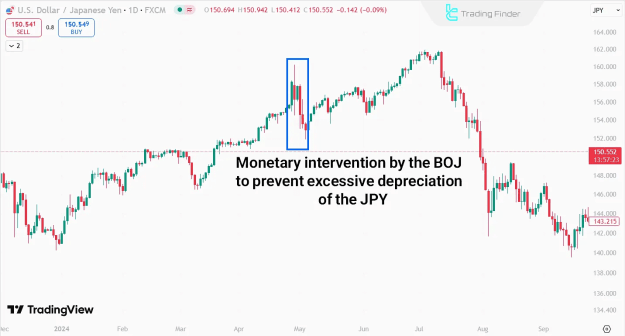
- Currency Intervention: In emergency situations, central banks may directly intervene in the forex market to control exchange rates and stabilize their domestic currency. A notable example is the Bank of Japan's (BOJ) monetary intervention when the yen experienced historic lows against the dollar, involving substantial spending to stabilize the currency.
Types of Monetary Policy
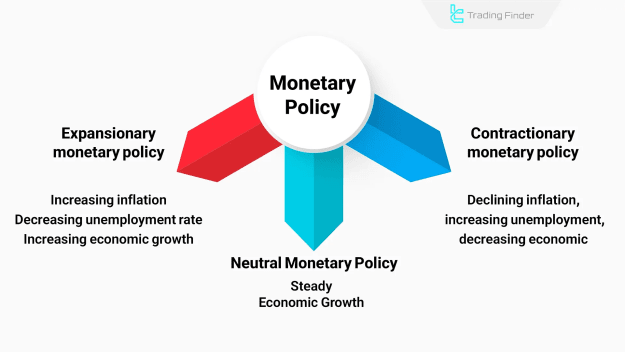
Monetary policy is broadly categorized into different types, each exerting a distinct impact on the economy. Central banks select their policy approach based on their prevailing economic objectives.
Expansionary Monetary Policy
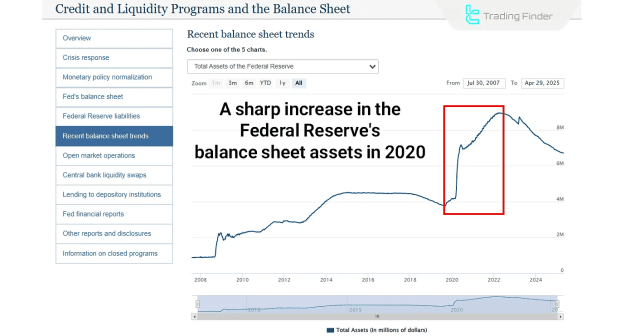
Expansionary monetary policy is typically implemented through interest rate cuts or bond purchases, leading to an increase in overall market liquidity. Central banks utilize this policy during recessions to stimulate Gross Domestic Product (GDP) and reduce unemployment. For instance, the Federal Reserve's balance sheet significantly expanded in early 2020 due to extensive bond purchases—an expansionary monetary policy coupled with interest rate cuts. This concerted effort aimed to foster economic growth, lower unemployment, and manage inflation.
Impact of Expansionary Monetary Policy:
- Unemployment Rate: Stimulates economic growth and demand, thereby reducing unemployment.
- Economic Growth: Boosts demand, increases liquidity, and facilitates easier access to credit, ultimately enhancing economic growth.
Contractionary Monetary Policy
Contractionary monetary policy is generally implemented through interest rate hikes, which reduce liquidity and weaken demand, consequently slowing economic growth. This policy is primarily employed to control inflation or prevent an economy from overheating.
Impact of Contractionary Monetary Policy:
- Unemployment Rate: Reduces consumer demand and puts pressure on producers, potentially leading to an increase in unemployment.
- Economic Growth: Lowers liquidity and suppresses demand, slowing overall growth. Prolonged contractionary policies may even contribute to a recession.
Neutral Monetary Policy
Neutral monetary policy aims to maintain interest rates at a level that neither stimulates nor restricts economic growth. Under this policy, the economy is expected to grow at a steady and sustainable rate. It is important to note that the neutral interest rate is an estimation by central banks and is not precisely defined.
Conclusion
Central banks strategically implement monetary policies to stimulate economic growth, enhance labor market conditions, or control inflation. Their primary tools include adjustments to interest rates, open market operations (bond purchases/sales), reserve requirements, the discount rate, and credit ceilings. The policy stances adopted by central banks significantly influence forex, bonds, stocks, cryptocurrency, and commodities markets. A thorough understanding of monetary policy cycles equips traders and investors to identify and capitalize on optimal market opportunities across various economic phases.