

TP & SL Tool: Risk Reward Ratio Calculator RRR MT5 | Prop Firm Protector: Trade Assist Prop Firm Plus TF Expert MT5 | Money Management + DrawDown Protector: Trade Panel Prop Firm Drawdawn Limiter Pro MT5 |Get a free Expert Advisor license via Telegram and WhatsApp
What Do Hawkish and Dovish Mean?
The terms hawkish and dovish are metaphors rooted in the animal kingdom, symbolizing aggression and peace, respectively.
- A hawkish stance, drawing from the image of a hawk, signifies an assertive and firm approach to monetary policy.
- A dovish stance, associated with a dove, represents a more gentle and accommodating policy.
These terms define the central bank's position on monetary policy, indicating whether it's leaning towards tightening or easing measures.
The Core Differences Between Hawkish and Dovish Policies
The fundamental distinction between hawkish and dovish policies lies in their objectives and implementation.
- A hawkish policy describes a tightening monetary policy. Its primary goal is controlling or reducing inflation. This is typically achieved by increasing interest rates or halting rate cuts during a period of economic slowdown. Such measures generally slow economic growth and strengthen the domestic currency.
- Conversely, a dovish policy refers to an easing monetary policy. Its main objective is to stimulate economic growth. This is usually implemented by decreasing interest rates or pausing rate hikes during an upward economic trend. These actions tend to boost economic growth, increase inflation expectations, and weaken the domestic currency.
When Are Hawkish or Dovish Policies Implemented?
Central banks adopt hawkish or dovish stances in response to specific economic conditions:
When Dovish Policies Are Adopted (Shifting from Hawkish to Dovish)
A central bank typically shifts to a dovish stance when faced with:
- Weak economic growth
- Disinflation or deflationary pressures
- A weak labor market characterized by a high unemployment rate
- Interest rates that are perceived to be hindering economic expansion (above the neutral rate)
When Hawkish Policies Are Adopted (Shifting from Dovish to Hawkish)
A hawkish policy is generally adopted in environments marked by:
- Inflation exceeding the central bank's target
- An overheated labor market, which can fuel inflation risks
- Low interest rates that are below the neutral range, potentially contributing to inflationary pressures
Identifying the Central Bank’s Stance
Market participants meticulously analyze various indicators to determine a central bank's current or projected stance.
Central Bank Communications: Speeches and Statements
The language used by central bank officials in their speeches and official statements provides crucial clues.
- A dovish stance is implied when the central bank signals a move towards expansionary monetary policy or aims to soften existing tightening measures. This might include hints about potential rate cuts, influencing market sentiment accordingly.
- A hawkish stance is evident when the central bank signals a tightening policy or a reduction in easing measures. Such communications often contain language suggesting interest rate hikes or other contractionary actions.
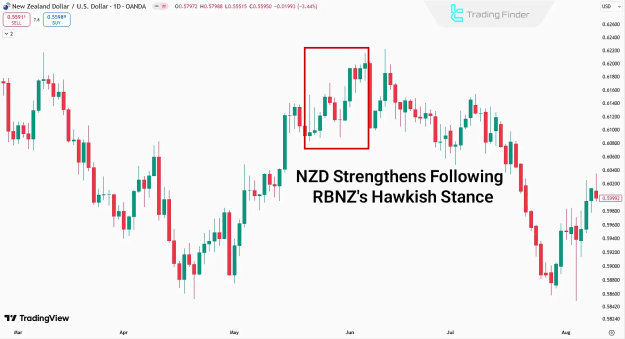
For instance, if the Reserve Bank of New Zealand (RBNZ) adopts a hawkish stance, as observed in May 2024 to curb inflation, they might signal that rate cuts are unlikely until later, causing the New Zealand Dollar to temporarily strengthen.
Central Bank Projections
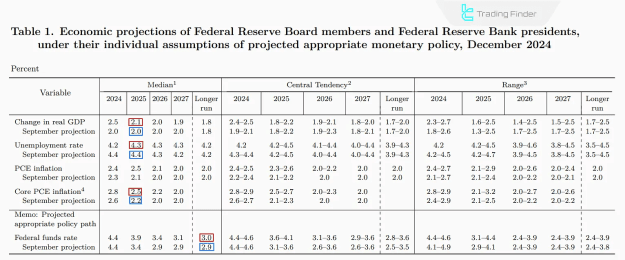
Central banks regularly release economic projections, typically on a quarterly basis. Traders and analysts compare these new projections against previous ones to assess shifts in the central bank's stance.
For example, if the Federal Reserve's December 2024 projection, when compared to September 2024, reveals:
- A higher neutral interest rate
- Plans to reduce rate cuts to manage rising inflation
- A lower unemployment rate, potentially driving up wages and inflation
- Higher economic growth, which could lead to more inflationary pressure
These changes are considered hawkish, as they support the idea of stronger interest rates and a stronger U.S. Dollar.
Impact of Hawkish and Dovish Policies on Financial Markets
The distinct objectives of hawkish and dovish stances lead to varied impacts across financial markets.
Impact of a Dovish Stance on Financial Markets
A dovish stance (expansionary policy) is generally perceived positively by risk assets, such as stocks and cryptocurrencies.
- Easing policies boost market liquidity by lowering interest rates, creating a more favorable environment for these assets.
- When interest rates are reduced, or even when a central bank official hints at a potential rate cut, the related currency in the Forex market tends to weaken. This weakening of the currency further supports risk asset appreciation.
Impact of a Hawkish Stance on Financial Markets
Conversely, a hawkish stance (tightening policy) typically has a negative impact on risk markets due to reduced liquidity.
- Contractionary policies decrease the availability of money in the economy. When consumers and businesses have less disposable income for essential purchases, their willingness to invest in higher-risk assets diminishes.
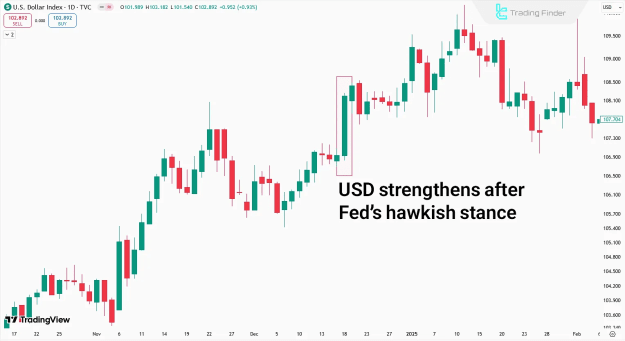
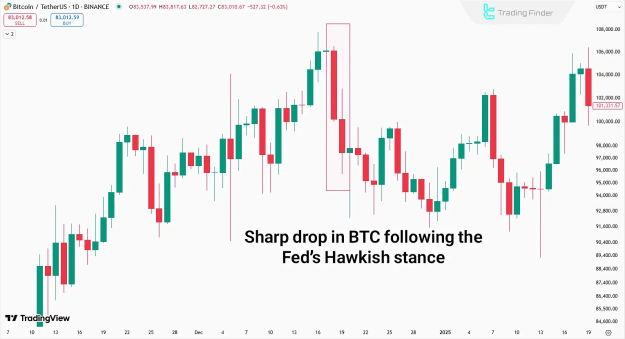
- For example, a decidedly hawkish stance by the Federal Reserve, as seen in the December 18, 2024, meeting where Chair Jerome Powell stated, "We are not ruling out the possibility of further interest rate hikes!", can trigger a sharp decline in risk assets like Bitcoin and lead to a strengthening of the U.S. Dollar (DXY).
Conclusion
Deciphering the central bank's stance is crucial for participants in financial markets. This can be achieved by carefully analyzing the hawkish and dovish tone in the governor’s speeches and official statements. Furthermore, scrutinizing changes in central bank economic projections—including inflation estimates, unemployment rates, expected rate cuts, and the neutral interest rate level—provides valuable insights into future monetary policy directions and their likely impact on various asset classes.