

TP & SL Tool: Risk Reward Ratio Calculator RRR MT4 | Prop Firm Protector: Trade Assist Prop Firm Plus TF Expert MT4 | Money Management + DrawDown Protector: Trade Panel Prop Firm Drawdawn Limiter Pro MT4 |Get a free Expert Advisor license via Telegram and WhatsApp
Introduction to the ICT 20 Pips a Day Strategy
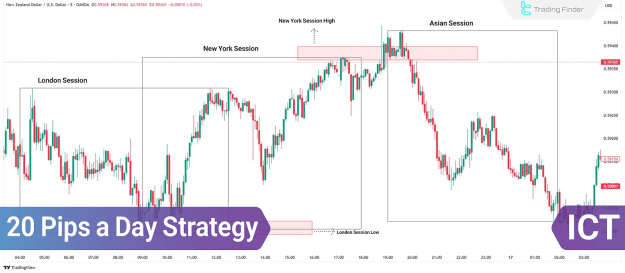
The core objective of the 20 Pips a Day strategy is to secure a minimum of 20 pips from the market each trading day. This method capitalizes on liquidity grabs and market structure shifts (MSS) to exploit short-term price movements, particularly within lower timeframes. Unlike predictive trading strategies, the 20 Pips a Day strategy is based on actual price behavior and evolving liquidity dynamics.
Advantages of the ICT 20 Pips a Day Strategy
Despite its straightforward nature, the 20 Pips ICT scalping strategy possesses several characteristics that make it highly effective for short-term traders:
- Ease of Execution: Implementation is straightforward, requiring only basic tools such as 5-minute and 1-minute charts.
- Daily Profitability: When executed with precision, this strategy can generate consistent daily profits.
- Defined Risk-to-Reward Ratio: The strategy typically maintains at least a 1:1 risk/reward ratio, enhancing effective money management.
- Smart Position Management: Traders have the option to maintain a portion of their position, allowing for additional profit capture if the trend persists.
Applying the ICT 20 Pips a Day Strategy
This strategy is primarily applied during two key trading sessions: the Asia session and the New York session.
Executing ICT 20 Pips a Day in the Asia Session
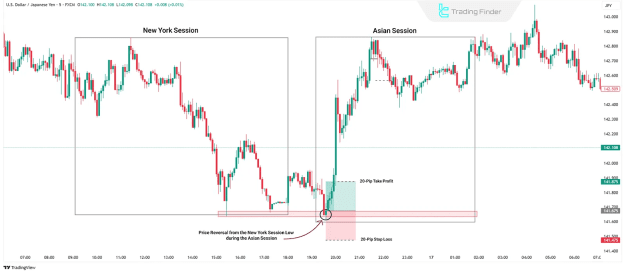
Implementation during the Asia session occurs between 8:00 PM to 12:00 AM (New York time). During this window, price frequently gravitates towards liquidity zones established during the preceding New York session. Upon engaging these zones, the market typically exhibits reactive behavior, such as reversals or directional movements.
Buy Scenario – Asia Session
To initiate long trades in the Asia session:
- On the 5-minute timeframe, identify short-term lows formed towards the conclusion of the New York session.
- Await a brief price breach of these lows to confirm a Liquidity Raid.
- Transition to the 1-minute timeframe and seek indications of price rejection or a Market Structure Shift (MSS).
- Upon confirmation, enter a buy position. Set the stop-loss 20 pips below the entry point and the take-profit 20 pips above.
- Should the price move favorably, consider holding a portion of the position to capture further gains.
Sell Scenario – Asia Session
To initiate short trades:
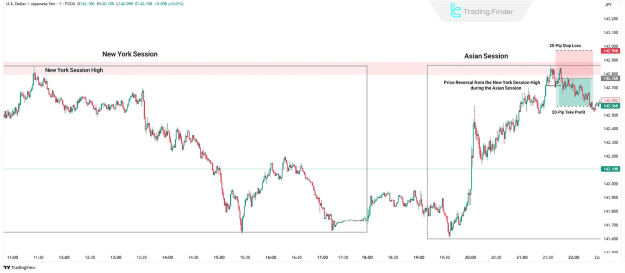
- Similar to the buy setup, focus on short-term highs established at the end of the New York session.
- If the price breaches these highs and initiates a liquidity grab, shift to the 1-minute chart for further validation.
- Observe for clear signs of price rejection or an MSS.
- Enter a sell trade. Set both the stop-loss and take-profit at 20 pips.
Executing ICT 20 Pips a Day in the New York Session
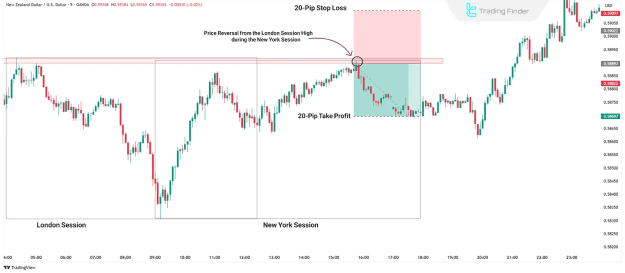
This strategy is applied from the New York session open until approximately 10:00 AM (New York time). After the London session establishes the daily high or low, the New York session often experiences a retracement or reversal, presenting prime scalping opportunities.
Buy Scenario – New York Session
Steps for a buy setup:
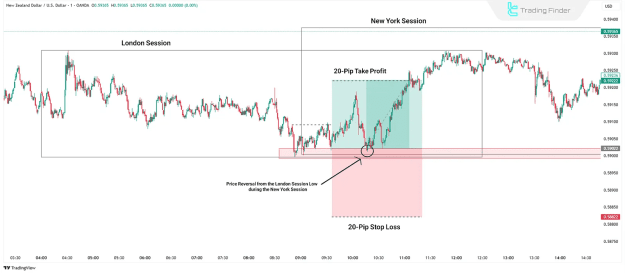
- Confirm that the London session has established the daily low.
- On the 5-minute timeframe, identify short-term lows that form subsequent to the New York open.
- If the price breaches these lows and initiates a liquidity grab, transition to the 1-minute chart.
- Upon observing an MSS or price rejection, enter a buy trade. Set the stop-loss and take-profit at 20 pips.
Sell Scenario – New York Session
Steps for a sell setup:
- Confirm that the London session has established the daily high.
- Identify short-term highs that form after the New York open on the 5-minute chart.
- If the price breaches these highs and initiates a liquidity grab, analyze the 1-minute chart.
- Upon confirming an MSS or rejection, enter a sell position with a 20-pip stop-loss and take-profit.
Additional Tips for Success with the ICT 20 Pips Strategy
To enhance the win rate when employing the ICT 20 Pips a Day strategy, consider the following:
- Assess Overall Market Condition: Do not rely solely on specific setups; always integrate broader market context, including the prevailing market trend, whether the market is in a range vs. trend phase, and the potential impact of news events.
- Utilize Higher Timeframes: Analyzing H1 or H4 charts aids in validating setups and understanding the overarching market direction.
- Risk Management is Critical: Always pre-define your stop-loss and position size to effectively mitigate significant losses.
- Maintain Discipline and Patience: Only enter trades when all predefined conditions are met. Avoid impulsive entries near key levels without valid signals.
Conclusion
The ICT-style 20 Pips a Day strategy represents a structured trading methodology grounded in price action and liquidity behavior. Traders can identify opportune moments such as Market Structure Shifts (MSS) and Liquidity Raids to enter trades at precise points. A key characteristic of this method is its integration of lower timeframe analysis with higher-level structures, including daily highs/lows and critical London/New York trading zones.