

TP & SL Tool: Risk Reward Ratio Calculator RRR MT5 | Prop Firm Protector: Trade Assist Prop Firm Plus TF Expert MT5 | Money Management + DrawDown Protector: Trade Panel Prop Firm Drawdawn Limiter Pro MT5 |Get a free Expert Advisor license via Telegram and WhatsApp
What is a Trading Session?
Trading sessions are specific timeframes within a trading day when participants from different global time zones actively engage in the Forex market. For example, during the Tokyo session, Japanese and other Asian financial institutions are highly active, which typically leads to increased volatility and trading volume in Japanese Yen (JPY) currency pairs.
Breakdown of Trading Sessions
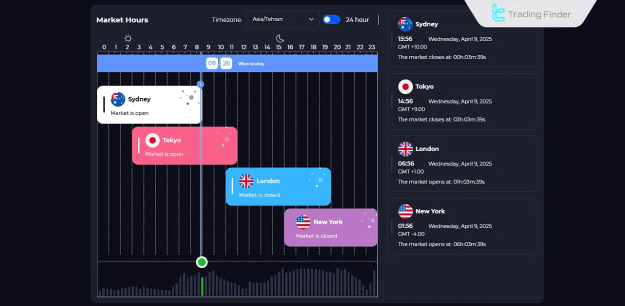
Understanding the opening and closing times of Forex trading sessions is crucial for traders. Tools, such as the Forex Market Sessions Tool on TradingFinder, allow traders to monitor the real-time status (open/closed) of these sessions.
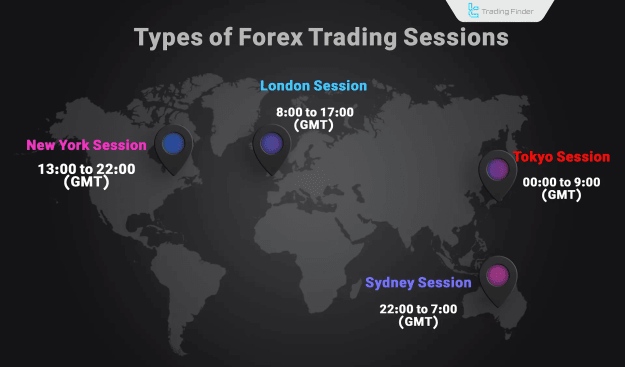
Types of Forex Trading Sessions
Forex trading sessions are categorized into four main types:
- Sydney Session: This marks the beginning of the trading week. It generally exhibits the lowest volatility among all sessions, with the Australian Dollar (AUD) being the most closely observed currency.
- Tokyo Session: The opening of Japanese markets significantly increases trading volume in Asian markets, particularly for the JPY.
- London Session: Overlapping with both Asian and U.S. markets, the London session experiences the highest Forex trading volume, accounting for over 30% of all global transactions.
- New York Session: The overlap between the London and New York sessions offers peak liquidity and tight spreads, making it an ideal period for scalping strategies. Notably, U.S. economic reports are released during the New York session, which can cause short-term volatility in major USD pairs and influence overall market sentiment (risk-on/risk-off).
Why is Understanding Trading Sessions Important?
Understanding trading sessions is paramount, especially for short-term traders, as they directly impact trading volume, volatility, and the effectiveness of various trading strategies. Some strategies are only viable during specific sessions.
Key Benefits of Knowing Trading Sessions:
- Optimal Trading Times: The London and New York sessions provide high liquidity, making them particularly suitable for scalpers and day traders.
- Economic Data Releases: Critical economic indicators, such as inflation rates, non-farm payrolls (NFPs), and interest rates, are typically published during the London and New York sessions. This timing facilitates news trading and enables traders to manage or avoid risk effectively.
- Trader Psychology: Asian sessions are generally characterized by a cautious market sentiment, while the London and New York sessions often exhibit a high-risk/high-reward mentality.
Differences Between Trading Sessions
Forex sessions differ significantly in terms of trading volume, price volatility, active trading strategies, and key currency pairs.
- Sydney (22:00-06:00 GMT): Characterized by low volatility, it is often associated with swing trading. Key currency pairs include AUD/USD and NZD/USD.
- Tokyo (00:00-08:00 GMT): Marks the start of the Asian market peak with a focus on JPY. Volatility is medium, and range trading is a common strategy. USD/JPY and AUD/USD are key pairs.
- London (08:00-16:00 GMT): Known for the highest liquidity and high volatility. Scalping and day trading are prevalent. GBP/USD and EUR/USD are key pairs.
- New York (13:00-21:00 GMT): Features U.S. reports and high volatility. Similar to London, scalping and day trading are popular. GBP/USD and EUR/USD are also key pairs.
Technical Patterns in Forex Sessions
Due to high trading volume and reactions to economic news, certain technical patterns frequently emerge in high-volatility sessions like London and New York. These patterns are valuable for identifying trend reversals, fakeouts, and liquidity grabs.
- New York Reversal Pattern: This popular pattern often forms in the latter half of the New York session, signaling potential trend reversals after significant initial moves.
- Seek & Destroy Pattern: This pattern typically appears in the London and New York sessions. It involves liquidity sweeps and fake breakouts designed to trap retail traders.
Conclusion
Forex sessions, categorized by oceanic, Asian, European, and American financial hubs, are defined by their overlaps, trading volume, liquidity, and key currency pairs. Understanding these sessions is vital for effective trading. Patterns such as the New York Reversal and Seek & Destroy can be particularly useful for identifying short-term trends within the London and New York sessions.