

TP & SL Tool: Risk Reward Ratio Calculator RRR MT5 | Prop Firm Protector: Trade Assist Prop Firm Plus TF Expert MT5 | Money Management + DrawDown Protector: Trade Panel Prop Firm Drawdawn Limiter Pro MT5 |Get a free Expert Advisor license via Telegram and WhatsApp
What is Currency Correlation in Forex?
In the foreign exchange market, certain currencies, such as the Australian Dollar (AUD) and the New Zealand Dollar (NZD), often exhibit similar characteristics and tend to move in tandem. This phenomenon means that currency pairs may display either synchronized or divergent price movements. This observable synchronization or divergence is known as currency correlation.
Example of Currency Correlation in Forex
For instance, when the AUD/USD pair experiences a bullish trend, the NZD/USD pair is also highly likely to appreciate. This is due to the fundamental drivers of both the AUD and NZD being largely similar, leading to their correlated price action.
Understanding Currency Nature to Grasp Pair Correlation
Currencies that share similar underlying characteristics generally move in a similar fashion. Simultaneously trading such currencies in the same direction can significantly amplify risk. Currencies can broadly be categorized by their nature:
- Risk-On Currencies: AUD, NZD, CAD
- Risk-Off Currencies: JPY, USD, CHF
- Neutral Currencies: EUR, GBP
During periods of risk-off market conditions, where safe-haven currencies strengthen, a pair like CAD/CHF may experience a correction while USD/CAD trends upward. These pairs frequently exhibit a negative correlation coefficient, indicating their tendency to move in opposite directions.
Volatility in Correlated Currency Pairs
Even with established correlations, individual currency pair movements can vary in magnitude. For example, if the Swiss National Bank (SNB) adopts a dovish stance while the Federal Reserve (Fed) maintains a hawkish approach (assuming robust U.S. GDP growth), the ascent of USD/CAD could potentially outweigh any decline in CAD/CHF.
What Is the Correlation Coefficient?
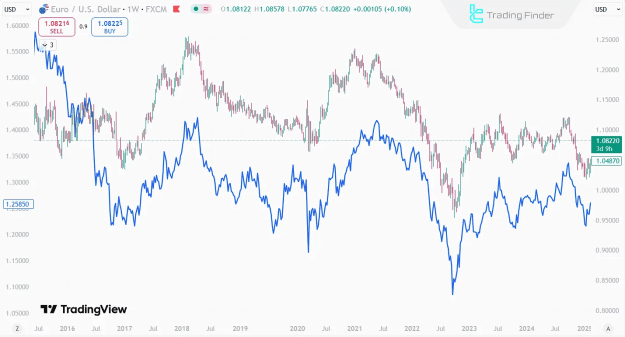
The correlation coefficient is a statistical measure that quantifies the strength and direction of the linear relationship between two assets. Its value ranges from −1 to +1:
- +1 (Perfect positive correlation): Indicates that the assets move identically in the same direction.
- 0 (No correlation): Suggests that the assets have no linear relationship.
- −1 (Perfect negative correlation): Signifies that the assets move inversely to each other.
For example, the correlation coefficient between NZD/USD and AUD/USD in February 2025 was recorded at +0.94, highlighting a strong positive correlation between these two pairs. Tools like TradingFinder’s Forex Correlation Tool can be invaluable for analyzing these relationships.
The Role of Currency Correlation in Risk Management
Ignoring the inherent nature of currencies and the correlations between pairs can inadvertently lead to significant risk accumulation.
Example of Unintended Risk Exposure
EUR/USD and GBP/USD are typically highly positively correlated. If a trader simultaneously opens sell positions on both pairs, they face amplified risk. This is because a single fundamental factor, such as a robust U.S. economic report, could weaken both pairs concurrently. In essence, opening a 1-lot sell position on EUR/USD and another 1-lot sell position on GBP/USD is analogous to effectively opening a 2-lot sell position on EUR/USD in terms of exposure.
Currency Correlation and Hedging
Traders can actively mitigate risk by strategically leveraging currency correlations and prevailing market sentiment. For instance, during periods of geopolitical tension (a risk-off environment), a trader might opt to hold long positions in gold and the Swiss Franc (CHF) while simultaneously opening a position in a risk-on asset to achieve a balanced exposure.
Conclusion
A comprehensive understanding of currency correlation is paramount for effective hedging, robust risk control, and the successful execution of various trading strategies, including swing trading. Positively correlated currency pairs tend to move in the same direction, and opening simultaneous positions on such pairs inherently increases risk exposure.