

A clear understanding of the Margin Level is critical to avoiding margin calls and stop-out scenarios, enabling traders to develop robust risk management strategies through proper Forex education.
TP & SL Tool: Risk Reward Ratio Calculator RRR MT4 | Prop Firm Protector: Trade Assist Prop Firm Plus TF Expert MT4 | Money Management + DrawDown Protector: Trade Panel Prop Firm Drawdawn Limiter Pro MT4 |Get a free Expert Advisor license via Telegram and WhatsApp
What Is Margin Level?
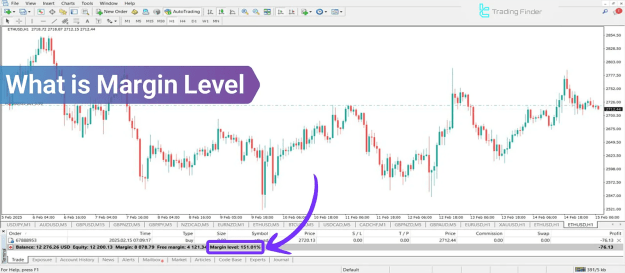
The Margin Level is a percentage ratio that reflects the relationship between a trader’s Equity and Used Margin. It is a fundamental indicator that determines whether a trader has enough funds to open new positions or sustain current ones.
- Formula:
Margin Level = (Equity / Used Margin) × 100% - An increasing margin level indicates higher liquidity and more flexibility to enter new trades.
- A decreasing margin level signals increasing risk, and may lead to a margin call or stop-out enforced by the broker.
Professional traders closely monitor this metric to avoid critical situations and adjust their trading strategies accordingly.
Importance of Monitoring Margin Level
Margin Level is automatically calculated and displayed on trading platforms such as MetaTrader 4 (MT4). It serves as an essential guide to:
- Evaluate available liquidity.
- Determine risk exposure.
- Prevent forced liquidation by the broker.
- Maintain trading capacity during market fluctuations.
How to Calculate Margin Level
Margin Level = (Equity / Used Margin) × 100%
- Equity = Account Balance ± Floating Profit/Loss
- Used Margin = Total margin used in open trades
If no trades are open, the Margin Level will be zero.
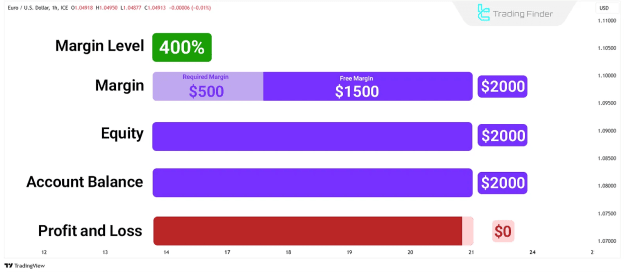
Example 1: Margin Level on an Open Long EUR/USD Position
- Account Balance: $2,000
- Position Size: 1 Mini Lot (10,000 units)
- Required Margin (5%):
10,000 × 0.05 = $500 - Floating P/L: $0
- Equity:
$2,000 + $0 = $2,000 - Margin Level:
(2,000 / 500) × 100% = 400%
In this case, a margin level of 400% reflects ample free margin to enter additional trades.
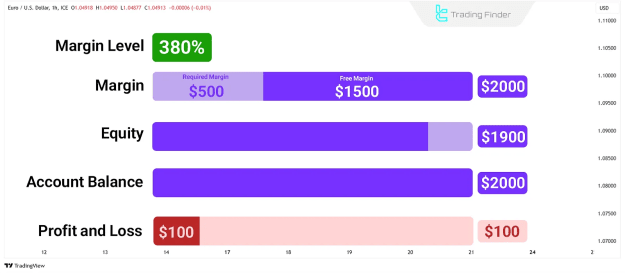
Example 2: Margin Level with a Floating Loss
Assume the same position but with a $100 floating loss:
- Equity:
$2,000 - $100 = $1,900 - Used Margin: $500
- Margin Level:
(1,900 / 500) × 100% = 380%
Even with a floating loss, the margin level remains above 100%, allowing the trader to maintain the position.
Margin Call and Stop-Out Explained
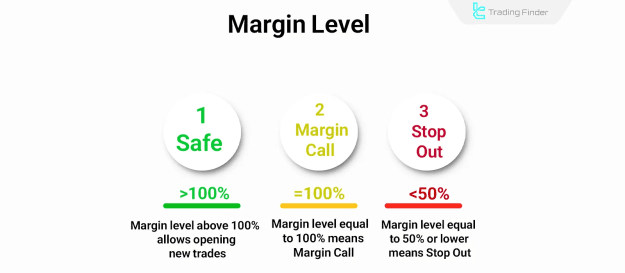
Margin Call Threshold
- A Margin Call is triggered when the Margin Level reaches 100%.
- At this point:
- No new trades can be opened.
- The trader must either deposit additional funds or close existing positions.
Stop-Out Level
- A Stop-Out occurs when the Margin Level falls to a critical value, typically 50% or less.
- In this case:
- The broker begins closing positions automatically to restore margin levels.
- Positions are closed starting with the ones with the highest loss.
Example:
- Equity: $400
- Used Margin: $400
- Margin Level: (400 / 400) × 100% = 100% → Margin Call
If the equity drops further to $200:
- Margin Level: (200 / 400) × 100% = 50% → Stop-Out triggered
Conclusion
The Margin Level is a critical metric for maintaining control over capital and managing exposure in Forex trading.
- A Margin Level above 100% means the trader can open new positions.
- A Margin Level at 100% leads to a margin call, restricting the opening of new trades.
- A Margin Level below 50% typically triggers a stop-out, where the broker forcibly closes open trades.
By consistently monitoring this ratio, traders can make informed decisions, mitigate risks, and enhance overall trading efficiency in dynamic markets.