

TP & SL Tool: Risk Reward Ratio Calculator RRR MT4 | Prop Firm Protector: Trade Assist Prop Firm Plus TF Expert MT4 | Money Management + DrawDown Protector: Trade Panel Prop Firm Drawdawn Limiter Pro MT4 |Get a free Expert Advisor license via Telegram and WhatsApp
Core ICT Concepts in the Twitter Model
The power of the Twitter Model lies in its meticulous application of the following ICT concepts:
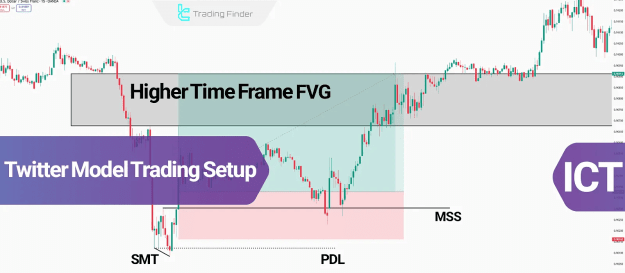
- Market Structure Shift (MSS): This signifies a significant mid-term trend reversal, confirmed by a decisive break of either a Swing High or Swing Low. It indicates a shift in market control from buyers to sellers, or vice versa.
- Smart Money Divergence (SMT): SMT identifies discrepancies in price movements between correlated assets. These divergences often precede significant market turns, acting as a crucial signal of liquidity grabs or fakeouts orchestrated by institutional players ("Smart Money").
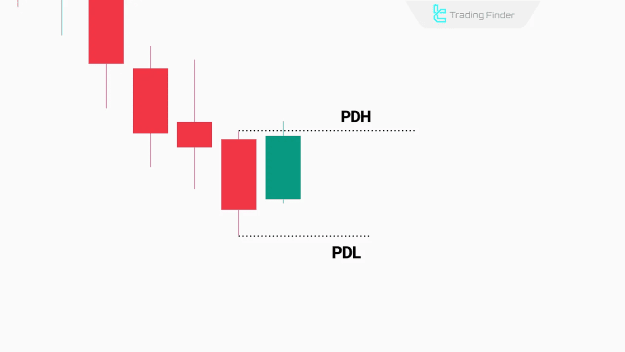
- Previous Day Low (PDL): The lowest price point reached during the prior trading day. PDL frequently acts as a significant liquidity level or a potential area of support, where buyers might step in.
- Previous Day High (PDH): Conversely, the highest price achieved in the previous trading day. PDH often serves as a key resistance level or a target for price expansion, attracting sellers.
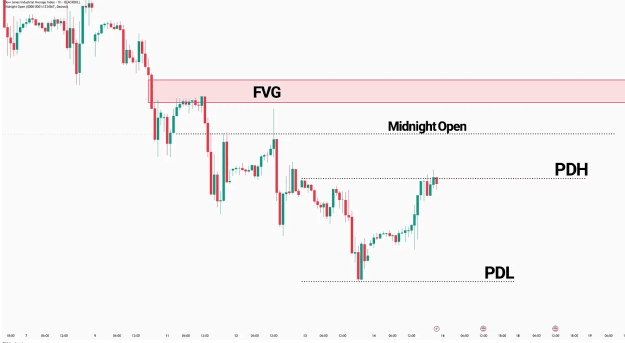
- Fair Value Gap (FVG): An FVG represents a price inefficiency or liquidity imbalance, characterized by a gap between three consecutive candles. Price frequently retraces to fill these gaps, making them attractive targets for entries or exits.
Twitter Model Setup: Identification and Trading Steps
The Twitter Model employs a multi-timeframe analysis approach, with each component of the setup scrutinized on a specific timeframe to ensure robustness.
Formation Steps of the Twitter Model
The identification process is sequential and requires confirmation at each stage:
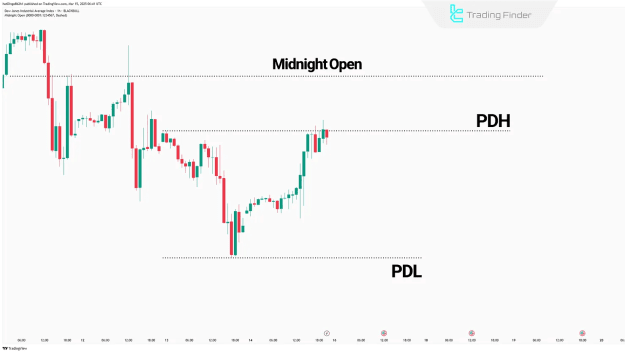
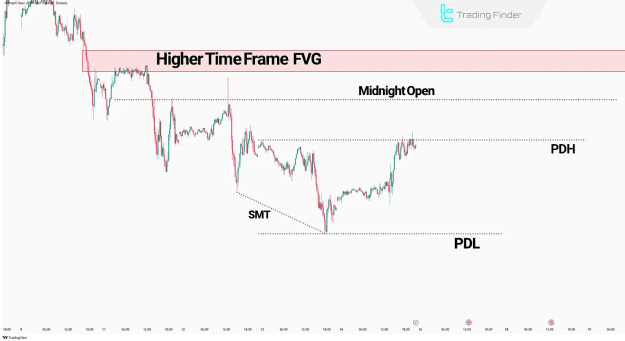
- Identify PDH or PDL on the Daily Timeframe: Begin by pinpointing the Previous Day High (PDH) or Previous Day Low (PDL) on the daily chart. These levels serve as critical reference points for detecting divergence.
- Mark Midnight Open: The Midnight Open price is crucial for assessing the prevailing trade direction (buy or sell bias). This reference point helps in aligning subsequent trade decisions with the overall market sentiment from the daily open.
- Spot Fair Value Gap (FVG) in the 1-Hour Timeframe: Next, identify a clear Fair Value Gap (FVG) on the 1-hour chart. This FVG represents a price zone that the market is highly likely to retrace to, offering potential entry or take-profit areas.
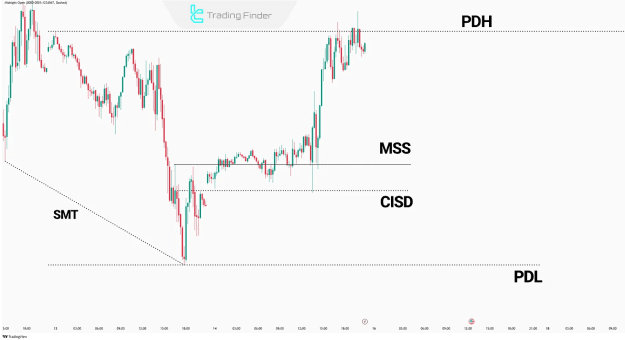
- Look for SMT Divergence to PDH/PDL on the 15-Minute Timeframe: Shift to the 15-minute timeframe to detect Smart Money Divergence (SMT) in relation to the previously identified PDH or PDL. This divergence, when aligned with the Midnight Open bias, provides a strong indication of impending price movement.
- Confirm Market Structure Shift (MSS) in the 15-Minute Timeframe: The final confirmation comes from a Market Structure Shift (MSS) on the 15-minute timeframe. This break in market structure validates the potential trend reversal signaled by the earlier indicators.
Crucially, an entry is only valid if all the above conditions are confirmed. The absence of even one condition invalidates the entire setup, and no trade should be taken.
Trading Steps Using the Twitter Model Setup
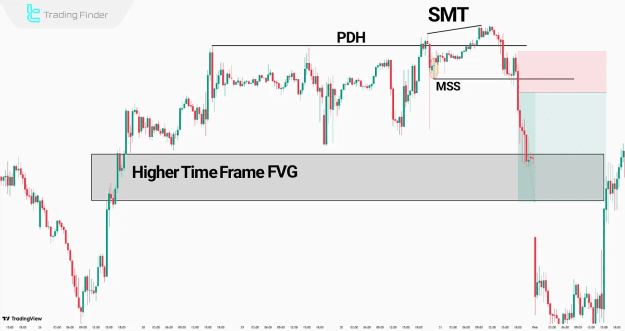
Once all conditions are met and the Market Structure Shift (MSS) is confirmed, trade orders can be strategically placed:
- Entry Points:
- Immediately After MSS Confirmation: This aggressive entry method offers a lower risk-to-reward ratio but ensures participation in the move, especially if no subsequent retracement occurs.
- Pullback to the 1-Hour Fair Value Gap (FVG): This more conservative entry improves the risk-to-reward ratio. However, there's a risk of missing the trade if the price does not retrace to the FVG.
- Stop Loss (SL) Points:
- Below the MSS Candle: Placing the stop loss here provides a favorable risk-to-reward profile but can be susceptible to "stop hunts" by larger market participants.
- Below the Wick of the SMT Divergence Candle: This stop loss placement offers greater security, reducing the likelihood of being stopped out prematurely, though it may slightly reduce the risk-to-reward ratio.
- Take Profit (TP):
- The 1-hour FVG zone is often a suitable area for exiting the trade, aligning with the concept of price rebalancing liquidity imbalances. Take profit decisions should also consider prevailing price momentum and market conditions.
Pros and Cons of the Twitter Model Setup
The Twitter Model offers significant advantages by aligning entries with Smart Money Concepts (SMC), but its sophistication necessitates a deep understanding and meticulous execution.
Pros
- Precise Liquidity & Order Flow Integration: The model directly incorporates key liquidity levels and order flow dynamics, offering a high-probability edge.
- Aligns with Smart Money Behavior: By identifying SMT divergences and market structure shifts, the strategy seeks to trade in harmony with institutional movements.
- Filters Out Fake Breakouts: The multiple confirmation steps effectively minimize false signals and "fakeouts."
- Entry at High-Liquidity Points: The emphasis on PDH/PDL and FVG ensures entries are at significant price levels.
- Optimal Risk Management: The defined stop-loss and take-profit areas facilitate effective risk management.
Cons
- Execution Complexity: The multi-timeframe analysis and multiple confirmation steps can make execution challenging for novice traders.
- Limited Signal Frequency: Due to the stringent confirmation requirements, valid trading signals may not occur frequently.
- Requires Multiple Timeframe Analysis: Traders must be proficient in analyzing charts across various timeframes simultaneously.
- Demands Multiple Confirmations: The need for all conditions to be met can lead to missed opportunities if even one element is absent.
- Session Dependency (NY & London): The strategy often performs optimally during specific trading sessions, particularly New York and London, due to higher liquidity and institutional activity.
Conclusion
The Twitter Model is a powerful and intricate trading setup that effectively synthesizes MSS, SMT, FVG, and critical liquidity levels to decipher Smart Money movements. While it offers a sophisticated framework for identifying high-probability trades, its successful implementation hinges on a thorough understanding of ICT concepts and disciplined multi-timeframe analysis. Valid entries are strictly contingent upon the confirmed presence of both SMT divergence and MSS formation.