

TP & SL Tool: Risk Reward Ratio Calculator RRR MT5 | Prop Firm Protector: Trade Assist Prop Firm Plus TF Expert MT5 | Money Management + DrawDown Protector: Trade Panel Prop Firm Drawdawn Limiter Pro MT5 |Get a free Expert Advisor license via Telegram and WhatsApp
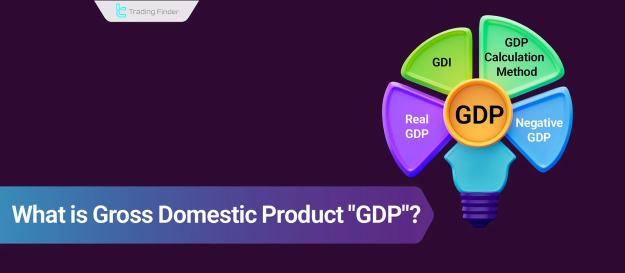
What is GDP?
Gross Domestic Product (GDP) represents the total monetary value of all final goods and services produced within a country's borders during a specific period. It stands as a crucial indicator of national output and a fundamental measure of economic growth.
Key Considerations in GDP Calculation
Certain economic activities are intentionally excluded from GDP calculations to ensure accuracy and prevent double-counting:
- Non-market Production: Activities like housework and charitable services are not included as they do not involve market transactions.
- Illegal Goods: The value of illicit goods and services is excluded.
- Final Goods Only: To avoid double-counting, only the value of final goods is considered. For instance, the value of flour used in bread production is counted only when the bread (the final product) is sold, not as a separate raw material.
- Geographic Boundaries: GDP strictly adheres to geographical borders. Production within a country's territory contributes to its GDP, regardless of the nationality of the producing company. For example, if an American company like Apple manufactures products in China, that production contributes to China's GDP.
- Excluded Transactions:
- Second-hand goods are not included as their value was already captured in a previous period's GDP.
- Financial securities (stocks, bonds) represent transfers of ownership, not new production.
- Household and charitable activities are excluded as they are not market-based.
Understanding Gross National Product (GNP) and Its Distinction from GDP
Gross National Product (GNP) measures the total value of goods and services produced by companies owned by a country's citizens, irrespective of their geographical location. For example, if Nike, a U.S. company, produces goods in China, the final value of those products contributes to the U.S. GNP.
Formula for Calculating Gross National Product (GNP)
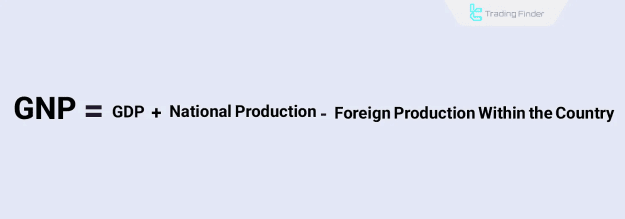
GNP can be calculated as:
GNP = GDP + Net Factor Income from Abroad
Where "Net Factor Income from Abroad" represents the income earned by domestic residents from their foreign investments minus the income earned by foreign residents from their domestic investments.
Conceptual Differences Between GDP and GNP
The core distinction between GDP and GNP lies in their focus:
- GDP: Border-Centric: GDP prioritizes geographical location, including all goods produced within a nation's borders, regardless of the producer's nationality.
- GNP: Nationality-Centric: GNP prioritizes nationality, encompassing all goods produced by a nation's citizens and companies, regardless of where the production occurs.
Functional Differences Between GDP and GNP
- GDP Function: Primarily used to gauge a country's economic activity and identify periods of recession or boom.
- GNP Function: Provides insights into a country's reliance on and gains from foreign resources. A country with substantial foreign investments by its citizens will likely have a higher GNP than GDP. Conversely, a nation heavily dependent on foreign investment will likely exhibit a higher GDP than GNP.
Methods for Calculating GDP
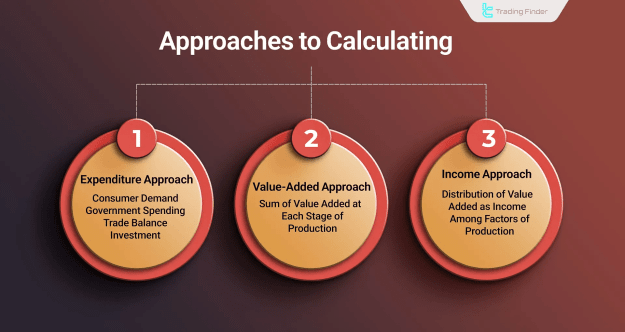
Since GDP only accounts for the value of final goods and services, three primary approaches are used for its calculation:
1. Expenditure Approach
This is the most common and widely used method for calculating GDP. It is based on the principle that all goods produced in an economy are eventually consumed. Therefore, GDP can be derived by summing up total expenditure by consumers, the government, and investments.
The expenditure approach comprises four key components:
- Consumer Expenditures (C): Spending by households on goods and services.
- Government Expenditures (G): Government spending on public services and benefits.
- Investment (I): Spending on capital goods, inventory, and new construction.
- Net Exports (NX): The difference between a country's total exports and total imports (Exports−Imports).
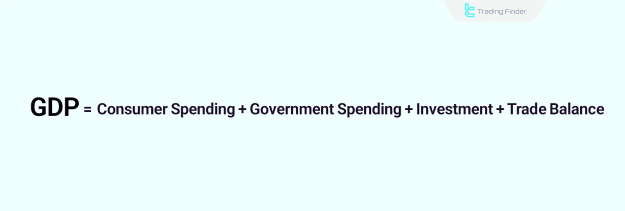
The formula is:
GDP=C+G+I+NX
2. Value-Added Approach
This method sums the value added at each stage of production. By calculating the value added at each step, from raw materials to the final product, the total value of the final good is determined, avoiding double-counting of intermediate goods.
3. Income Approach
The income approach aggregates the income earned by all factors of production within an economy. This includes wages, rent, interest, and profits. Gross Domestic Income (GDI) reports, derived from this approach, are valuable for tracking income distribution and identifying the economic sectors with the largest share of production.
Understanding Negative Economic Growth
Negative economic growth occurs when a country's GDP in the current period is lower than in the previous period.
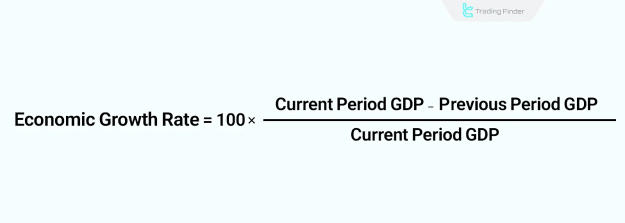
The formula for calculating the economic growth rate is:
Economic Growth Rate = ((GDP in Current Period−GDP in Previous Period) / GDP in Previous Period) × 100
If the current period's GDP is less than the previous period's, the economic growth rate will be negative. This signifies a decrease in the total value of domestic production.
Key Points on Negative Economic Growth:
- A decrease in the rate of economic growth is distinct from negative economic growth. A decrease means growth is slowing, while negative growth means the economy is shrinking.
- Technically, if an economy experiences two consecutive quarters of negative economic growth, it is officially considered to be in a recession.
- During periods of negative economic growth, market sentiment in financial markets typically shifts towards risk aversion.
The Importance of Real GDP
While GDP calculates the total monetary value of all goods produced, it can be influenced by inflation. If prices increase due to inflation, nominal GDP may rise, even if the actual volume of goods and services produced remains stagnant or declines.
Real GDP adjusts for the effects of inflation, providing a more accurate measure of economic growth. Central banks and financial analysts rely on Real GDP to gain a true understanding of a country's economic expansion and for robust comparisons of economic growth between nations.
Conclusion
Gross Domestic Product (GDP) is an indispensable measure of a nation's economic activity and overall health, serving as a critical tool for central banks in shaping monetary policy. In fundamental analysis, Real GDP is the preferred metric for comparing economic growth across countries, as it effectively removes the distorting effects of inflation from the total value of goods produced.