

TP & SL Tool: Risk Reward Ratio Calculator RRR MT5 | Prop Firm Protector: Trade Assist Prop Firm Plus TF Expert MT5 | Money Management + DrawDown Protector: Trade Panel Prop Firm Drawdawn Limiter Pro MT5 |Get a free Expert Advisor license via Telegram and WhatsApp
Building a Robust Trade Entry Model with ICT Methodology
Constructing a trade entry model leveraging the ICT methodology requires careful consideration of several crucial aspects:
Selecting the Optimal Entry Timeframe
The initial step in developing an ICT-based entry model involves defining the appropriate timeframe. This choice is highly dependent on an individual trader's style and preferences.
- Some traders may opt for higher timeframes, such as the 15-minute chart, for a broader market perspective.
- Conversely, others prefer lower timeframes, including the 1-minute or even 15-second charts, for more granular entry points.
For the purpose of this guide, the explanations will primarily utilize 5-minute and 1-minute timeframes, as they offer enhanced flexibility for short-term trades.
Identifying the Ideal Kill Zone
Forex kill zones represent specific periods during the trading day characterized by heightened market liquidity. For instance, the New York Open is a prime example of a kill zone, offering ample opportunities for identifying trade entries due to its inherent volatility and liquidity.
Key Concepts for an ICT-Based Entry Model
The following fundamental concepts are integral to the successful construction of an ICT entry model:
- Displacement: Refers to a strong, directional price movement characterized by multiple large-bodied candles, indicating aggressive buying or selling pressure.
- Fair Value Gap (FVG): Represents a price imbalance, signaling an area of market inefficiency where price is likely to return to fill the gap.
- Order Block: Denotes price areas where significant institutional buy or sell orders were placed, often serving as support or resistance.
- Balance Price Range (BPR): Identifies overlapping areas of two Fair Value Gaps (FVGs), suggesting a balanced zone of supply and demand.
- Optimal Trade Entry (OTE): A Fibonacci-based setup utilized to pinpoint key price reversal levels, typically within the 0.62 to 0.79 retracement zone.
- Internal Range Liquidity (IRL): Refers to liquidity pools situated within a defined price range, often formed by existing FVGs.
These core concepts form the bedrock upon which various ICT entry models are developed.
Types of ICT Entry Models
ICT-based entry models are typically created by strategically combining multiple of the aforementioned concepts. The subsequent sections detail different ICT entry model variations.
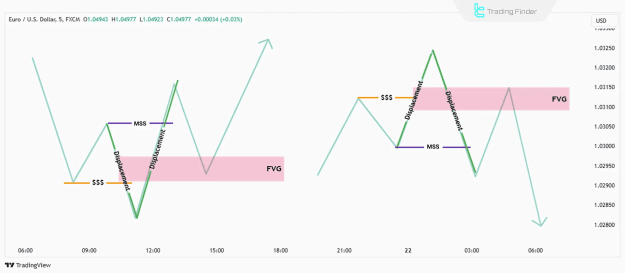
Entry Based on Fair Value Gap (FVG)
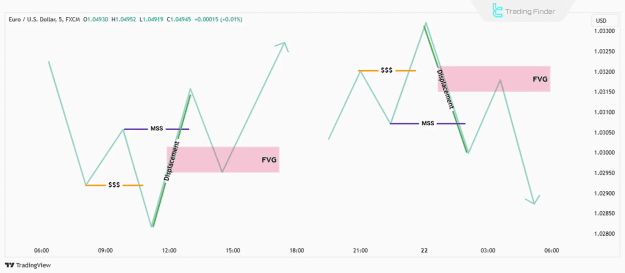
The FVG-based entry model is a structured three-step approach:- Liquidity Grab: Price collects liquidity from a significant range, often preceding a swift price reversal.
- Displacement: Following the liquidity grab, price executes a strong displacement move in the opposite direction, leading to a Break of Structure (BOS).
- Return to Fair Value Gap: After the BOS, price subsequently retraces back to the Fair Value Gap, presenting a potential entry opportunity.
(Schematic of bullish and bearish Fair Value Gap entry in ICT method)
Entry Based on Internal Range Liquidity (IRL)
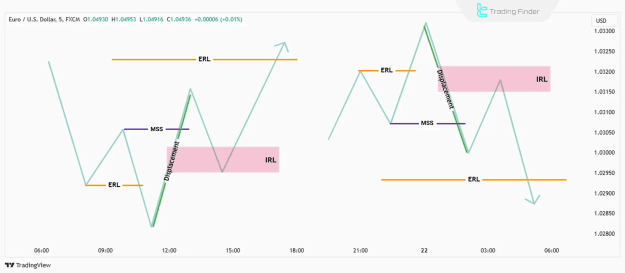
The IRL-based entry model can be summarized in three distinct steps:- Internal Liquidity Grab: Price initially moves towards Internal Range Liquidity (IRL), frequently involving a brief counter-trend movement.
- Displacement: Subsequent to collecting internal liquidity, price initiates an aggressive move aligned with the primary trend direction, resulting in a Break of Structure (BOS).
- Next Target: After absorbing internal liquidity, price then targets External Range Liquidity (ERL).
(Schematic of Bullish and Bearish Entry Using Internal and External Liquidity Concepts in ICT Method)
Entry Based on FVG Within OTE Setup
This model is a refined variation of the FVG-based entry, where the Fair Value Gap specifically occurs within OTE levels. The steps are as follows:
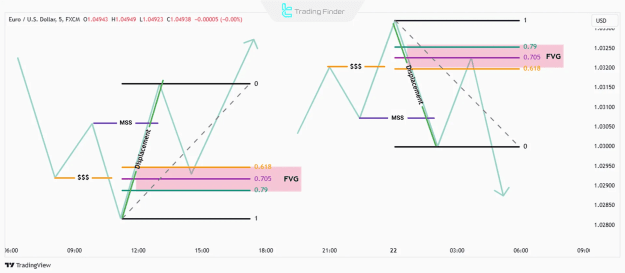
- Liquidity Grab: Liquidity is absorbed from a critical area, followed by a rapid price reversal.
- Displacement: A powerful move against the prior trend leads to a Break of Structure (BOS).
- Return to FVG: Price retraces to the Fair Value Gap after the BOS.
- Additional Condition: Crucially, the Fair Value Gap must reside within the OTE retracement levels (typically 0.62 to 0.79) to enhance the risk-to-reward ratio.
(Schematic of Bullish and Bearish entry using OTE levels and FVG in ICT method)
Internal Liquidity with OTE Levels
The Internal Liquidity with OTE model represents a strategic combination of the IRL and OTE/FVG models, where internal liquidity is collected, and the Fair Value Gap is located within OTE levels.- Internal Liquidity Grab: Price first moves to capture internal liquidity.
- Displacement: A strong price move creates a definitive Break of Structure (BOS).
- Return to FVG in OTE Zone: Entry is triggered when price retraces to an FVG situated within the OTE levels (0.62-0.79) subsequent to the BOS.
Entry Based on Balance Price Range (BPR)
The Balance Price Range (BPR) model is designed around the overlap of aggressive price movements and Fair Value Gaps in both directions (e.g., a rapid up-and-down move). The steps involved are:- Aggressive Buy & Sell Moves: A sharp two-sided price movement generates overlapping Fair Value Gaps.
- Identifying the Balance Zone: The overlapping FVGs precisely define a potential entry point, known as the balance zone.
- Entry & Risk Management: Entry occurs at the balance zone, with stop-loss orders strategically placed above the highs or below the lows of the aggressive moves.
- Combining with Other Concepts: This model can be further optimized by integrating it with OTE levels, discount zones, or premium zones to achieve superior risk-to-reward ratios.
(Schematic of Bullish and Bearish Entry Using Balance Price Range with Overlapping FVGs in ICT Method)
Key Considerations in Combining Techniques for a Custom Model
One significant advantage of ICT trading lies in its inherent flexibility, allowing traders to combine various concepts. Traders can seamlessly integrate elements such as Fair Value Gaps, Order Blocks, Balance Price Range, and Internal Liquidity based on their individual trading preferences and market analysis. Key points to consider include:
- Defining Precise Entry Criteria: Each model developed should possess specific, well-defined conditions for accurately identifying entry points.
- Considering Risk-to-Reward Ratio: Strategically employing concepts like OTE levels can significantly optimize the risk-to-reward ratio of trades.
- Testing Models in Various Market Conditions: It is imperative to rigorously test each model across diverse market conditions (e.g., bullish, bearish, and ranging markets) to ensure its consistent effectiveness and robustness.
Conclusion
When identifying an ICT-based entry model, the synergistic combination of concepts such as FVG, Order Blocks, Balance Price Range, and OTE setups provides a highly structured and effective approach to trade entries.
Analyzing appropriate timeframes, recognizing high-liquidity kill zones, and focusing on key market levels are all crucial steps in developing a successful and consistent ICT entry model.