

TP & SL Tool: Risk Reward Ratio Calculator RRR MT4 | Prop Firm Protector: Trade Assist Prop Firm Plus TF Expert MT4 | Money Management + DrawDown Protector: Trade Panel Prop Firm Drawdawn Limiter Pro MT4 |Get a free Expert Advisor license via Telegram and WhatsApp
Equity (Net Account Value) in Forex and Its Impact on Margin
While many traders perceive equity simply as the real-time account value, its utility extends further. In algorithmic trading, for instance, a predefined drop in equity can serve as a sophisticated filter, signaling the need to halt or adjust automated strategies. Additionally, sharp fluctuations in equity can act as an early indicator of potential price spikes within the market.
Definition of Equity (Net Account Value)
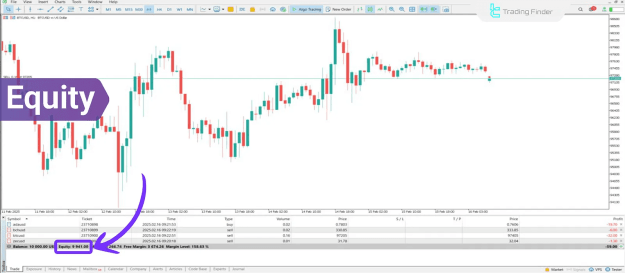
Equity, also known as net account value, represents the current financial worth of a trading account in the forex market. Beyond the initial account balance, it incorporates the unrealized gains or losses from all open positions, which are directly influenced by ongoing market fluctuations. This comprehensive metric is a core indicator of a trader's financial stability and overall health.
The calculation of equity is based on two key components:
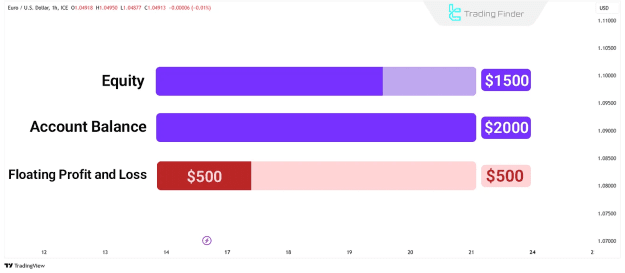
- Account Balance: This encompasses the total of all deposits, withdrawals, and any realized profit or loss from trades that have already been closed.
- Floating Profit and Loss: These are the unrealized gains or losses from currently open positions, which change in real-time as market prices move.
Equity Calculation Formula
The equity calculation is dynamic and depends on the trading activity in the account:
- When no positions are open: In this scenario, the equity is equivalent to the account balance.
- When trades are open: The equity continuously fluctuates in direct response to prevailing market prices and the performance of open positions.
The fundamental formula for calculating equity is:
Equity = Account Balance + Floating Profit or Loss
Role of Equity in Capital Management
In forex trading, equity is a pivotal metric that directly impacts a trader's available liquidity, margin level, and the capacity to initiate new trades.
Margin Level Calculation
A higher margin level signifies a greater capacity for a trader to open new trades. The margin level is calculated using the following formula:
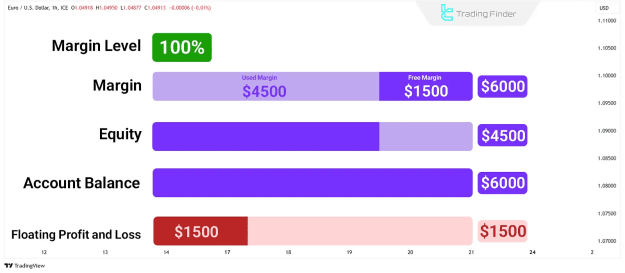
Margin Level = (Equity / Used Margin) × 100%
Free Margin Control
A decrease in equity directly translates to a reduction in free margin, thereby limiting a trader's ability to enter new positions. The formula for free margin is:
Free Margin = Equity – Used Margin
Avoiding Margin Calls and Stop Out
A significant drop in equity can trigger a margin call, at which point a trader is typically prevented from opening any new positions. If the decline in equity persists, the broker may automatically close some or all open trades to prevent further losses. This automated closure process is known as a stop-out. Understanding and monitoring equity is paramount to proactively avoid these critical scenarios.
Equity and Capital Management
Understanding equity calculations is essential for traders to accurately assess their financial standing and implement robust capital management strategies.
Equity Calculation in Different Scenarios
Here's how equity is calculated in various trading scenarios, illustrating its dynamic nature:
- No Open Trades: If the account balance is, for example, $5,000, and there are no open positions, the equity will also be $5,000.
- Open Trades with Profit: If an account starts with a $5,000 balance and open positions generate a floating profit of $1,200, the equity will rise to $6,200 ($5,000 + $1,200).
- Open Trades with Loss: Conversely, if the initial account balance is $5,000 and open positions incur a floating loss of $800, the equity will decrease to $4,200 ($5,000 - $800).
Conclusion
Equity in the forex market is a dynamic and essential measure of a trader's real-time financial health, risk exposure, and liquidity. It plays an indispensable role in effectively managing risk, preventing margin calls and stop-outs, and maintaining control during periods of market volatility.
When combined with prudent leverage management and diligent margin tracking, a thorough analysis of equity significantly strengthens a trader's decision-making process, enabling them to navigate both calm and volatile market conditions with increased confidence.