

TP & SL Tool: Risk Reward Ratio Calculator RRR MT5 | Prop Firm Protector: Trade Assist Prop Firm Plus TF Expert MT5 | Money Management + DrawDown Protector: Trade Panel Prop Firm Drawdawn Limiter Pro MT5 |Get a free Expert Advisor license via Telegram and WhatsApp
What Are Forex Market Makers?
Market makers are financial organizations or individuals with significant capital that provide liquidity to the market and actively influence trends. With their extensive resources, sophisticated trading tools, and precise information, they play a crucial role in directing market movements.
Key Players in the Forex Market
The Forex market comprises a diverse range of participants, from large institutional entities to individual traders. Each player, regardless of their capital size, contributes to the market's overall dynamics.
Central Banks
Central banks exert a profound impact on currency pair fluctuations primarily through the implementation of monetary policy and the management of liquidity levels.
- For instance, a contractionary monetary policy, such as raising interest rates, typically reduces liquidity and leads to currency strengthening. Traders often analyze discrepancies in monetary policies between economies to identify trading opportunities.
- Beyond monetary policy, central banks also influence the market through verbal or monetary interventions to align the market with their specific objectives.
Example of Central Bank Influence in Forex
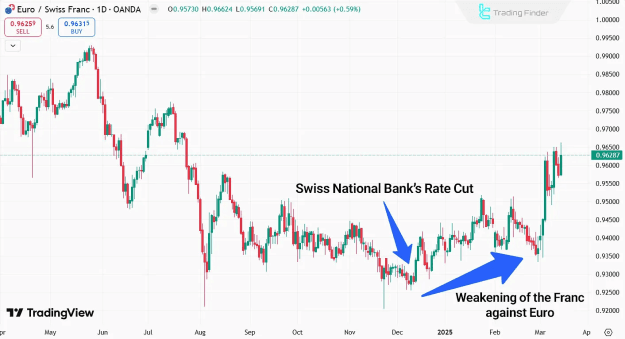
A notable example is the Swiss National Bank (SNB). To counteract excessive strengthening of the Swiss Franc and avert a deflationary crisis, the SNB verbally threatened monetary intervention. This action, coupled with a reduction in interest rates, effectively led to the weakening of the Franc, achieving the central bank's goal.
Large Banks and Liquidity Providers
Large banks and liquidity providers (LPs) are prominent market makers engaged in extensive currency buying and selling as part of their market-making operations. Their activities, particularly their order flow, can be observed in Commitment of Traders (COT) reports.
- Their continuous, high-volume trading allows them to generate substantial income from the spread (the difference between Bid and Ask prices).
- These entities significantly influence short-term market fluctuations.
Electronic Liquidity Providers (ELPs)
Electronic Liquidity Providers (ELPs) leverage artificial intelligence and complex trading algorithms to inject liquidity into financial markets.
- These providers utilize automated algorithms to execute orders, continuously scanning prices and placing orders based on prevailing market conditions.
- ELPs generate income through various methods:
- Spread: The difference between buy and sell prices.
- Arbitrage: Profiting from price discrepancies of an asset across different brokers.
- Market-making fees: Receiving fees from various brokers for providing liquidity.
Large Commercial Companies
Transactions undertaken by large commercial companies are a key driver of exchange rate changes.
- For example, when a company like Apple (an American entity) needs to convert US Dollars to Chinese Yuan to acquire raw materials from China, it effectively sells Dollars and buys Yuan. This action contributes to a reduction in the Dollar's value against the Yuan.
Hedging Strategies of Commercial Companies
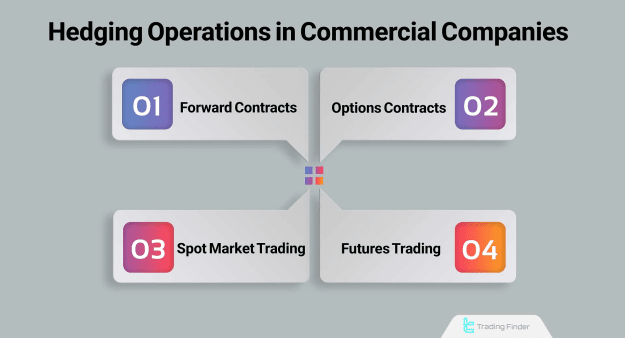
As significant Forex market participants, commercial companies employ various hedging strategies to mitigate foreign exchange risk:
- Forward Contracts: Companies enter into agreements with banks or brokers to exchange a specific currency at a predetermined price on a future date.
- Options Contracts: Companies can purchase call or put options based on their market analysis. For instance, a U.S. exporter concerned about the Euro's depreciation might purchase a put option to offset potential losses.
- Spot Market Trading: Companies execute trades in the spot market based on their analysis to cover potential losses.
- Futures Trading: Companies utilize futures contracts to lock in a price for commodities or currencies.
Speculators (Hedge Funds and Individual Traders)
This group accounts for a substantial portion, approximately 90%, of the overall trading volume and significantly impacts market fluctuations. Their primary objective is not hedging or commercial trading, but rather identifying market trends through analysis to generate profit.
Hedge Funds
Hedge funds are considered significant Forex market makers, often referred to as "smart money." With their substantial capital, algorithmic tools, and advanced technical analysis, they often dictate short-term market trends. Their order directions can be tracked through COT reports on platforms like Tradingster.
Retail Traders
Retail traders rely on their personal studies of fundamental analysis and technical analysis to identify market trends. Their collective large numbers contribute to increased liquidity, and their emotions, such as fear and greed, can influence the market in the short term.
Conclusion
The Forex market is a complex ecosystem shaped by a variety of participants. Central banks, liquidity providers, commercial companies, banks, hedge funds, and retail traders all play crucial roles. Liquidity providers and hedge funds are particularly prominent as market makers, and tracking their order flow can offer valuable insights into market trends.