

TP & SL Tool: Risk Reward Ratio Calculator RRR MT4 | Prop Firm Protector: Trade Assist Prop Firm Plus TF Expert MT4 | Money Management + DrawDown Protector: Trade Panel Prop Firm Drawdawn Limiter Pro MT4 |Get a free Expert Advisor license via Telegram and WhatsApp
Overview of ICT Internal and External Range Liquidity
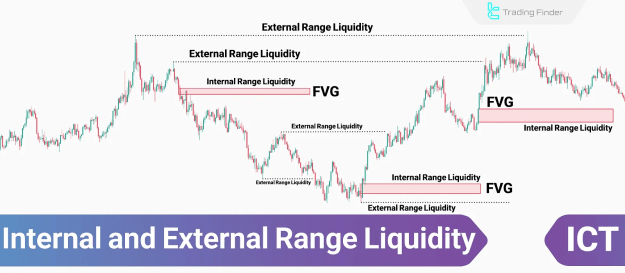
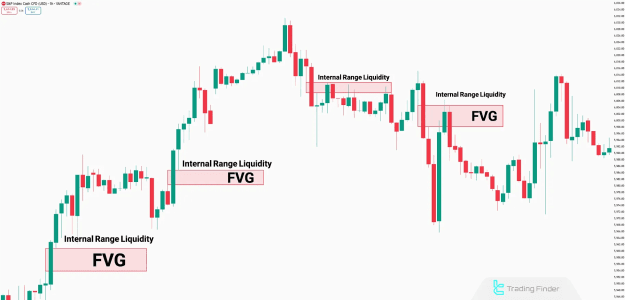
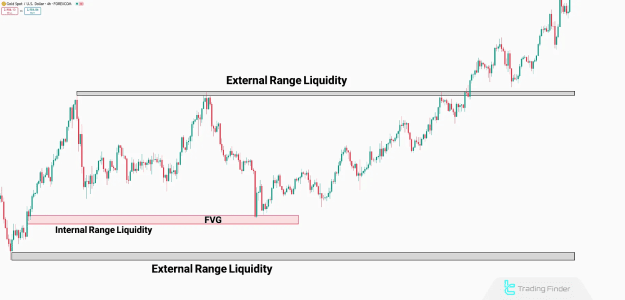
In the ICT framework, Internal Range Liquidity (IRL) is represented by Fair Value Gaps (FVGs) found within a price range. These gaps signify imbalances that the market tends to revisit to "fill." Conversely, External Range Liquidity (ERL) corresponds to Old Highs and Old Lows, which are seen as areas where a significant concentration of stop orders exists, making them prime targets for price.
How Does Price Move According to ICT?
According to the ICT methodology, prices in financial markets move algorithmically, solely driven by the need to gather liquidity and address imbalance zones like Fair Value Gaps (FVGs). This perspective views the market as operating on an underlying algorithm, pushing price towards liquidity regardless of traditional technical analysis patterns.
What is a Dealing Range in ICT?
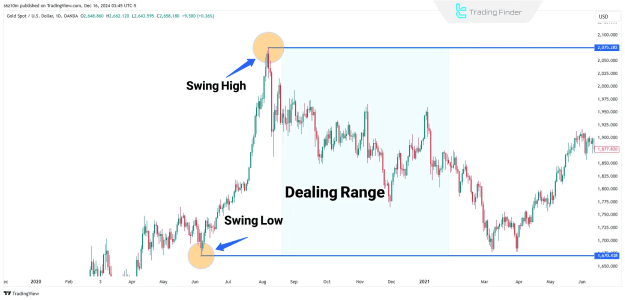
A Dealing Range in ICT refers to the price area established between a Swing High and a Swing Low. This range represents a distinct step in price movement. Within a Dealing Range, various significant levels and areas can be identified, including:
- Fair Value Gaps (FVGs)
- Order Blocks
- Liquidity levels associated with short-term highs and lows
Dealing Range in IRL and ERL
The Dealing Range serves as the context for understanding both Internal Range Liquidity (IRL) and External Range Liquidity (ERL). Price movements within this range are often directed towards filling FVGs (IRL), while the boundaries of the range (Swing Highs and Lows) often represent ERL targets.
What Are Internal and External Range Liquidity?
Essentially, Internal Range Liquidity (IRL) represents orders trapped within a swing, often in the form of imbalances. In contrast, External Range Liquidity (ERL) typically targets breakout traders and is associated with stop hunts at significant swing points.
Internal Range Liquidity (IRL)
Internal Range Liquidity (IRL) specifically refers to Fair Value Gaps (FVGs) that form within a defined price range. Each FVG is considered an imbalance and a magnet for price, attracting market movement to "fill" or rebalance these areas.
External Range Liquidity (ERL)
External Range Liquidity (ERL) is found at levels above Old Highs and below Old Lows. Retail traders often perceive these levels as traditional support or resistance, leading to a high concentration of stop orders. This makes these areas highly attractive for algorithmic price movements, often resulting in stop hunts.
How Does Price Move Towards Liquidity?
In ICT analysis, market price is believed to move algorithmically, drawn inherently towards areas of liquidity. A constant cycle governs this movement:
- When the market reaches an Internal Range Liquidity (IRL), it is subsequently drawn towards an External Range Liquidity (ERL).
- Conversely, after reaching an External Range Liquidity (ERL), the market is then drawn back towards an Internal Range Liquidity (IRL).
This continuous oscillation between IRL and ERL forms the fundamental mechanism of price movement in the ICT perspective.
What Are the Applications of Internal (IRL) and External (ERL) Liquidity Concepts?
The effective application of IRL and ERL concepts can significantly enhance a trader's approach by:
- Identifying Daily Bias: Traders can determine the overall market direction and daily bias by analyzing internal and external liquidity concepts on higher timeframes (e.g., monthly, weekly, and daily charts).
- Precise and Optimized Trading: Applying these concepts on lower timeframes (e.g., less than 4 hours) assists traders in accurately identifying optimal entry points for trades. Furthermore, these concepts facilitate the precise setting of stop loss and take profit levels, aligning trades with institutional order flow and liquidity cycles.
Conclusion
The concepts of Internal Range Liquidity (IRL) and External Range Liquidity (ERL) within the ICT style are paramount for understanding price behavior. IRL primarily refers to Fair Value Gaps (FVGs), while ERL denotes Old Highs and Old Lows – both acting as crucial liquidity-attracting zones. In this analytical approach, price moves algorithmically to collect liquidity and bridge gaps between IRL and ERL. The continuous interaction between these liquidity ranges forms the bedrock of ICT analysis, providing guidance for market direction and enabling precise entry and exit points in trading.