

TP & SL Tool: Risk Reward Ratio Calculator RRR MT5 | Prop Firm Protector: Trade Assist Prop Firm Plus TF Expert MT5 | Money Management + DrawDown Protector: Trade Panel Prop Firm Drawdawn Limiter Pro MT5 |Get a free Expert Advisor license via Telegram and WhatsApp
The Reversal Sequence Setup
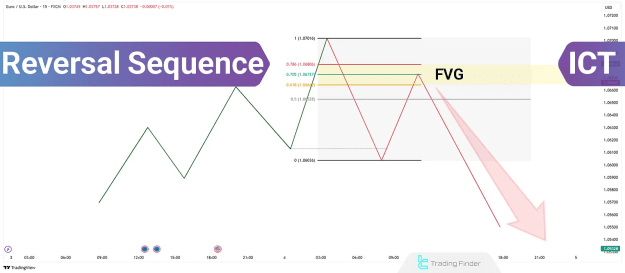
The core of the Reversal Sequence Strategy lies in its focus on liquidity at key highs and lows, along with specific price action concepts: Fair Value Gaps (FVG), Order Blocks, and Optimal Trade Entry (OTE) Levels. When initiating trades without an MSS or BOS, prioritizing Higher Time Frame (HTF) areas is paramount, as these zones frequently serve as origins for price reversals.
Key concepts vital for trading within these HTF areas include:
- Identifying Key Highs or Lows: The initial step involves patiently observing price action until it reaches a significant high or low on the higher time frame. This movement often occurs rapidly, and identifying and marking these critical areas is fundamental.
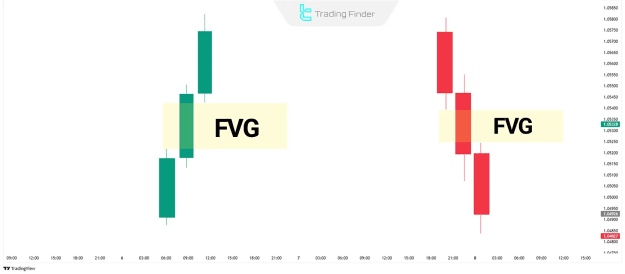
- Fair Value Gap (FVG): An FVG is a three-candle pattern where the first and third candles do not overlap. This specific area is considered a crucial zone for potential trade entries.
- Price Inversion: Price Inversion occurs when a previously formed Fair Value Gap is completely filled and subsequently acts as a level of support or resistance. This phenomenon often serves as a confirmation of an impending price reversal.
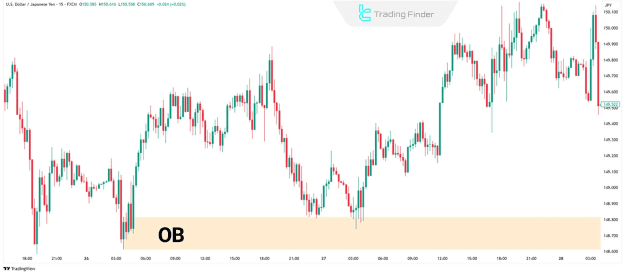
- Order Block: Order Blocks represent areas where large orders from financial institutions and banks are concentrated. Within the Reversal Sequence Strategy, these levels are frequently points of price reversal, presenting prime opportunities for trade initiation.
- Breaker Block: Similar to an Order Block, a Breaker Block forms when the price first creates a new high or low and then reverses. These areas are also considered advantageous for trade entries.
- OTE Levels: Optimal Trade Entry (OTE) Levels are derived using the Fibonacci retracement tool. In the context of the Reversal Sequence Strategy, traders utilize these levels to re-enter the prevailing trend. The 70.5% Fibonacci level is particularly significant within this method.
Stages of Price Reversal Formation in the Reversal Sequence Strategy
Price reversals typically unfold in a series of stages, each providing additional confirmation for trade entries:
- 1. Liquidity and Stop Hunts: This initial stage involves the market breaking a significant high or low, triggering stop-loss orders. This is often followed by a rapid reversal, a movement designed to absorb new orders and establish the conditions for a trend reversal, known as a Liquidity Sweep.
- 2. Use of Premium and Discount Zones: Following the liquidity sweep, price often moves from Premium (overbought) zones to Discount (oversold) zones, and vice versa. These zones are determined using Fibonacci retracement and are used in conjunction with other confirmations like FVGs and Order Blocks for trade entries.
- 3. Price Inversion and Closing of Fair Value Gap (FVG): After liquidity absorption, the market typically returns to the breakout zone and fills the Fair Value Gap (FVG). If price stabilizes within this area, it can signal a trend reversal, with the filled FVG acting as new support or resistance.
- 4. Change in the State of Delivery (CISD): The Change in the State of Delivery (CISD) stage is characterized by a strong candle breaking the previous structure. Price then stabilizes above this broken structure, confirming the influx of new orders and the commencement of a fresh trend.
- 5. Formation of Breaker Block or Final Confirmation via FVG: The final confirmation of a price reversal is achieved through the formation of a Breaker Block or the complete filling of a new Fair Value Gap (FVG).
Bullish Trade in Reversal Sequence Setup
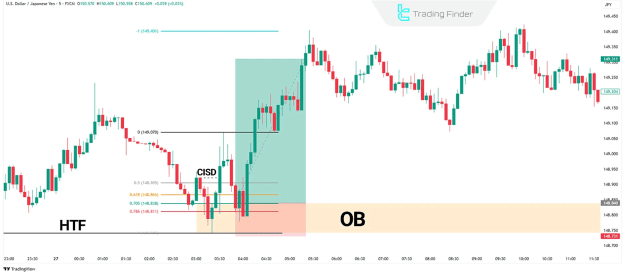
Consider a scenario on a 5-minute timeframe for the USD/JPY pair. Price reaches a significant higher timeframe zone and absorbs liquidity. Following the formation of an Order Block and a Change in the State of Delivery (CISD), a trader would wait for price to retrace back to the Order Block. Upon price interaction with this level and receiving confirmation, a BUY trade can be initiated, typically utilizing OTE zones for optimal entry.
Bearish Trade in Reversal Sequence Setup
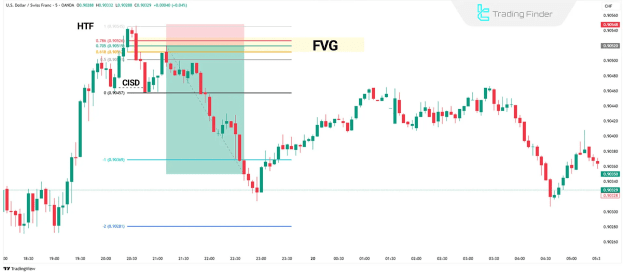
In a bearish example, such as the USD/CHF chart, price reaches a key higher timeframe zone, triggers pending orders, and begins to absorb sell orders. After the formation of a bearish FVG and a Change in the State of Delivery (CISD), the trader would await price's return to this FVG zone. Upon confirmation of a reversal from the FVG and analysis of OTE zones, a SELL trade can be initiated.
Conclusion
The Reversal Sequence Strategy, a specialized method within the ICT trading style, provides a robust framework for entering trades without the need for a Market Structure Shift (MSS) or Break of Structure (BOS). By meticulously focusing on liquidity, Fair Value Gaps (FVG), Order Blocks, Breaker Blocks, and OTE Levels, this strategy aims to provide traders with superior risk-to-reward entry points.