

TP & SL Tool: Risk Reward Ratio Calculator RRR MT4 | Prop Firm Protector: Trade Assist Prop Firm Plus TF Expert MT4 | Money Management + DrawDown Protector: Trade Panel Prop Firm Drawdawn Limiter Pro MT4 |Get a free Expert Advisor license via Telegram and WhatsApp
Increasing Risk-to-Reward Ratio Using Lower Timeframes
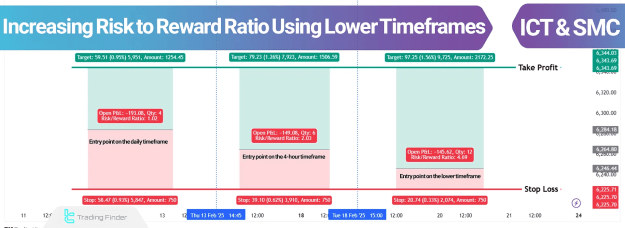
Optimizing trade entries on lower timeframes is a core technique for increasing the risk-to-reward ratio within ICT and Smart Money trading frameworks. This approach focuses on refining entry precision to minimize potential losses relative to potential gains.
Pros and Cons of Increasing Risk-to-Reward Ratio Using Lower Timeframes
While increasing the risk-to-reward ratio through lower timeframe analysis offers considerable advantages, it also presents specific challenges.
Pros:
- Optimized entry point and reduced stop-loss: Pinpointing exact entry levels minimizes the distance to the stop-loss, leading to smaller potential losses.
- Increased trade accuracy: Granular analysis on lower timeframes allows for more precise identification of market turning points, enhancing the accuracy of trade setups.
- Better control and utilization of hidden liquidity: Lower timeframes can reveal subtle liquidity zones and hidden liquidity that are less apparent on higher timeframes, enabling strategic entry and exit.
Cons:
- Increased chance of stop-loss being triggered early: Tighter stop-losses, a direct result of lower timeframe refinement, are more susceptible to being hit by minor market fluctuations.
- More frequent stop-loss triggers due to rapid fluctuations: The heightened volatility inherent in lower timeframes can lead to multiple consecutive stop-out events.
- Requires deep market analysis knowledge: Successfully implementing this strategy demands a comprehensive understanding of market structure, Order Blocks, Fair Value Gaps, and liquidity concepts.
How to Increase the Risk to Reward Ratio (RRR)?
To effectively optimize trade entries and substantially increase the risk-to-reward ratio, traders must first conduct a thorough analysis of the higher timeframe. This initial step involves identifying key entry zones such as Order Blocks or Fair Value Gaps (FVG). Subsequently, by transitioning to lower timeframes and performing more precise analysis, these identified entry zones can be refined and narrowed. This process directly contributes to reducing the stop-loss distance, thereby significantly improving the risk-to-reward ratio (RRR).
The systematic process of increasing the risk-to-reward ratio by leveraging lower timeframes involves the following sequential steps:
#1 Identifying Key Zones on the Higher Timeframe
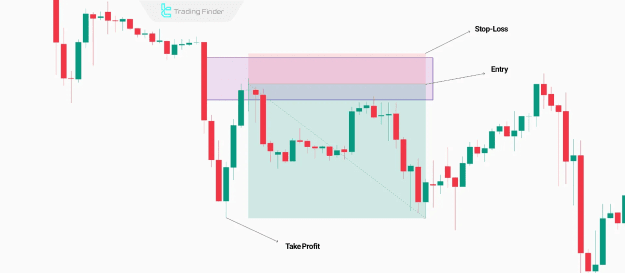
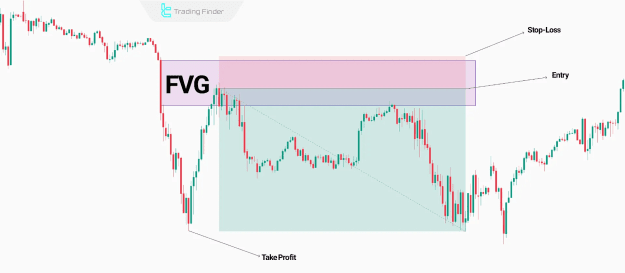
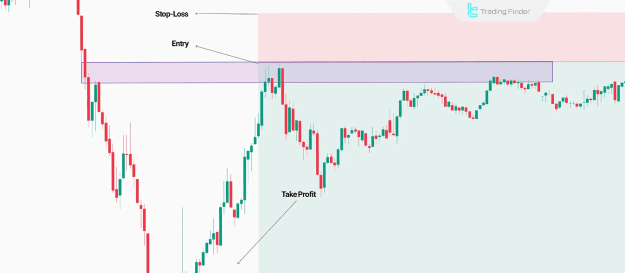
To initiate the optimization of trade entries and enhance the risk-to-reward ratio, traders must first accurately identify an Order Block, Fair Value Gap (FVG), or liquidity zone on a higher timeframe (e.g., 1-hour or 4-hour chart). This identified zone serves as the primary potential entry area and forms the foundational basis for subsequent, more detailed analysis. For instance, based on an FVG strategy and liquidity principles in Forex, the stop-loss is typically placed above the candle that forms the FVG, while the take-profit target is set below the liquidity associated with the previous low.
#2 Precise Analysis on the 15-Minute Timeframe
Once the initial entry zone has been precisely determined on the higher timeframe, traders should then transition to the 15-minute timeframe to further refine their entry points. During this phase, critical analysis of the break of structure (BOS), liquidity, and the narrowing of the defined entry zones significantly enhance overall trade accuracy. This shift to a lower timeframe directly contributes to an increased risk-to-reward ratio as the stop-loss distance is consequentially reduced.
#3 Final Entry Refinement on the 5-Minute Timeframe
In the ultimate stage of this refinement process, the trader moves to the 5-minute timeframe to pinpoint the exact entry area with the highest degree of precision. This timeframe often reveals entry points that allow for even tighter stop-losses, thereby maximizing the risk-to-reward ratio. However, it is crucial to acknowledge that while reducing the stop-loss on these lower timeframes enhances the RRR, it concurrently increases the likelihood of more frequent stop-loss activations due to the heightened market volatility experienced at these granular levels.
The progressive utilization of lower timeframes systematically narrows the entry zone and stop-loss distance, while the take-profit target remains fixed, based on the initial analysis from the higher timeframe. This strategic approach leads to a substantially improved risk-to-reward ratio. Nevertheless, it is imperative to understand that this reduction in stop-loss distances, while advantageous for the RRR, also inherently raises the probability of early stop-loss activations, potentially resulting in multiple consecutive stop-outs.
Conclusion
Optimizing the risk-to-reward ratio through the strategic application of lower timeframes involves the precise identification of liquidity zones and the diligent filtering of low-risk entry points in close proximity to Order Blocks (OBs) and Fair Value Gaps (FVGs). This sophisticated technique empowers traders to significantly reduce their stop-loss distance while meticulously maintaining the same take-profit target that was initially defined on the higher timeframes. Consequently, this not only substantially enhances the risk-to-reward ratio but also, as a trade-off, increases the inherent probability of early stop-loss activations.