

TP & SL Tool: Risk Reward Ratio Calculator RRR MT4 | Prop Firm Protector: Trade Assist Prop Firm Plus TF Expert MT4 | Money Management + DrawDown Protector: Trade Panel Prop Firm Drawdawn Limiter Pro MT4 |Get a free Expert Advisor license via Telegram and WhatsApp
What is the ICT Dealing Range?
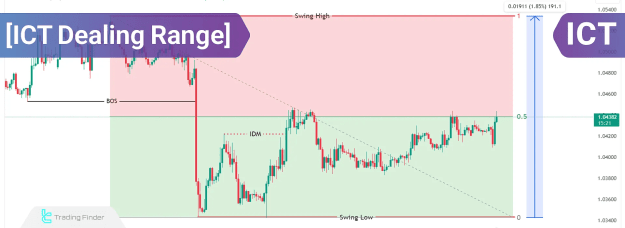
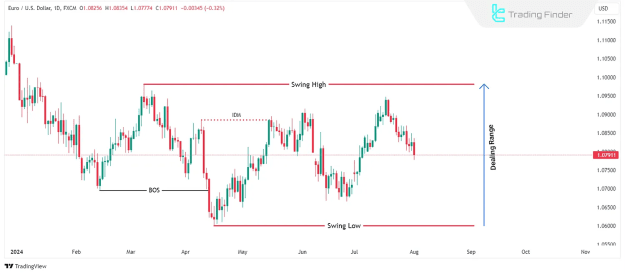
The ICT dealing range defines a specific price range between the high and low of the most recent swing. Within this identified range, institutional participants and market makers actively engage in accumulation and distribution phases. This is because the dealing range offers sufficient data for these entities to pinpoint liquidity positioning between the swing's high and low. The primary objective of institutions using the ICT dealing range is to manipulate price movements, hunt liquidity, and generate significant price shifts, often to capitalize on retail traders' positions.
The market generally navigates between ICT dealing ranges to achieve several objectives:
- Balance Fair Value Gaps (FVGs)
- Hunt liquidity by breaking equal highs (EQH) and equal lows (EQL)
Key Elements of the ICT Dealing Range
To effectively utilize the ICT dealing range concept, a comprehensive understanding of the following elements is crucial:
Market Structure
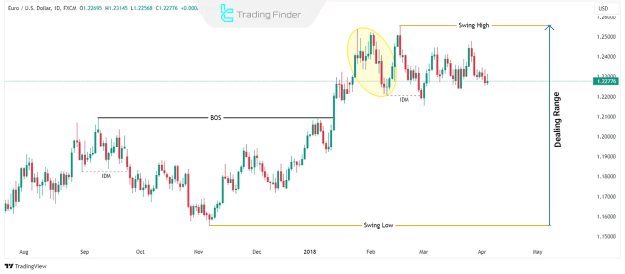
Establishing market structure involves pinpointing the swing high and swing low that define the dominant trend. These identified highs and lows form the foundational boundaries of the ICT dealing range. The confirmation of a swing high or swing low occurs when the price retraces and subsequently breaks the initial pullback level, often referred to as the Inducement Level. This break validates the formation of the high or low.
Premium/Discount Arrays (PD Array)
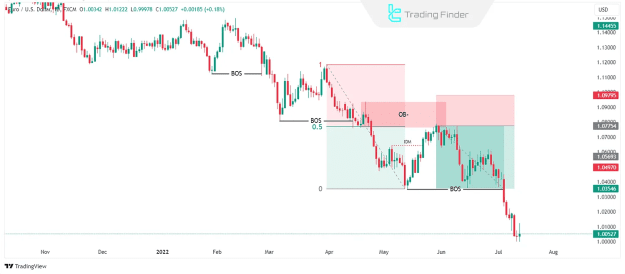
The ICT dealing range is strategically divided into Premium and Discount areas, with the 50% Fibonacci level serving as the Equilibrium level of the range.
- In an uptrend, the area below the equilibrium level is considered the discount area. ICT traders and institutional participants typically seek buying opportunities within this zone.
- Conversely, in a downtrend, the area above the equilibrium level is the premium area. Here, ICT and institutional traders are more inclined to identify selling opportunities.
Liquidity in Forex
Liquidity pools represent critical zones on a price chart where substantial volumes of stop-loss orders and pending orders accumulate. These zones frequently form within the identified dealing range and are commonly located at:
- Internal Lows
- Internal Highs
- Equal Highs (EQH)
- Equal Lows (EQL)
Identifying the ICT Dealing Range
Identifying the ICT dealing range involves precisely marking the swing high and swing low. For an uptrend, the high is marked, and for a downtrend, the low is marked. The confirmation of these swing points, as mentioned, relies on the price breaking the Inducement Level, which is the first pullback from the extreme.
Trading the ICT Dealing Range in a Bullish Market
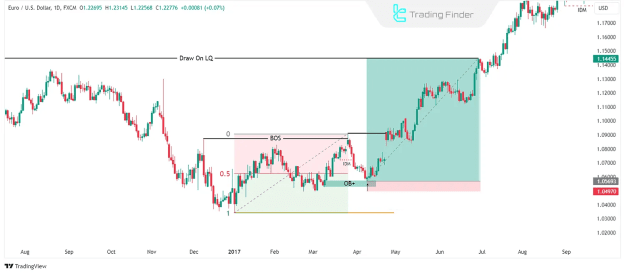
Following the formation of a Higher High (HH) or a swing high in a bullish market, price movements often occur within the newly established ICT dealing range. This scenario allows ICT traders to identify key levels primarily within the discount area.
- Bullish PD arrays located in the discount zone of an uptrend present potential buying opportunities.
- Order blocks and FVGs are specifically identified and marked within these discount areas.
- Conversely, the premium zones within the dealing range are typically designated as profit targets.
Trading the ICT Dealing Range in a Bearish Market
In a bearish market, subsequent to the formation of a Lower Low (LL) or a swing low, price action frequently unfolds within the confines of the ICT dealing range. Here, an ICT trader will focus on identifying key levels within the premium area.
- Bearish PD arrays situated in the premium zone of a downtrend indicate potential selling opportunities.
- Order blocks and FVGs are marked in these premium areas.
- The discount zones within the dealing range are then established as profit targets.
Conclusion
The ICT dealing range strategy is a sophisticated approach to market analysis. By meticulously focusing on market structure, critical liquidity levels, and specific price patterns, this strategy empowers traders to decipher smart money behavior and enhance the accuracy of their price movement predictions. Defining a precise range between the most recent swing's high and low, the ICT dealing range strategy provides a framework for identifying optimal entry and exit points, largely based on its distinct premium and discount levels.