

TP & SL Tool: Risk Reward Ratio Calculator RRR MT4 | Prop Firm Protector: Trade Assist Prop Firm Plus TF Expert MT4 | Money Management + DrawDown Protector: Trade Panel Prop Firm Drawdawn Limiter Pro MT4 |Get a free Expert Advisor license via Telegram and WhatsApp
Distinguishing Market Structure Shift (MSS) from Change in State of Delivery (CISD)
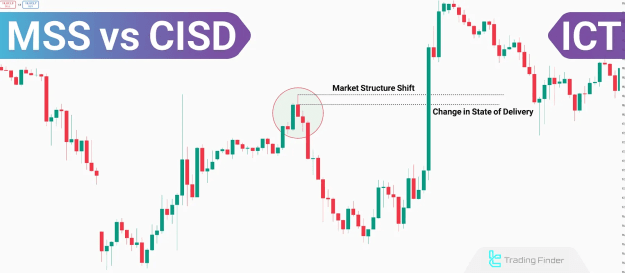
While both MSS and CISD are fundamental to the ICT (Inner Circle Trader) methodology, they serve different purposes in identifying market behavior. MSS signals significant, medium-term shifts in trend, whereas CISD indicates more immediate, short-term price corrections. Notably, a CISD often precedes an MSS, acting as an early indicator of potential changes.
What is Market Structure Shift (MSS)?
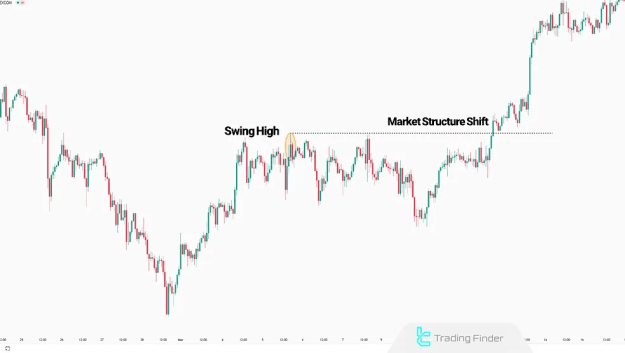
A Market Structure Shift (MSS) occurs when the price decisively breaks a previous Swing High in an uptrend or a Swing Low in a downtrend. This breach signifies a fundamental alteration in the market's direction, marking the conclusion of the preceding medium-term trend and the initiation of a new one.
What is Change in State of Delivery (CISD)?
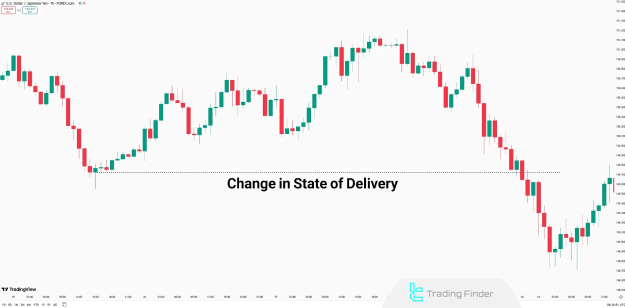
Change in State of Delivery (CISD), within the ICT framework, describes an interruption or reversal of the prevailing price flow. This typically follows periods of consolidation or after liquidity has been absorbed. A CISD acts as a signal for a price correction that moves against the existing market trend.
MSS vs. CISD: A Comparative Analysis
Differentiating between MSS and CISD empowers traders to accurately distinguish between a true trend reversal and a temporary price correction, thereby minimizing trading errors.
- Definition:
- CISD: Primarily responsible for corrective movements within an established trend.
- MSS: Changes the medium-term trend by breaking a significant swing high or swing low.
- Support and Resistance Levels:
- CISD: Based on the open and close prices of a candlestick.
- MSS: Determined by the candle wick, representing extreme price points.
- Signal Indication:
- CISD: Points to an imbalance in supply and demand that leads to corrective price action.
- MSS: Indicates a structural change in the overarching market trend.
- Suitable Trades:
- CISD: Best suited for scalping and other short-term trading strategies.
- MSS: Ideal for swing trading and medium-term positions.
- Risk-Reward Ratio:
- CISD: Offers a medium to low risk-reward ratio but provides frequent entry opportunities.
- MSS: Presents a medium to high risk-reward ratio.
- Time-Based Analysis:
- CISD: Often observed during market openings or significant economic news releases.
- MSS: Frequently aligns with the overlap of the London and New York trading sessions.
In essence, Market Structure Shift (MSS) is primarily used to identify medium-term trend changes, whereas Change in State of Delivery (CISD) is more suitable for detecting short-term corrective movements within a trend.
Integrating MSS and CISD with Inverted Fair Value Gap (IFVG)
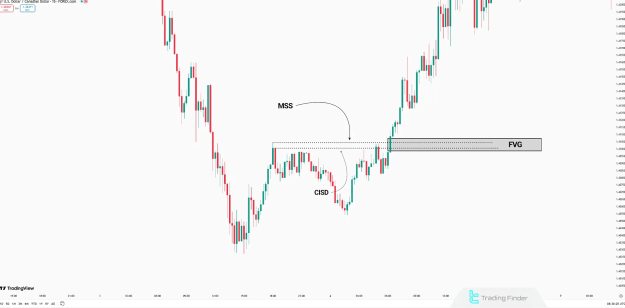
Combining these three ICT concepts allows traders to pinpoint precise reversal zones and identify low-risk entry points. After a Change in State of Delivery (CISD) is observed and a subsequent Market Structure Shift (MSS) is confirmed, the price typically retraces to the Inverted Fair Value Gap (IFVG) to fill the imbalance before initiating a new directional move.
1. Identifying Market Structure Shift (MSS)
While sudden price movements may suggest an MSS, confirmation from higher timeframes is crucial for reliability.
- Determine Daily Bias: Analyze higher timeframe (HTF) charts to identify key highs and lows, establishing the overall daily trend direction.
- Break of Swing High or Swing Low with Displacement Move: Validate the breakout of support or resistance levels on lower timeframe (LTF) charts, ensuring it's a decisive move.
2. Identifying Change in State of Delivery (CISD)
In markets with limited liquidity, a CISD might be a temporary correction. Thorough examination of liquidity manipulation is essential for final confirmation.
- After confirming the Market Structure Shift (MSS), locate the CISD point, considering it a potential entry level.
- Identify the IFVG zone as an optimal area for both entry and stop-loss placement.
3. Entry Strategy
The choice between low-risk and high-risk entries depends on the conviction derived from the confirmed absorbed liquidity within the market structure.
- Low-Risk Entry: Wait for clear price reaction and candlestick confirmation at identified key levels.
- High-Risk Entry: Enter at the first identified level without waiting for further confirmation, accepting the higher possibility of MSS, CISD, and IFVG levels becoming invalidated.
4. Stop-Loss and Take-Profit Placement
When the market is seeking hidden liquidity, avoid placing stop-loss orders directly under the shadow of large orders.
- Stop-Loss: Place slightly below (for buy trades) or above (for sell trades) the IFVG zone or the preceding swing high/low.
- Take-Profit: Set targets at identified liquidity pools or the next anticipated price gaps.
Conclusion
By understanding the distinct roles of Market Structure Shift (MSS) and Change in State of Delivery (CISD), traders can differentiate between significant medium-term trend shifts and temporary short-term price corrections, leading to more precise trade execution. The integration of the Inverted Fair Value Gap (IFVG) further refines this approach by providing an optimal zone for entry and stop-loss placement. Combining these three ICT concepts empowers traders to strategically structure their trades, leveraging insights into liquidity flow and the underlying supply-demand dynamics.