

TP & SL Tool: Risk Reward Ratio Calculator RRR MT4 | Prop Firm Protector: Trade Assist Prop Firm Plus TF Expert MT4 | Money Management + DrawDown Protector: Trade Panel Prop Firm Drawdawn Limiter Pro MT4 |Get a free Expert Advisor license via Telegram and WhatsApp
Understanding the Next Day Market Maker Trading Strategy
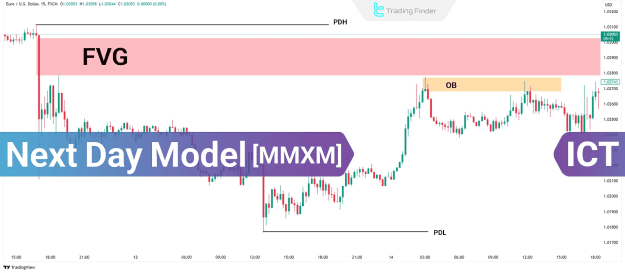
The Next Day Model (NDM) integrates ICT's core strategies to anticipate future price behaviors. It provides a clear framework for:
- Streamlining entry and exit points: Assisting traders in precisely timing their trades.
- Determining market trends: Helping traders understand the prevailing market direction.
For enhanced analytical capabilities, traders can leverage the MMXM Trader indicator available on TradingView, developed by the Trading Finder team.
Advantages of Employing the Next Day Market Maker Model
Implementing the Next Day Model offers several significant benefits for traders:
- Improved Trend Prediction: Traders gain the ability to analyze potential trading patterns and evaluate probable price movements for the subsequent day.
- Enhanced Risk Management: This methodology facilitates the identification of optimal entry and exit points, enabling the effective application of risk management tools such such as stop-loss and take-profit levels.
- Optimized Strategy Performance: By combining the Next Day Model with other MMXM Trader techniques, including liquidity patterns and order blocks, overall strategy execution is refined.
Steps for Trading with the Next Day Market Maker Model (MMXM)
The Next Day Model within MMXM Trader is executed through four critical steps:
1. Analyzing the Market Structure
Traders commence by evaluating the overall market structure and prevailing trend on higher timeframes, such as H4 (4-hour) and Daily charts. This initial assessment determines whether the market exhibits bullish, bearish, or ranging characteristics.
2. Identifying Key Areas
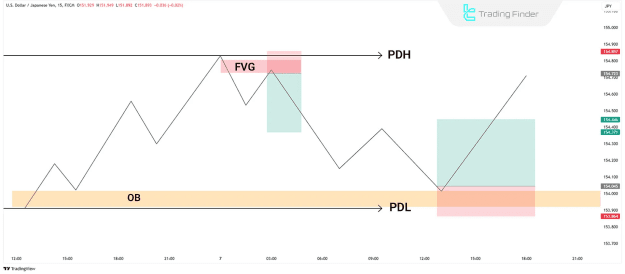
The identification of key liquidity zones involves marking significant areas like support and resistance levels, order blocks (OBs), and Fair Value Gaps (FVGs). These identified levels exert considerable influence on price volatility for the upcoming trading day.
3. Liquidity Analysis
Price stop-hunts frequently occur in areas of high liquidity. Consequently, the previous day’s highs and lows are crucial points for anticipating liquidity sweeps within financial markets.
4. Timing Trades Based on Sessions
Trade timing in MMXM Trader's Next Day Model emphasizes the significance of distinct trading sessions: Asian, London, and New York. For instance, a notable price breakout during the New York session often has a direct impact on subsequent price behavior.
Conditions for Utilizing the Next Day Market Maker Model (MMXM)
To effectively implement the Next Day Model, traders must adhere to the following conditions:
- Avoid trading on Mondays due to inherent market instability.
- Focus trading activities on the New York trading session.
- Execute trades primarily on the 15-minute chart.
- Utilize an economic calendar to account for macroeconomic events.
- Initiate trades exclusively when the price reaches a key level on higher timeframes.
Trade Example Using the Next Day Market Maker Model (MMXM)
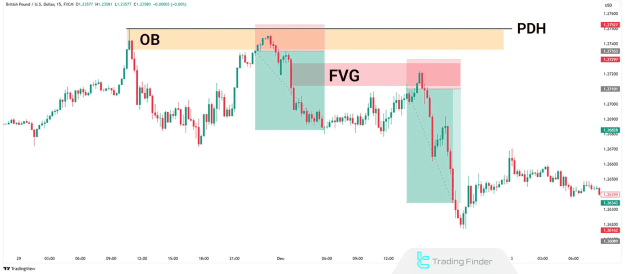
Consider a scenario on the GBP/USD 15-minute chart where the price approaches the previous day’s high (PDH), indicating a potential sell opportunity. As the price nears this significant level on higher timeframes, traders would then seek specific entry points by identifying order blocks and FVGs.
Conclusion
The Next Day Model (NDM) represents an advanced strategy in ICT trading. It systematically leverages historical data analysis and liquidity structure to anticipate potential trading scenarios for the next day. By focusing on liquidity zones, structural breaks, and price behavior at key levels, the Market Makers Next Day Buy and Sell Model enhances trading strategies, enabling traders to capitalize on smart money movements.