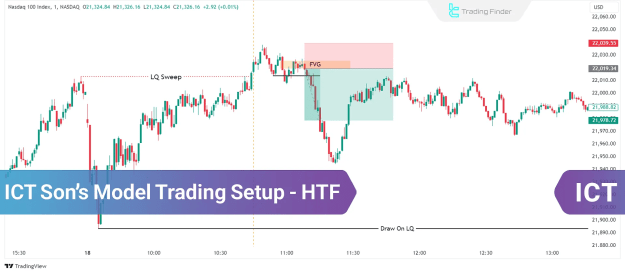


A fundamental distinction of this approach is its reliance on higher time frames for identifying crucial market areas, providing more robust and reliable trading signals compared to lower time frame setups. The ICT Son's Model - HTF strategy is meticulously designed to optimize trading performance by focusing on key elements such as liquidity, market structure, and sophisticated entry techniques.
TP & SL Tool: Risk Reward Ratio Calculator RRR MT5 | Prop Firm Protector: Trade Assist Prop Firm Plus TF Expert MT5 | Money Management + DrawDown Protector: Trade Panel Prop Firm Drawdawn Limiter Pro MT5 |Get a free Expert Advisor license via Telegram and WhatsApp
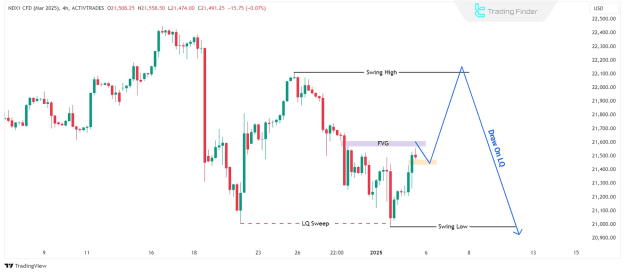
1. Draw On Liquidity (DOL)
The initial phase of the ICT Son's Model - HTF strategy involves pinpointing liquidity areas and ascertaining the Draw On Liquidity (DOL) direction on either the 1-hour or 4-hour chart. This requires identifying historical price reversal points, including Highs and Lows, as well as internal and external liquidity zones.
- Key Levels: Traders should meticulously mark significant levels on 4-hour or 1-hour charts. These levels encompass prominent Highs, Lows, and Fair Value Gaps (FVGs), which serve as potential reversal points and areas of liquidity accumulation.
- Internal and External Liquidity: When determining the DOL, it is crucial to recognize the market's consistent movement from internal liquidity to external liquidity zones and vice versa.
2. Liquidity Sweep
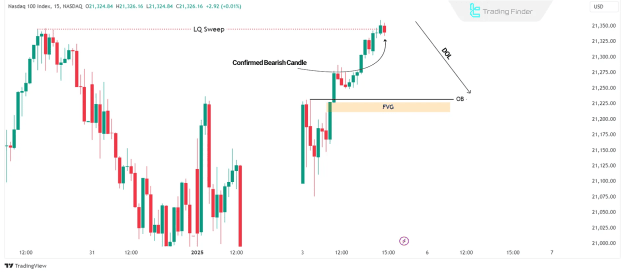
Following the identification of DOL, the subsequent step in the ICT Son's Model - HTF trading strategy is to observe the Liquidity Sweep on the 15-minute chart.
- Swing Highs and Lows: Traders should specifically look for the sweep of a Swing High or Swing Low.
- Bullish Confirmation: If the DOL direction indicates a bullish bias, wait for a bullish candle to definitively close after a Swing Low has been swept.
- Bearish Confirmation: Conversely, if the DOL direction is bearish, look for a bearish candle to close after a Swing High has been swept.
3. Entry Techniques
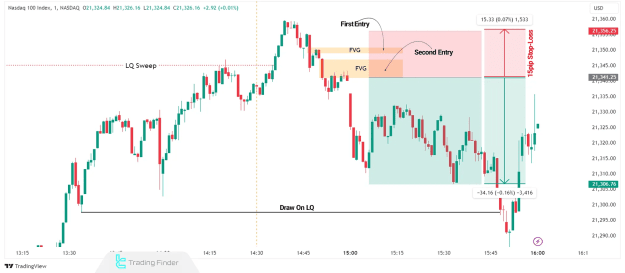
The entry point within the ICT Son's Model – HTF setup is paramount, with Fair Value Gaps (FVGs) playing a pivotal role.
- After Liquidity Sweep: Immediately subsequent to a liquidity sweep (of a High or Low) and the confirmation of a reversal candle's close (bullish or bearish), transition to the 1-minute chart.
- Using FVGs: On the 1-minute chart, await the formation of an FVG before initiating the trade. These gaps signify areas where price is highly probable to retrace.
- 5-Minute Chart: Traders who prefer entering trades on the 5-minute chart should identify the DOL direction on either the 4-hour or daily chart.
4. Risk Management
Robust risk management is indispensable for sustaining profitability in trading. The ICT Son's Model higher time frame setup underscores the importance of maintaining a balanced risk-to-reward ratio.
- Risk/Reward Ratio: Endeavor to achieve a risk/reward ratio of 1:1, or a maximum of 1:2. This ensures that potential profits are at least equivalent to, or double, the potential losses.
- Stop Loss: For volatile indices such as NASDAQ and S&P, implement a minimum stop loss of 15-20 points to safeguard trading capital against sudden market movements.
Conclusion
The ICT Son's Model trading setup when applied to higher time frames (HTF) offers a disciplined and structured methodology for navigating both forex and cryptocurrency markets. By concentrating on liquidity, optimizing entry techniques, and rigorously adhering to strict risk management principles, traders can approach the markets with enhanced confidence and precision.