

TP & SL Tool: Risk Reward Ratio Calculator RRR MT4 | Prop Firm Protector: Trade Assist Prop Firm Plus TF Expert MT4 | Money Management + DrawDown Protector: Trade Panel Prop Firm Drawdawn Limiter Pro MT4 |Get a free Expert Advisor license via Telegram and WhatsApp
What Are Supply and Demand Zones?
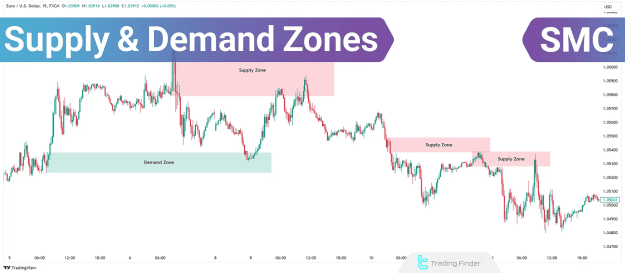
Within Smart Money Concepts (SMC) trading and price action analysis, supply and demand zones are crucial price regions defined as:
- Supply Zone: A specific price area where an abundance of sell orders significantly increases supply, subsequently driving prices down.
- Demand Zone: A distinct price area where a surge in buy orders substantially increases demand, leading to price appreciation.
Why Are Supply and Demand Zones Important?
Supply and demand zones are vital areas on a price chart because they are instrumental in identifying potential reversal and trend continuation trades. These zones frequently trigger rapid and significant market reactions. According to Smart Money Concepts, institutional traders execute trades in these zones with substantial volume, thereby creating the increased supply or demand that influences price movement. Traders are advised to wait for the market to test these zones before initiating buy or sell trades, effectively following the "footprints" of institutional traders and Smart Money.
How to Identify Supply and Demand Zones
To accurately identify supply and demand zones, a foundational understanding of basic market structure concepts is essential:
Break of Structure (BOS)
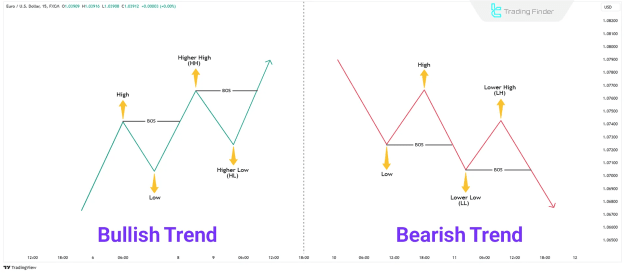
When the market exhibits a clear trend, it consistently breaks previous structures in the direction of that trend, indicating a continuation of movement. This phenomenon is termed a Break of Structure (BOS):
- In an uptrend, the market surpasses the previous high, establishing a Higher High (HH).
- In a downtrend, the market falls below the previous low, creating a Lower Low (LL).
Change of Character (CHoCH)
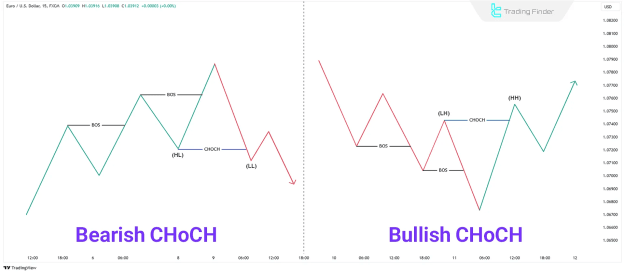
A Change of Character (CHoCH) signals a shift in the prevailing market trend. It occurs when the market transitions from an uptrend to a downtrend, or vice versa:
- When shifting from a downtrend to an uptrend, the previous Higher Low (HL) is broken, subsequently forming a new Higher High (HH).
- When shifting from an uptrend to a downtrend, the previous Higher Low (HL) is broken, leading to the formation of a new Lower Low (LL).
Identifying Supply Zones
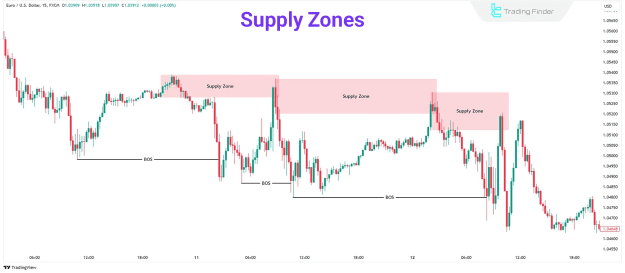
A Supply Zone represents a market area where intense selling pressure causes prices to decline rapidly. These zones typically emerge during downtrends. Supply zones are formed during price pullbacks that precede either a CHoCH or a BOS, followed by a sharp drop in prices. These pullbacks may consist of one or multiple bullish candles.
Identifying Demand Zones
A Demand Zone is a market area characterized by significant buying pressure, which drives prices upward rapidly. These zones typically form during uptrends. Demand zones usually appear during price pullbacks that occur before a CHoCH or a BOS, followed by a sharp rise in prices. These pullbacks may consist of one or multiple bearish candles.
How to Trade Using Supply and Demand Strategy
To effectively trade using supply and demand zones, the initial step is to determine the prevailing market trend:
- Uptrend:
- Following a bullish CHoCH or BOS, identify the demand zone.
- When the price retraces and approaches this demand zone, execute a buy trade.
- If the demand zone is extensive, consider waiting for the market to test at least 50% of the zone, with additional confirmations such as lower timeframe structure changes.
- Place the stop loss a few pips below the demand zone.
- Downtrend:
- Following a bearish CHoCH or BOS, identify the supply zone.
- When the price retraces and approaches this supply zone, execute a sell trade.
- If the supply zone is extensive, consider waiting for the market to test at least 50% of the zone, with additional confirmations such as lower timeframe structure changes.
- Place the stop loss a few pips above the supply zone.
Conclusion
In Smart Money Concepts (SMC), supply and demand are the fundamental drivers of price movements in financial markets. Supply and demand zones are critical areas on price charts that not only dictate the trend direction but also present valuable trading opportunities. A Supply Zone indicates high selling pressure, leading to price decreases, and typically appears in downtrends after a BOS or CHoCH.