

TP & SL Tool: Risk Reward Ratio Calculator RRR MT5 | Prop Firm Protector: Trade Assist Prop Firm Plus TF Expert MT5 | Money Management + DrawDown Protector: Trade Panel Prop Firm Drawdawn Limiter Pro MT5 |Get a free Expert Advisor license via Telegram and WhatsApp
What is Liquidity in Forex Trading?
Understanding liquidity is crucial in the ICT trading style, as it provides insights into the primary drivers of price movement: Market Makers. Liquidity can be categorized into various forms, but at its core, it represents the availability of readily tradable assets.
- High Liquidity: Assets with high liquidity can be swiftly sold and converted into cash without significant price impact.
Measuring Liquidity in the Forex Market
In the Forex market, liquidity is determined by the volume of active and pending orders. A higher concentration of orders indicates greater liquidity, suggesting that large trades can be executed with minimal disruption to prices.
Role of Market Makers in Liquidity
Market Makers often target order-dense points, such as stop-loss levels, to capture the liquidity of retail traders. Their strategy involves manipulating prices to trigger these pending orders, allowing them to accumulate or distribute positions profitably.
Pros and Cons of Mastering the Liquidity Trading Strategy
Mastering a liquidity trading strategy offers distinct advantages, but it also comes with its own set of challenges.
Advantages
- Ability to anticipate market moves before they occur: By understanding liquidity flows and Market Maker behavior, traders can foresee potential price shifts.
- Reduced likelihood of stop-loss hunting: A deep understanding of liquidity can help traders place stop-losses strategically, making them less susceptible to being targeted by Market Makers.
- Incorporates practical analysis and risk management: This strategy emphasizes a thorough analysis of market structure and effective risk management techniques.
Disadvantages
- Requires advanced understanding of liquidity, market structure, and FVG: The complexity of this strategy demands a comprehensive grasp of various advanced concepts.
- It takes time to learn and understand Market Maker's behavior: Developing the intuition and skill to anticipate Market Maker actions requires significant practice and experience.
Three-Step Process to Perform the Master Liquidity Strategy
To effectively identify liquidity in financial markets and implement the Master Liquidity Strategy, follow these key steps:
- Consider highs and lows as key areas: These price points are commonly where pending orders accumulate, making them significant liquidity zones.
- Market Makers collect liquidity by targeting one side and then moving to the other: Observe how Market Makers manipulate prices to trigger orders on one side of the market before reversing direction to target the opposite side.
- After identifying liquidity and observing Market Maker behavior, traders can enter positions in Fair Value Gaps (FVG) and place stop-losses above or below previous highs or lows: This strategic entry and exit point minimizes risk while maximizing potential profits.
Types of Liquidity in Trading
Similar to orders, liquidity is fundamentally divided into two primary types:
Buy-Side Liquidity
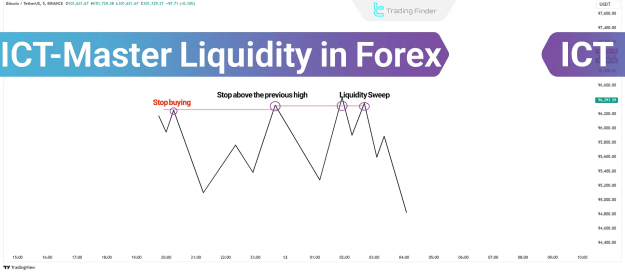
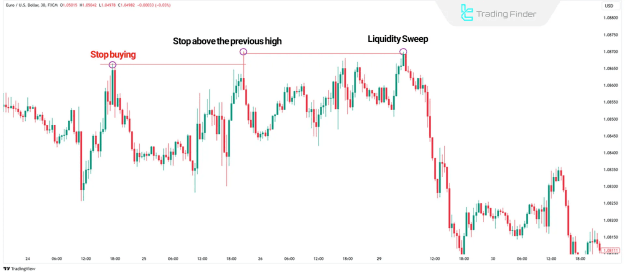
Buy-Side Liquidity refers to pending buy orders, primarily Buy Stops. Traders frequently place stop-losses above significant highs (e.g., daily or weekly highs) to safeguard their short positions. These historical highs are thus designated as Buy-Side Liquidity.
- Market Makers target these highs: They activate pending buy orders, then often reverse the market's direction to profit from the subsequent price movement. This systematic process is widely known as the Liquidity Hunt.
Sell-Side Liquidity
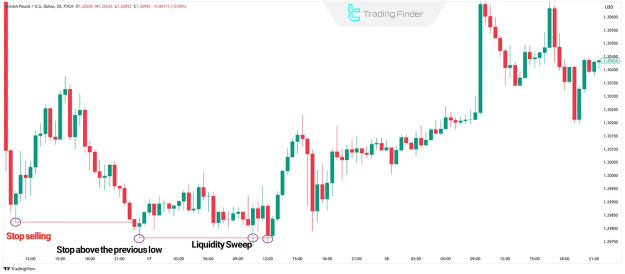
Sell-Side Liquidity pertains to pending sell orders, specifically Sell Stops. Traders place stop-losses below significant lows to protect their long positions, thereby establishing these lows as Sell-Side Liquidity.
- Market Makers target these lows: They trigger pending sell orders, and then typically shift the market in the opposite direction to capitalize on the resulting price change.
Why Understanding Liquidity is Important?
Having examined the core concepts and types of liquidity in Forex, it becomes clear that Market Makers aim to hunt liquidity to fulfill their orders. The importance of a deep understanding of liquidity for successful trading cannot be overstated.
Market Movement
When the market actively hunts liquidity on one side (activating buy or sell orders), it frequently proceeds to seek liquidity on the opposite side. In essence, the market systematically targets one set of orders before moving on to the next.
Liquidity and Price Movement
Liquidity is the primary driver of price movement. Prices naturally gravitate toward areas with substantial volumes of pending buy or sell orders.
The Importance of Deep Liquidity Knowledge
Without a clear and comprehensive understanding of liquidity, traders are highly susceptible to having their orders targeted and exploited by Market Makers.
Success in Trading
To achieve sustained success in trading, it is imperative for traders to effectively identify liquidity and align their trades with the overarching market flow by keenly understanding Market Maker behavior.
Conclusion
The Master Liquidity in Forex Trading style fundamentally centers on identifying liquidity at price highs and lows, coupled with a thorough understanding of Market Maker behavior. This strategic approach enables traders to predict market moves more accurately and to trade in alignment with the actions of dominant market participants. The core principles of this strategy involve entering trades in Fair Value Gaps (FVG), meticulously managing risks with stop-loss orders, and precisely targeting liquidity points.