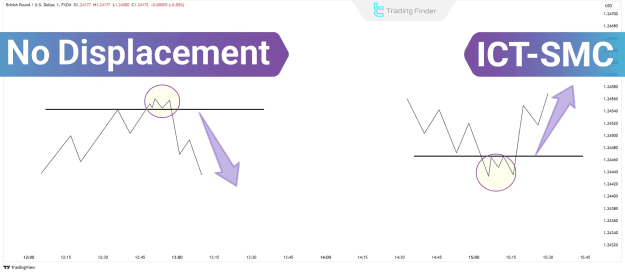


Characteristics of No Displacement
Identifying No Displacement requires recognizing specific price action characteristics:
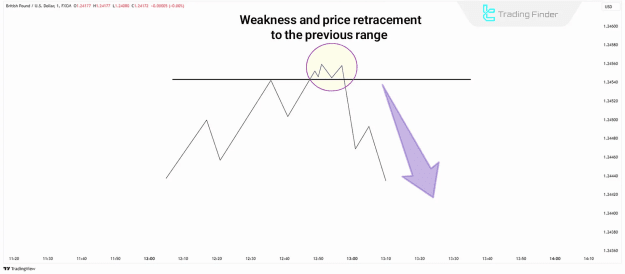
- Quick Retracement to the Previous Range: Following a breakout attempt, instead of aggressive movement, the price promptly reverts back into the established range.
- Small and Weak Candlesticks: The candlesticks formed subsequent to the breakout are typically small in size and exhibit a distinct lack of momentum, indicating indecision or insufficient buying/selling pressure.
- Failure to Close Beyond the Breakout Level: A key indicator is the inability of candles to close definitively beyond the breakout level. Instead, they often close within or near the original range, negating the validity of the breakout.
- Failed Breakouts: Ultimately, No Displacement manifests as unsuccessful or failed breakouts. These are widely recognized as strong signals for potential reversals.
Why Does No Displacement Occur?
No Displacement arises from a combination of underlying market dynamics:
- Lack of Liquidity: Insufficient liquidity in the market, particularly in Forex, can prevent a sustained move, causing prices to snap back.
- Counter-Orders at Breakout Levels: Significant counter-orders (e.g., strong buying pressure at a bearish breakout point or selling pressure at a bullish breakout point) can absorb the initial momentum, leading to a reversal.
- Market Consolidation: When the market is in a phase of consolidation, price often lacks the necessary directional momentum to maintain a breakout, resulting in a return to the ranging behavior.
How to Identify No Displacement
To effectively identify No Displacement, traders must meticulously analyze candlestick behavior at key price levels:
- Strong Displacement: A breakout accompanied by large, robust candles that close decisively near the high (for an uptrend breakout) or low (for a downtrend breakout) indicates strong Displacement and a high probability of trend continuation.
- No Displacement: Conversely, a rapid retracement to the previous range, characterized by small, weak candles, strongly suggests a lack of Displacement.
Evaluating this pattern across multiple timeframes can significantly enhance the precision of identifying trading opportunities.
How to Use No Displacement in Trading
Understanding and applying No Displacement can provide valuable trading insights:
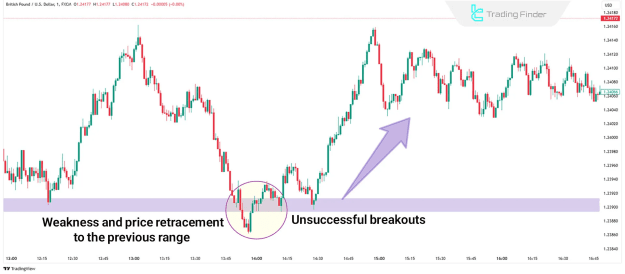
- In an Uptrend: If the price breaks a short-term low but quickly retraces without strong bearish momentum (i.e., small, weak bearish candles), it suggests weak bearish pressure and could present a buying opportunity.
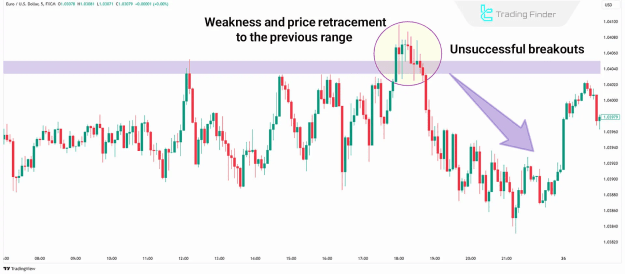
- In a Downtrend: Similarly, if the price breaks above a high but quickly retraces without strong bullish momentum (i.e., small, weak bullish candles), it indicates weak bullish pressure and could present a selling opportunity.
Failed breakouts, particularly those exhibiting the characteristics of No Displacement, serve as potent reversal signals that can be strategically leveraged for counter-trend trades.
No Displacement Example in Uptrend (Bullish)
To trade this setup in an uptrend:
- The price attempts to break a short-term low but rapidly retraces instead of continuing its downward movement.
- The candlesticks formed during the attempted breakdown are weak and conspicuously lack bearish strength, confirming the absence of strong selling pressure.
This scenario, often referred to as No Displacement in ICT Trading (Bullish), highlights how a lack of follow-through after a bearish breakout can signal underlying bullish strength.
No Displacement Example in Downtrend (Bearish)
To trade this setup in a downtrend:
- The price attempts to break a high, but there is no presence of strong bullish candles following the breakout.
- The price swiftly retraces back into the range, indicating a clear lack of sustained buying pressure.
This scenario, often referred to as No Displacement in ICT Trading (Bearish), demonstrates how a failed bullish breakout can signify an underlying bearish bias.
Conclusion
The No Displacement Model in ICT trading is a critical concept that underscores market weakness in sustaining trend continuation. When price breaches a significant level but fails to exhibit robust momentum and quickly reverts, the probability of a market reversal dramatically increases. Under such conditions, failed breakouts offer prime reversal trade opportunities. Integrating this pattern with robust risk management strategies and multi-timeframe analysis can substantially enhance trading accuracy.